What Is a Value Proposition and How to Create One
Let's cut right to the chase. A value proposition is your promise to a customer. It’s a simple, clear statement that answers one crucial question: “Why should I buy from you and not the other guy?”
In short, it tells people how your product or service solves a problem, makes their life better, and why your solution is the best one out there.
Table of Contents
What a Value Proposition Really Is
Think of your value proposition as the handshake that starts a relationship. It's not just a clever tagline or a marketing slogan; it’s the very core of why your business or creative project exists. It should be the first thing someone sees and gets when they land on your website.
This single statement sets the tone for everything else you do.

When you nail your value proposition, you give your ideal customer a "lightbulb moment." They instantly feel understood and see that you have a credible solution to their specific struggle. For a creator selling a new online course, a community membership, or an e-book, this clarity is gold.
It’s what turns a random browser into someone who leans in, genuinely interested, because your message hits home.
The 3 Core Elements of a Powerful Value Proposition
A truly effective value proposition isn't just a random assortment of words. It's built on three essential pillars that work together to convince your audience that you're the right choice.
To make this crystal clear, here's a breakdown of what each element does and the key question it needs to answer.
| Element | What It Means | Key Question to Answer |
|---|---|---|
| Relevance | How your product connects to a real customer problem. | "Do you understand my specific challenge?" |
| Quantified Value | The specific, measurable benefits they'll get. | "What tangible results can I expect from this?" |
| Unique Differentiation | What makes you the best choice among competitors. | "Why are you better than the alternatives?" |
Getting these three elements right isn't just a "nice-to-have"—it directly impacts your bottom line.
When a potential customer lands on your page, they need to see this value instantly. This core message is what you'll feature front and center on your most critical pages. To see this principle in action, check out our guide on what is a landing page—you'll notice how the entire page is built around delivering on the promise made in the value proposition.
Why Creators Cannot Afford to Ignore Their Value Proposition
In a world overflowing with content, a strong value proposition isn't just a nice-to-have marketing asset for a creator—it’s a survival tool. It’s the sharpest instrument you have for cutting through the digital noise, grabbing someone's attention, and earning their trust in a split second.
Without one, you're just another voice shouting into the void. But with a clear, compelling promise, you become a signal that your ideal audience can finally lock onto.
Think of it as your business's North Star. It keeps you on track. Every online course you launch, every community you build, and every paid newsletter you write should be guided by it. This ensures your message stays consistent and powerful, stopping you from chasing shiny objects that don't actually help your audience.
The Bridge Between What You Make and Who You Serve
At its core, a value proposition translates your passion into a tangible promise. It’s the bridge connecting that amazing course, community, or e-book you’ve poured your heart into with the real-world problems and desires of your potential customers.
This clarity has a direct, measurable impact on your bottom line. For creators like us, this translates into:
- Higher Conversion Rates: A well-crafted value proposition on a sales page can be the difference between a visitor bouncing and a new member signing up for your course.
- Stronger Brand Loyalty: When people know exactly what you stand for and you consistently deliver on that promise, they become more than just customers. They become loyal fans.
- More Effective Marketing: Your value proposition sharpens every piece of your marketing—your ad copy, your social media posts, your free content—so you attract the right people and stop wasting money.
Ultimately, it helps you build a real business founded on genuine value, not just temporary hype. For any creator, this is the very foundation of how to build a personal brand that opens doors by defining your unique value.
A Tool for Business Survival
Choosing to ignore this is a huge risk. A primary reason new businesses fail is a lack of market need. A strong value proposition tackles this head-on. By clearly stating how you solve a real problem, you prove your product deserves to exist.
A value proposition isn't about what you sell; it's about the transformation you promise. It’s the clear, confident answer to a potential customer’s silent question: "What's in it for me?"
For a "Business Architect" earning PLN 10k–100k+ a month, this clarity protects their margins and helps them scale efficiently. For a "Craft Master" delivering top-tier content, it reinforces their premium positioning. And for a "Potential Explorer," it provides the confidence to finally launch their first digital product. It all starts here.
Real-World Value Proposition Examples From Top Creators
Theory is one thing, but seeing a great value proposition in the wild is another. That’s when the lightbulb really goes on. When you see how successful brands and creators nail their messaging, the abstract ideas suddenly become concrete, repeatable strategies.
Let's break down a few examples to see what makes them tick.
Take a classic like Slack. Their value proposition boils down to this: Slack saves your team time by bringing all communication into one place. It’s dead simple. It’s direct. And it goes straight for a massive headache every business deals with—scattered conversations and overflowing email inboxes. Notice it doesn't drone on about features; it promises a clear, desperately needed outcome.
Or look at the online flower company, Bloom & Wild. Their promise is to make sending and receiving beautiful flowers effortless and joyful. They deliver on this with clever innovations like letterbox-friendly packaging and a super-smooth mobile app, directly tackling the annoyances of traditional flower delivery.
How Digital Creators Can Craft Their Message
For creators, the same principles apply, but the game is far more personal. Your audience isn't just buying a product; they're buying into you—your expertise, your perspective, and your unique way of doing things.
Let's look at a few examples tailored for creators.
-
For an Online Course Instructor:
- Headline: Master Conversational Polish in 12 Weeks.
- Sub-headline: Go from basic phrases to confident conversations with our proven immersion method, even if you only have 15 minutes a day.
- Why it works: This is rock-solid. It’s specific (conversational Polish), it has a deadline (12 weeks), and it crushes a huge objection ("I don't have time"). Best of all, it promises a tangible transformation—confidence.
-
For a Paid Community Manager:
- Headline: Join Poland's #1 Community for Freelance Creatives.
- Sub-headline: Stop guessing and start growing with peer support, expert Q&As, and exclusive job leads you won't find anywhere else.
- Why it works: It immediately claims authority (#1 community), calls out its exact audience (freelance creatives), and then lists exclusive, high-value benefits that solve real problems like loneliness and the endless hunt for clients. Many thriving communities actually start out as podcasts. If that's you, check out our guide on how podcasters make money.
Zanfia's Value Proposition Deconstructed
It’s only fair we turn the lens on ourselves. Our value proposition at Zanfia is built entirely around one core idea: empowering Polish creators to build and scale their digital business without giving up control or profits.
Our Promise: Build and scale your online business on your own terms. Zanfia is the all-in-one Polish platform for courses, communities, and digital products that lets you keep 100% of your revenue.
Every word in that statement is chosen to speak directly to the creators we serve, from those just starting to explore their ideas ("Potential Explorers") to established experts ("Business Architects" and "Craft Masters").
Here’s how we break it down:
- The Outcome: "Build and scale your online business on your own terms." This hits on the deep desire for independence and growth that drives every entrepreneur.
- The Differentiator: "Keep 100% of your revenue." This is our 0% platform fee model. It's a massive differentiator from competitors who take a commission on every single sale you make.
- The "How": "The all-in-one Polish platform for courses, communities, and digital products." This explains that we're an integrated, locally-focused solution, so you can stop wrestling with a dozen different tools or paying for expensive foreign platforms that don't understand the Polish market.
Each piece of this puzzle is designed to solve a real frustration for creators: the need for control, the pain of high fees, and the tech headaches that come from a messy, disjointed setup.
A Simple Framework for Nailing Your Value Proposition
You don’t need an MBA to write a killer value proposition. Forget about complex marketing theories for a moment. At its heart, it’s all about empathy, clarity, and following a simple, repeatable process.
Instead of trying to pull a brilliant slogan out of thin air, we're going to break it down into a few manageable steps. This turns a task that feels big and intimidating into a logical exercise of just answering a few key questions about who you help and how you help them.
Start With Geoff Moore's Classic Template
One of the best and most battle-tested starting points is a simple fill-in-the-blanks template from Geoffrey Moore's book, Crossing the Chasm. It’s brilliant because it forces you to get crystal clear on every essential component in a single, powerful sentence.
For [your target customer] who [has this specific need or problem], our [product/service name] is a [product category] that [provides this key benefit/solution].
Let’s see how this works for a creator selling a digital product, maybe on a platform like Zanfia:
- For busy Polish freelance designers
- who struggle to manage client projects and invoices,
- our "Freelance OS" Notion Template
- is a project management system
- that organizes all your work in one place, saving you 5+ hours a week on admin.
See how that structure makes you be specific? It leaves no room for vague promises. You have to name your audience, their exact problem, and the unique outcome you deliver.
This is how a great value proposition gets built—by combining a bold headline with a clear explanation and tangible benefits.
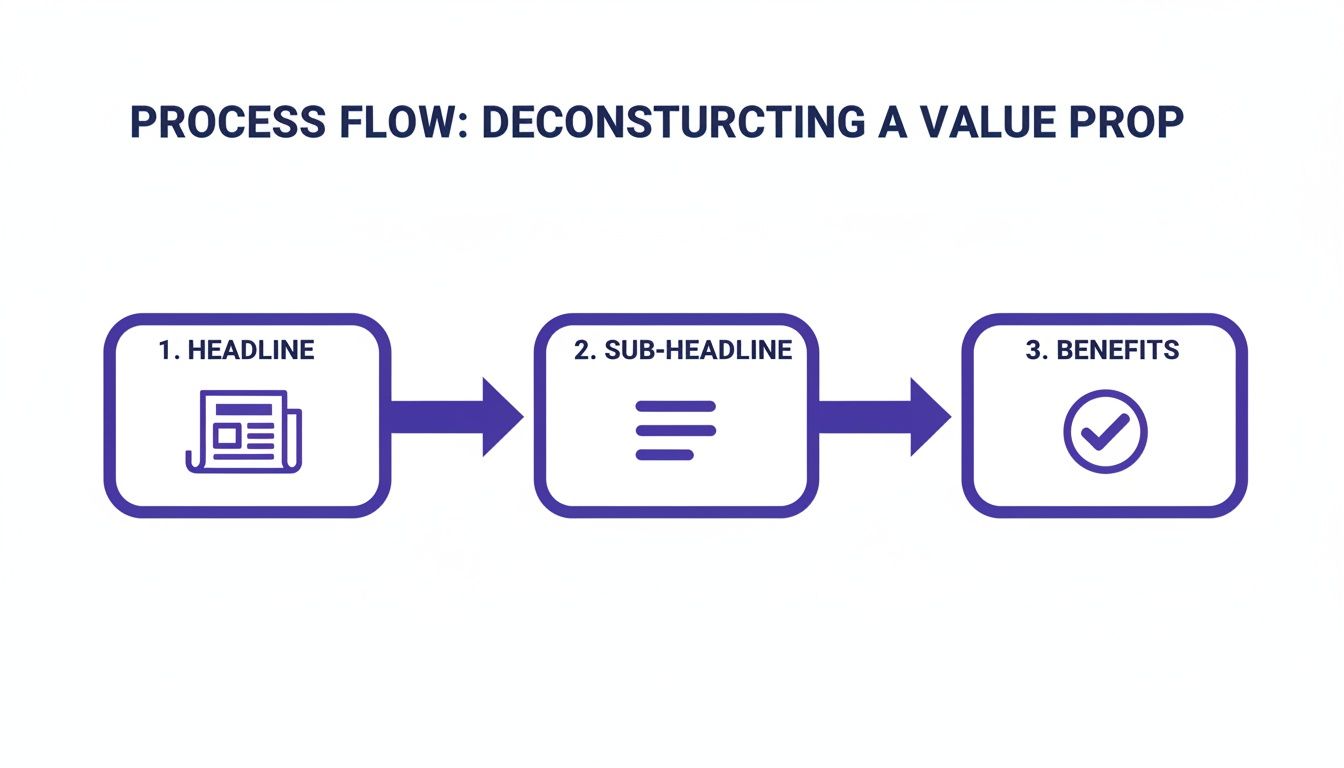
The headline grabs attention, the sub-headline explains the 'how,' and the bullet points prove the value. Together, they form an irresistible promise.
Answering the Four Core Questions
To fill in that template with answers that actually land, you need to go a bit deeper. Grab a notebook or open a blank document and just brainstorm—don't filter yourself yet. Just get the raw ideas out by answering these four questions.
-
Who is my ideal customer? Get super specific here. "Everyone" is the enemy of a strong value proposition. Who are you really talking to? What’s their job? What are their goals? Knowing your audience is the first, most crucial step. If you want to go deeper, these powerful audience segmentation strategies will help you zero in on your ideal buyer.
-
What is their biggest frustration? What’s the one problem that keeps them up at night? What are they really struggling with that your product or service can fix? Try to get to the core pain, not just the surface-level symptom. For instance, the pain isn't "needing a course"; it's "feeling stuck in a dead-end job and not having the skills to make a change."
-
How do I solve it? Now, connect their pain to your solution. How does your course, your community, or your e-book make that specific problem go away? Pinpoint the top 1-3 ways you deliver relief or create a genuine transformation.
-
What makes me different? In a crowded world, why should they choose you? It could be your unique perspective, your hands-on experience, or the incredible community you've built. Maybe it’s a business model that’s built for creators, like Zanfia’s 0% platform fee structure. This is your secret sauce.
Your Value Proposition Writing Template
Ready to put it all together? This simple table walks you through building your own statement, piece by piece.
| Component | Your Answer |
|---|---|
| For: (Your target customer) | |
| Who: (Struggles with this problem) | |
| Our: (Product/Service Name) | |
| Is a: (Category/Type of Solution) | |
| That: (Delivers this core benefit) | |
| Unlike: (The alternatives) | |
| We: (Offer this unique difference) |
Take your time with each box. When you’re done, you’ll have all the ingredients you need to craft a value proposition that truly connects with the people you’re meant to serve.
Common Mistakes That Weaken Your Message
You've put in the work to craft your value proposition, which is a huge step. But it's surprisingly easy to stumble right at the finish line. A few common missteps can water down your message, making it vague, hard to believe, or just plain invisible to the very people you want to reach.
Let's walk through these traps so you can sidestep them and make sure your message truly connects.
One of the biggest culprits? Relying on empty buzzwords. We've all seen them: "next-level," "game-changing," "revolutionary." They sound impressive, but what do they actually mean? Nothing. They're just filler words that have been so overused they trigger skepticism, not excitement.
Your potential customers are looking for real results, not abstract hype. A strong value proposition is always grounded in reality.
Confusing Features with Benefits
Here's another classic mistake: listing features instead of spelling out the benefits. Nobody buys a course because it has "20 video modules"; they buy it for the confidence to land that new job. People don't sign up for "community access"; they sign up to stop feeling so isolated and finally find collaborators for their next big idea.
A feature is what your product is or has. A benefit is what your customer can do or become with it. Always lead with the benefit.
Think about it this way: a creator on Zanfia could talk about the 0% platform fee—that's a feature. But the real benefit is that they get to keep 100% of their hard-earned revenue. This means they can reinvest more into their business, protect their margins, and grow faster. That small shift from "what it is" to "what it does for me" is everything.
A simple trick to avoid this trap is to ask "so what?" after every feature you list. This little question forces you to connect the dots and explain the real human outcome, which is what actually makes someone decide to buy.
Creating a Message for Everyone
Trying to be everything to everyone is a surefire way to be nothing to anyone. A value proposition that's too broad just becomes generic noise. Saying your product is "for creators" is a start, but it’s not nearly specific enough.
Are you talking to a "Potential Explorer" who's overwhelmed by tech, or a "Business Architect" earning PLN 100k+ a month who needs an integrated solution to scale? These two people have completely different problems, pains, and goals.
A powerful message speaks directly to one of them, using their language to solve their specific problem. You can always have different messages for different audiences, but each one needs to be laser-focused. Once you get crystal clear on who you're talking to, you'll see your conversions climb. To dig deeper into this, check out these conversion rate optimization strategies.
How an All-in-One Platform Helps You Deliver on Your Promise
Nailing your value proposition is a huge first step. But the real magic—the thing that builds a loyal following and a sustainable business—is actually delivering on that promise, day in and day out. Your message is only as strong as your execution, and the right tech stack is what makes your promise a reality for your customers.
This is where your choice of platform becomes mission-critical. It's the engine behind your entire operation.

Think about it. If you promise a seamless, integrated learning and community experience, you can't achieve that by duct-taping a dozen different plugins or sending your audience to external tools like Discord. A true all-in-one platform like Zanfia makes that promise real by bringing everything under one roof with a single login for your members, keeping them in your branded ecosystem.
Turning Promises into Reality
The features of the platform you choose become the very building blocks of the trust you're trying to earn. They are the tangible proof that you can walk the walk, not just talk the talk.
- Promise of Professionalism: When you use your own custom domain and white-labeling on every plan, your audience gets a pure, branded experience. They're interacting with you, not a generic platform, which instantly reinforces your credibility and brand identity.
- Promise of Simplicity and Value: A model with 0% platform fees is a direct fulfillment of a "fair value" promise—you keep 100% of what you earn. Powerful automations, like instantly granting course access after a purchase, deliver on the promise of a smooth, frustration-free customer journey that saves you 5-10+ hours a month.
- Promise of High-Quality Content: Having native video hosting built-in means you don't have to juggle costly third-party services like Vimeo or Wistia. It ensures your courses are delivered flawlessly, backing up any claim you make about offering a premium experience.
Your platform isn't just a technical decision; it's a strategic one. It's the operational backbone that directly impacts your ability to keep the promises you make to your audience.
Choosing the right platform to sell digital products is absolutely crucial. For Polish creators who are serious about delivering consistently, an integrated solution built for the local market like Zanfia makes all the difference. It simplifies everything from payments and invoicing (with automatic integrations for inFakt and Fakturownia) to community engagement, ensuring your operations always live up to your marketing.
Your Top Value Proposition Questions, Answered
Even after you’ve nailed down what seems like the perfect value proposition, some practical questions always come up. Getting clear on these helps you keep your message sharp and effective as your business and your audience change. Let's tackle a few of the most common ones we see.
How Often Should I Revisit My Value Proposition?
Think of your value proposition less like a stone carving and more like a living document. It has to grow with you. A solid rule of thumb is to give it a formal review at least once a year, but you should also check in any time your business makes a significant shift.
What counts as a "significant shift"? Look for triggers like these:
- You’re launching a major new product, like a signature course or a paid community.
- You’re expanding into a new market or trying to attract a totally different audience.
- You notice your main competitors have all changed their messaging.
- Your conversion rates start to dip, and you can’t pinpoint another obvious reason.
What’s the Difference Between a Value Proposition and a Slogan?
This one trips a lot of people up, but the distinction is actually pretty simple. Your value proposition is the strategic why, while a slogan is the catchy, creative what.
A value proposition explains why a customer should choose you. It’s the full story: the problem you solve, the benefits you deliver, and what makes you the best choice. A slogan is a short, memorable brand tagline designed for recall—think Nike’s "Just Do It."
A slogan is great for a t-shirt or an ad campaign. But your value proposition is what belongs right at the top of your homepage, giving new visitors instant clarity.
How Can I Tell if My Value Proposition Is Actually Working?
The great thing is, you don't have to guess. The best test is to put it out there and see how people react. Start by placing your new value proposition front and center on your website's main landing page.
From there, let the data tell the story. Are people staying on your page longer? Is your bounce rate going down? And the big one: is your conversion rate—for sign-ups, sales, whatever your goal is—going up? These numbers are the clearest feedback you can get on whether your promise is strong enough to make people act.
Ready to build a business that delivers on its promises day in and day out? Zanfia gives you the all-in-one platform to launch courses, build communities, and sell digital products with 0% platform fees. Start building your creator business today.