

How to Make Money with Your Laptop: A Practical Guide to Quick Online Income

Forget the endless lists of side hustles that just trade your time for a few extra dollars. The real way to make money with your laptop boils down to a simple, powerful formula: create a valuable digital asset once, then sell it an infinite number of times.
This is how you stop trading hours for dollars and start building a business that works for you 24/7. It’s about turning your knowledge into scalable products like courses, e-books, and paid communities that generate income long after the initial work is done.
Table of Contents
Your Laptop Is A Business-In-A-Box
The true opportunity isn't about finding another gig—it's about creating and selling your own digital products. You don't need a massive social media following or a degree in computer science. All you need is the solution to a specific problem for a specific group of people.
This is the shift from being paid for your time to being paid for the value your product creates, whether you're at your desk or not. We dive deep into this concept in our guide on what is passive income and how to actually build it.
The Mindset Shift: From Service Provider To Product Owner
Here’s the core idea: stop being a service provider and start being a product owner.
Think about it this way. Instead of coaching clients one-on-one for an hourly rate, you create a comprehensive online course that can serve hundreds or thousands of students. Instead of writing freelance articles for other people's websites, you launch your own paid newsletter on a topic you’ve mastered.
It’s a simple, three-part process. You create the asset, you sell it, and you earn from it—repeatedly.
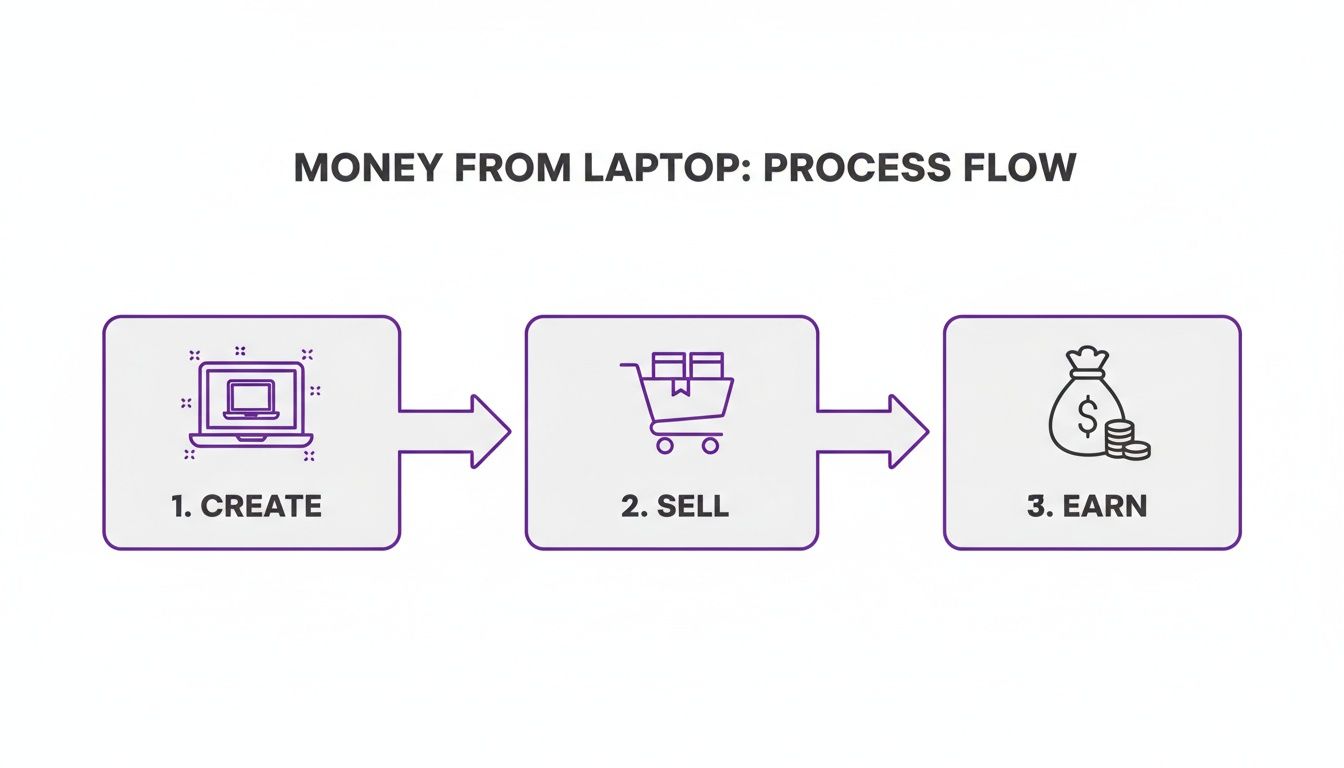
This simple model is the foundation of every successful laptop-based business.
The Numbers Don't Lie
The financial case for digital products is incredibly compelling. The market is projected to skyrocket to $511.43 billion by 2031 as more creators realize the economic advantage.
The real game-changer is the profit margin. Digital products can command margins of 70-90%, completely dwarfing the 20-30% typical for physical goods. With no inventory to manage and near-zero replication costs, almost every sale adds directly to your bottom line.
To get your gears turning, here’s a quick look at some of the most profitable digital products you can start creating today.
Top Digital Product Ideas for Laptop Entrepreneurs
| Product Type | Best For | Potential Income |
|---|---|---|
| Online Courses | Experts who can teach a skill or process step-by-step | High (recurring or one-time) |
| E-books & Guides | Writers and specialists who can package knowledge concisely | Moderate (high volume potential) |
| Paid Newsletters | Journalists and niche experts with consistent insights | High (recurring subscription) |
| Digital Templates | Designers and productivity gurus (e.g., Notion, Canva) | Moderate (passive and scalable) |
| Private Communities | Coaches and leaders who can foster valuable discussion | High (recurring membership) |
| Webinars & Workshops | Speakers and trainers who can deliver live value | High (premium one-time events) |
Each of these can be built and sold right from your laptop, turning your unique expertise into a scalable revenue stream. This economic shift makes it easier than ever to monetize what you know.
For a tangible example of a successful laptop-based model in action, check out this guide on how to make money with print on demand, which applies similar principles.
Ultimately, your journey begins with the decision to package your expertise. This guide will give you the roadmap to turn that decision into a real, profitable online business.
Find Your Niche and Validate Your First Product Idea

Before you build a single landing page or record one second of video, you have to answer the most important question: Will anyone actually pay for this? So many aspiring creators fall into the trap of building something in a vacuum, only to launch to absolute crickets.
Making real money with your laptop isn't about having a "perfect" idea. It’s about finding a profitable one—that sweet spot where your skills intersect with a problem people are desperate to solve. This validation work is the single most critical thing you'll do, and it can save you months of wasted effort.
Uncover Problems People Will Pay To Solve
The best digital products aren't dreamed up in brainstorming sessions. They're discovered by listening to the frustrations people are already talking about. Your job is to find where the pain is.
Stop guessing. Go directly to the source—the online communities where your ideal customers are openly complaining. This is where you find your first paying customers.
- Reddit & Niche Forums: Dive into subreddits or forums in your area of expertise. Hunt for posts that start with "How do I…?", "I'm struggling with…", or "Does anyone know a tool for…?". These aren't just questions; they're purchase orders in disguise.
- Facebook & LinkedIn Groups: Join the groups where your target audience lives. Watch for the questions that get asked over and over again. If the same problem pops up every week, that’s a massive signal of real market demand.
- Social Media Listening: Use the search bar on X (formerly Twitter) or Instagram. Search for keywords in your niche plus words like "frustrated," "stuck," or "help." You’ll get a real-time feed of your audience's biggest headaches.
For example, a personal finance pro might see freelancers in a group constantly asking about quarterly tax estimates. That's direct validation for an e-book like a "Freelancer's Tax Survival Guide." A gardening expert could see city dwellers in a forum lamenting their lack of space, validating a course on "Balcony Vegetable Gardens."
Test Your Idea Without Building Anything
Once you've pinpointed a problem, you need to confirm that people will open their wallets for a solution. You don't need a finished product or a fancy website to do this. You can get your answer with a few simple, low-effort tests.
The easiest way is a "smoke test." Post a simple offer in a relevant online group. Briefly outline what you're thinking of creating and ask directly if it’s something they'd be interested in.
Pro Tip: One of the most powerful validation methods is to build a dead-simple landing page for your future product. Describe the outcome and add an email form to join the waitlist. If you can get 50-100 people to sign up for something that doesn't even exist yet, you've got a winner.
Another great tactic is running a quick survey. Ask pointed questions to gauge how badly people want a solution. Questions like, "What’s the most frustrating part of [the problem]?" or "What would a perfect solution look like to you?" give you invaluable intel. For experts overwhelmed by tech, an all-in-one platform like Zanfia is often the simplest way to get from idea to first sale, removing the paralysis of launching.
After this process, you’ll have moved from a vague hunch to a validated concept. You’ll know exactly who your customer is, what they're struggling with, and what they’re willing to pay to fix it—the perfect foundation for a product that actually sells.
Create Digital Products People Are Eager to Buy
You've got a validated idea. That's a huge step, but now it’s time to move from research to revenue. This is the build phase—where you forge the actual asset your audience will pay for. Many aspiring creators get paralyzed here, thinking it requires a Hollywood-level budget and a team of developers.
That’s a myth. With the right tools, you can build premium digital products right from your laptop. You don’t need a fancy studio to film a course or a publisher to release an e-book. What you need is a clear blueprint and a platform that handles the heavy lifting.
How to Structure a High-Value Online Course
Online courses are transformation engines. Done right, they are one of the most profitable assets you can build. But a random collection of videos won’t work; success hinges on getting your students from Point A (their problem) to Point B (their desired outcome). A great course is a journey.
Start by reverse-engineering the transformation. What's the final result you promise? Break that down into major milestones (your modules), and then break those modules into individual, actionable lessons.
A proven course structure looks like this:
- Module 1: The Foundation: Start with the "why." Set the stage and establish the core principles of your method.
- Module 2: The Core Mechanics: This is where you teach the fundamental skills and techniques.
- Module 3: Practical Application: Show students how to use the skills with real-world examples and walkthroughs.
- Module 4: Advanced Strategies: Introduce next-level tactics for students who've mastered the basics.
- Module 5: The Path Forward: Guide students on what to do after the course to maintain momentum.
When it's time to record, prioritize crystal-clear audio and good lighting—those are non-negotiable. Modern platforms like Zanfia have advanced features like native video hosting, which saves you from paying for costly external services like Vimeo, and a smart video player that automatically saves student progress. This lets you focus on creating great content, not managing video files.
Build a Community People Will Pay For
A paid community is a destination, not just a content feed. It's where your members find connection, support, and accountability. Unlike a free Facebook group, a paid community generates a much higher level of commitment because everyone has skin in the game.
The secret to a thriving community is focused, organized conversation. This is where an all-in-one platform becomes essential, because it stops you from sending paying customers to distracting, third-party apps.
A thriving community is built on interaction, not just information. By integrating community spaces directly with your course content, you create a unified environment where students can ask questions right below the lesson video, share wins in a dedicated channel, and connect with peers—all under your brand. This dramatically boosts engagement and member retention.
Platforms like Zanfia are engineered for this. You can create dedicated discussion channels for specific topics, post in read-only announcement channels, and automatically group members based on which products they've purchased. It keeps everything in one place, strengthening your brand and delivering a seamless experience. As Przemysław Niemczuk of TreningBiegacza.pl notes, this approach delivers "simplicity and high functionality."
Create and Package a Professional E-book
E-books and guides are fantastic starter products. They are faster to create than a full course and are the perfect vehicle for packaging your expertise into a high-value, digestible format. A professional e-book isn't just a Word doc dumped into a PDF; its value is in its design, clarity, and actionable content.
Use simple tools like Canva or even Google Docs to create a clean, professional layout. Focus on these key elements:
- A compelling cover that signals the topic and its value.
- A clear table of contents so readers can navigate easily.
- Short paragraphs, headings, and bullet points to make it scannable.
- Actionable add-ins like checklists, worksheets, or templates.
The demand for this kind of content is massive and growing. The creator economy is projected to hit $234.65 billion by 2026, with internet users spending over $560 billion on digital media in 2024 alone. These trends confirm that consumers are actively seeking and paying for the exact kind of knowledge you can package and sell.
Whether you're building a course, a community, or an e-book, your goal is to deliver a real transformation. To dive deeper into the different types of assets you can create, check out our guide on what is a digital product. By focusing on quality and using the right tools, you'll create a product that not only sells but builds a loyal brand following.
Build Your Sales System and Choose the Right Pricing

You’ve poured your expertise into a fantastic digital product. Now comes the most critical part: actually turning that work into income. This is where so many creators stall out, getting lost in a maze of plugins, payment gateways, and technical headaches.
Let’s cut through the noise. Your number one goal here is to make it incredibly easy for someone to give you their money. Any friction in the buying process—a confusing checkout page, a broken link, or too many steps—is a direct hit to your sales.
The Two Paths to Building Your Sales System
When it comes to the tech, you really only have two main choices. You can go the DIY route and stitch together a system yourself, or you can use an all-in-one platform that handles everything for you. This decision will save you either a ton of time or a ton of money.
The do-it-yourself path, usually built on WordPress, means you're piecing together separate plugins for e-commerce (WooCommerce), course delivery (LearnDash), and maybe a community (BuddyBoss). While it sounds flexible, you quickly become a part-time IT manager, battling compatibility issues, security updates, and a tangle of hidden costs. Veteran developer Daniel Roziecki notes this struggle, highlighting the "peace of mind" a managed platform provides by letting him focus on teaching, not wrestling with tech.
The smart alternative is an integrated, all-in-one platform built for creators. These systems unify your sales pages, checkout, product delivery, and customer management into a single dashboard. It’s the fast lane to making money because the heavy technical lifting is already done for you.
Platform Comparison: DIY vs All-in-One
Deciding between a piecemeal WordPress setup and a unified platform like Zanfia is a major fork in the road. One path demands your time and technical skill, while the other demands a subscription but gives you back your focus.
Here’s a clear breakdown of what you're signing up for with each approach.
| Feature | WordPress + Plugins | All-in-One Platform (e.g., Zanfia) |
|---|---|---|
| Setup Time | Days or even weeks of configuration | Up and running in hours, sometimes minutes |
| Technical Skill | Moderate to high; ongoing updates & maintenance | None needed; the platform manages all tech |
| Security | Entirely your responsibility; vulnerable to plugin conflicts | Professionally managed and constantly monitored |
| Integrations | Often complex and can require custom work or Zapier | Built-in, seamless, and designed to work together |
| Customer Experience | Can feel disjointed with multiple logins | Unified and branded with a single login |
| True Cost | Multiple plugin licenses + hosting + potential developer fees | A single, predictable monthly subscription with 0% platform fees |
Ultimately, an all-in-one system is built so you can focus on creating and marketing, not on being your own tech support. As serial entrepreneur and investor Artur Kurasiński says, it's about finding “the most convenient and simplest solution” to get your products to market.
Choosing the Right Pricing Model for Your Offer
How you price your product is just as vital as what you're selling. The right model not only maximizes revenue but also attracts the right kind of customer and can build a predictable, stable income stream.
For digital products, it usually boils down to three core models:
- One-Time Payment: This is the simplest path. A customer pays once and gets lifetime access to your product, like an e-book or a signature course. It’s clean, straightforward, and works great for high-value flagship products.
- Subscription/Membership: This model is the engine for predictable income. It’s perfect for delivering ongoing value, whether that’s a paid community, a monthly newsletter, or a course library that gets regular updates. It creates monthly recurring revenue (MRR), the holy grail of a sustainable online business.
- Payment Plan (Installments): Offering a payment plan is a powerful way to make a higher-priced product more accessible. Instead of asking for one large payment of $500, you could offer three monthly payments of $175. This one tweak can dramatically boost conversion rates for your premium offers.
The best strategy often involves a mix. You might sell your main course for a one-time fee but also offer an exclusive coaching community as a monthly add-on. For a deeper dive, our guide on how to price digital downloads lays out more advanced strategies to find your pricing sweet spot.
The Hidden Cost of Transaction Fees
One of the sneakiest costs that can eat into your profits is the transaction fee. Many platforms will take a cut of every single sale you make, often somewhere between 5% and 10%. That might not sound like a huge deal at first, but as you grow, it becomes a massive drain on your revenue.
Imagine you’re earning PLN 10,000 per month. A platform charging an 8% transaction fee is taking PLN 800 from you every single month. That's PLN 9,600 per year that you've earned but don't get to keep. This is why a 0% transaction fee model is a financial game-changer for serious creators.
This is exactly where a platform like Zanfia gives you a massive financial edge. It runs on a clean SaaS subscription and charges flat zero-percent (0 %) transaction fees. You keep 100% of your revenue, paying only the standard, unavoidable processing fees from gateways like Stripe, PayU, or Przelewy24. For creators scaling from PLN 10k to PLN 100k+ a month, this can literally mean tens of thousands of zlotys saved every single year.
Market Your Product and Attract Your First Customers
This is where most creators get it wrong. They build a fantastic product, hit publish, and expect the sales to roll in. But a great product doesn't sell itself—at least not at first.
The good news? You don't need a huge marketing budget to get traction. The real secret is focusing on organic, relationship-driven strategies that attract your ideal customers and turn them into your first true fans. This is the playbook for getting your first 10, 50, and even 100 customers.
The Golden Rule: Build Your Audience First
Your launch doesn't begin on launch day. It starts the moment you decide to build an email list. This is the single most valuable asset you will own in your business, giving you a direct line of communication that isn’t controlled by some mysterious algorithm.
The fastest way to grow your list is with a lead magnet. This is a free, high-value resource that solves a very specific problem for your target audience. Think checklists, templates, a short e-book, or a mini-video training. It's a small taste of the value you deliver in your main product.
For those monetizing with a newsletter, choosing the right platform is critical. As Wojciech Pisarski, CEO of wMinutę, puts it, “Without Zanfia, developing a paid newsletter and community in Poland would be much harder—it’s the best tool in the market”.
When someone gives you their email for your lead magnet, they’re raising their hand and saying, "Yes, I'm interested in what you have to teach." You're not just collecting contacts; you're building a pre-qualified audience that is ready to hear from you.
The Simple Launch Plan That Actually Works
Forget the high-stress, overly complicated launch formulas. A simple, repeatable plan is all you need to create genuine buzz and secure your first wave of sales.
Here’s a proven, low-stress framework:
- The Warm-Up (1-2 weeks before launch): Start talking about the problem your product solves. Share valuable tips and stories on social media and with your growing email list. Hint that a solution is on the way.
- The Main Event (Launch Day): Host a free live event, like a webinar or a practical workshop. Teach something genuinely useful that’s related to your product. At the end, present your paid product as the logical next step for anyone who wants to go deeper.
- The Open Cart (3-5 days): This is when your product is officially for sale. Send a series of emails to your list covering the benefits, sharing early feedback or testimonials, and answering common questions. A short buying window creates natural urgency without being pushy.
This approach focuses on building authentic relationships first. It's not a hard sell; it's a natural conversation that leads to an offer for a warm, engaged audience.
Find Your First Customers in Online Communities
Don't sit back and wait for customers to discover you. You have to go where they already hang out. Online communities—Facebook groups, Reddit, Discord servers, forums—are absolute goldmines for finding your first clients.
The key is to be a helpful member, not a spammer. Jump in, answer questions, share your expertise freely, and build a reputation as a go-to resource.
When the moment is right, you can mention your product in a relevant context. For example, if someone posts a question that your course solves perfectly, you can offer a genuinely helpful answer and add, "I actually created a full course that walks through this step-by-step, if you're interested in going deeper."
And don't forget about direct outreach. Learning to write effective PR Emails can help you connect with influencers or niche media outlets who can introduce your work to a much bigger, relevant audience. This kind of targeted outreach can be incredibly powerful for a brand-new launch.
Scale Your Business with Automation and Recurring Revenue
The real freedom in making money with your laptop isn’t just about selling a product one time. It’s about building an actual business—a system that generates income so you can focus on creating, not just selling.This is the leap from trading your time for money to owning an asset that works for you. To get there, you need two critical ingredients: automation and recurring revenue. It’s how you stop being an active seller and finally become a true business owner.
Embrace the Power of Automation
Imagine getting 5-10+ hours of your time back every single month. That’s not a gimmick; it’s what happens when you build smart automations that handle the tedious administrative work for you.
Instead of manually onboarding every new customer, you build a workflow that runs on its own. This creates a seamless, professional experience for your customers from the moment they buy.
With an integrated platform, you can set up powerful triggers that do the heavy lifting:
- Grant Access Automatically: The second a payment goes through, your system unlocks the course, e-book, or community space. No more late-night emails granting access.
- Trigger Welcome Sequences: A new customer is immediately dropped into an email sequence that onboards them, shows them how to get the most value, and makes them feel like part of your world.
- Manage Subscriptions Effortlessly: The platform handles all recurring billing, sends payment reminders, and even revokes access if a subscription lapses. It’s all hands-off.
- Automate Invoicing: For Polish creators, platforms like Zanfia can connect directly to invoicing suites like inFakt or Fakturownia to automatically generate and send compliant invoices after every single purchase.
These systems don’t just save you time; they build trust and let you focus on high-impact work like creating new content or engaging directly with your community.
Build Predictable Income with Subscriptions
A one-time sale is great. But a subscription? That’s the foundation for a stable, predictable business. Shifting to a recurring revenue model is how you build a resilient brand and dramatically increase the lifetime value of every customer.
This isn't just a small trend. It's a massive shift in how people buy digital goods. The subscription economy controlled 56.20% of the digital goods market in 2025 and has exploded by 435% in the last decade alone. For laptop entrepreneurs, this is your ticket to tapping into a market valued at over $722 billion. You can dig into the numbers yourself in this detailed industry report on the digital goods market.
By offering tiered memberships, you can bundle multiple products—like a course, a private community, and monthly Q&A sessions—into a single subscription. This not only increases the perceived value but also creates a predictable income stream you can count on every month.
With a platform like Zanfia, you can easily package your offers into subscriptions, installment plans, or product bundles, giving you complete control. And because of the 0% platform transaction fees, you keep 100% of that hard-earned recurring revenue. This lets your business scale faster and much more profitably.
Frequently Asked Questions

When you’re first starting out, a few key questions always seem to pop up. Let’s tackle them head-on, so you can stop wondering and start building your business with confidence.
How Much Money Can I Realistically Make from My Laptop?
This is the big one, isn't it? While there’s no single number, the path is well-worn. In the beginning, most new creators focus on getting their first wins, which often looks like a few hundred to a couple of thousand dollars a month. This is the momentum-building phase.
The real financial growth kicks in when you start to scale. We see established creators who have built streamlined systems earning anywhere from PLN 10,000 to over PLN 100,000 per month. They do this by expanding their suite of digital products and building out paid communities. It all starts with a validated idea and a platform that can handle your growth without eating into your margins.
Do I Need a Large Social Media Following to Start?
Let’s clear this up right now: absolutely not. The idea that you need a massive audience before you can earn a dollar is one of the biggest myths in the creator economy. In reality, many of the most profitable creators started small, focusing on a specific niche audience that was hungry for a solution.
It's far more effective to have 100 true fans who are eager to buy from you than 10,000 passive followers who never engage.
Your first customers won't come from a viral post. They’ll come from genuine conversations in online forums, targeted content that solves a real problem, or even small, well-placed ad campaigns. EFL teacher Mateusz Grzywiński confirms this, stating, “If you plan to sell digital products and build a community of paying customers, Zanfia is the best solution.”
What Are the Biggest Mistakes to Avoid?
The most common pitfalls that sideline new creators are surprisingly easy to sidestep once you know what to look for. Keep these in mind as you get started:
- Building Before Validating: Never invest weeks or months creating a product before you have clear evidence people will pay for it. Run a presale, survey your audience, or offer a beta version first.
- Suffering from Tech Overwhelm: Don't get stuck trying to duct-tape a dozen different tools together. An all-in-one platform is designed to simplify your workflow, not add to it.
- Underpricing Your Expertise: Pricing your work too low is a fast track to burnout. It devalues your skills and attracts the wrong kind of customers.
- Ignoring Transaction Fees: Choosing a platform that takes a percentage of your revenue is a hidden tax on your growth. A 0% platform fee model means you keep what you earn.
Ready to stop juggling tools and start building your business on a single, powerful platform? Zanfia provides everything you need to create and sell online courses, paid communities, and digital products with 0% platform fees. Start building your online business with Zanfia today.


