

How to Repurpose Content and Work Smarter Not Harder

So, what exactly is content repurposing? At its core, it's a strategic way of taking your best-performing content—think blog posts, videos, or webinars—and cleverly adapting it into fresh formats. This isn't about recycling; it's about amplifying your reach and squeezing every last drop of value out of the hard work you've already done.
It's the ultimate "work smarter, not harder" strategy for creators. You can turn one great piece of content into a dozen different touchpoints, all while saving time and boosting your brand's presence.
Table of Contents
Unlock the Hidden Value in Your Existing Content

The pressure to constantly churn out brand-new content is a recipe for burnout. It’s an exhausting, inefficient grind. But what if your most powerful assets are already sitting in your content library, just waiting to be rediscovered?
That old blog post that got tons of traffic, that popular module from your first course, or that high-engagement video? That’s a goldmine. Learning how to repurpose content is about getting off the creation treadmill and shifting to a more strategic, high-impact approach.
From One-Off Effort to a Multi-Week Campaign
Let’s say you just wrapped up a fantastic webinar. Instead of just letting that recording collect digital dust, think bigger. That single one-hour recording has the DNA to become a powerful, multi-week campaign that drives both new leads and sales for your digital products.
Here's how one asset can suddenly multiply its value across your entire ecosystem:
- Short-Form Videos: Pull out the 5-7 most impactful insights. Chop them up into snappy, 60-second clips perfect for grabbing attention on social media.
- Paid Newsletter: Transcribe the Q&A session from the end of the webinar. Expand on those answers to create an exclusive, in-depth issue for your paying subscribers.
- Lead Magnet: Condense the core framework of your presentation into a downloadable PDF guide or a practical checklist that people will gladly exchange their email for.
- Community Content: Spark some conversation by posting discussion prompts based on the webinar’s main topics inside your Zanfia community.
This isn't just a time-saver; it’s about strategically amplifying your message. Before we get into the nitty-gritty, it's worth taking a moment to fully grasp what content repurposing is and how it can give any creator or business a serious competitive edge.
By deconstructing one core piece of content, you create numerous opportunities to connect with your audience on different platforms, reinforcing your expertise and keeping your brand top-of-mind. This saves the 5–10+ hours a month that disorganized efforts consume.
For creators building their business on a platform like Zanfia, this method is a game-changer. Those short video clips from your webinar can directly tease a paid online course with native video hosting, and the conversations that follow can happen right inside your branded community—not on some disconnected Facebook group. This unified approach keeps your audience engaged under your own domain and brand.
This integrated system transforms a single piece of content into a systematic engine for engagement and revenue. If this is a new concept for you, our guide on what a digital product is is the perfect starting point to see how it all fits together. This guide really sets the stage by explaining the "why" before we dive headfirst into the "how."
If you jump into repurposing without a plan, you're just making more work for yourself. It’s a bit like wandering through a new city without a map—you might stumble upon something cool, but you’ll waste a ton of time and energy along the way.
The smart move is to start with a content audit. This is just a methodical review of everything you've already published, designed to separate the genuine gold from the digital dust. Instead of guessing what to rework, you'll use data to find the content that's already proven its value.
Find Your Repurposing Gold with a Content Audit
This isn't just about digging up old posts. It's about finding the core ideas and messages that connect most deeply with your audience.
Start with Your Evergreen Winners
First up, go hunting for your evergreen content. These are the timeless, foundational pieces that keep pulling in traffic month after month, long after you hit publish. They're the workhorses of your content library, consistently delivering value.
To find them, you need to get comfortable with your website analytics. Look for the articles, guides, or videos that maintain steady page views without you having to constantly promote them. These are the assets solving a fundamental problem for your audience.
- High, Sustained Traffic: Which URLs are always in your top 10 or 20 for organic search?
- Low Bounce Rate: Which pages actually keep people on your site and make them want to click around?
- Backlinks: What content has other websites found valuable enough to link to on their own?
These evergreen pieces are your prime candidates for repurposing. Their core message is already a proven hit, making them a low-risk, high-reward place to start.
Pinpoint Your High-Engagement Hits
Next, switch gears and look for your high-engagement content. These are the pieces that started a conversation. They might not have the biggest traffic numbers, but they got the most comments, shares, and questions from your community.
Don't underestimate engagement. It's a powerful signal of what connects with your audience on an emotional or intellectual level.
An old blog post with a few dozen thoughtful comments is a flashing neon sign that you struck a nerve. Every single one of those comments is a potential angle for a new piece of content—a short video, a segment in your newsletter, or a discussion prompt for your community.
This is especially true for creators using platforms like Zanfia, where community interaction is built right in. A lively discussion happening inside a course module or a paid community is a direct signpost showing what your most dedicated customers want to learn next. This integrated ecosystem boosts member retention by keeping everything unified under your brand.
Organize Your Content for Action
Once you have your lists of evergreen and high-engagement content, it's time to get organized. A simple framework will help you prioritize where to put your energy for the biggest impact.
I like using a basic spreadsheet for this. It turns a messy library into a clear action plan.
Create a sheet with these columns:
- Content Title & URL: The name of the piece and a direct link.
- Type: Is it a blog post, video, webinar, or something else?
- Performance Score: Rate it from 1-5 based on traffic and engagement.
- Relevance Score: How relevant is this topic to your business goals right now? Score it 1-5.
- Repurposing Ideas: This is where you brainstorm. Jot down a few quick ideas like "turn into 5 short video clips," "create infographic," or "expand into a lead magnet."
This isn’t just busywork; it’s strategy. And it’s quickly becoming the standard for smart marketers. Today, 94% of marketers are actively repurposing content, with a significant 46% reporting measurable positive results in engagement and conversions.
By auditing your content first, you make sure every minute you spend on repurposing is a smart investment. You're building on a foundation of proven success, which is always more effective than starting from scratch. To really get into the weeds with your data, check out our guide on how to analyze website traffic effectively.
Alright, you've done the hard work of auditing your content and have a shortlist of your greatest hits. Now for the fun part: figuring out how to slice, dice, and remix those high-performers for new platforms and audiences.
This is where the real magic happens. It’s not about just spamming a link to your blog post across social media. That’s lazy. We’re talking about a real transformation—taking a single, valuable asset and spinning it into a dozen different pieces that attract, engage, and convert.
Think about one high-value module from an online course you’ve built. That single lesson is a goldmine. Let's break down how to mine it.
Deconstruct and Rebuild Your Core Content
I like to think of a "pillar" piece of content—like a deep-dive blog post or a detailed course lesson—as a block of marble. Your job is to find all the different sculptures hidden inside. A 30-minute video lesson isn’t just one thing. It's a collection of powerful quotes, actionable steps, surprising stats, and compelling stories.
The whole point of the content audit we just did was to find these blocks of marble. It helps you zero in on the content that's already proven to work, whether it’s an evergreen guide that pulls in steady traffic or a high-engagement topic that always gets people talking.
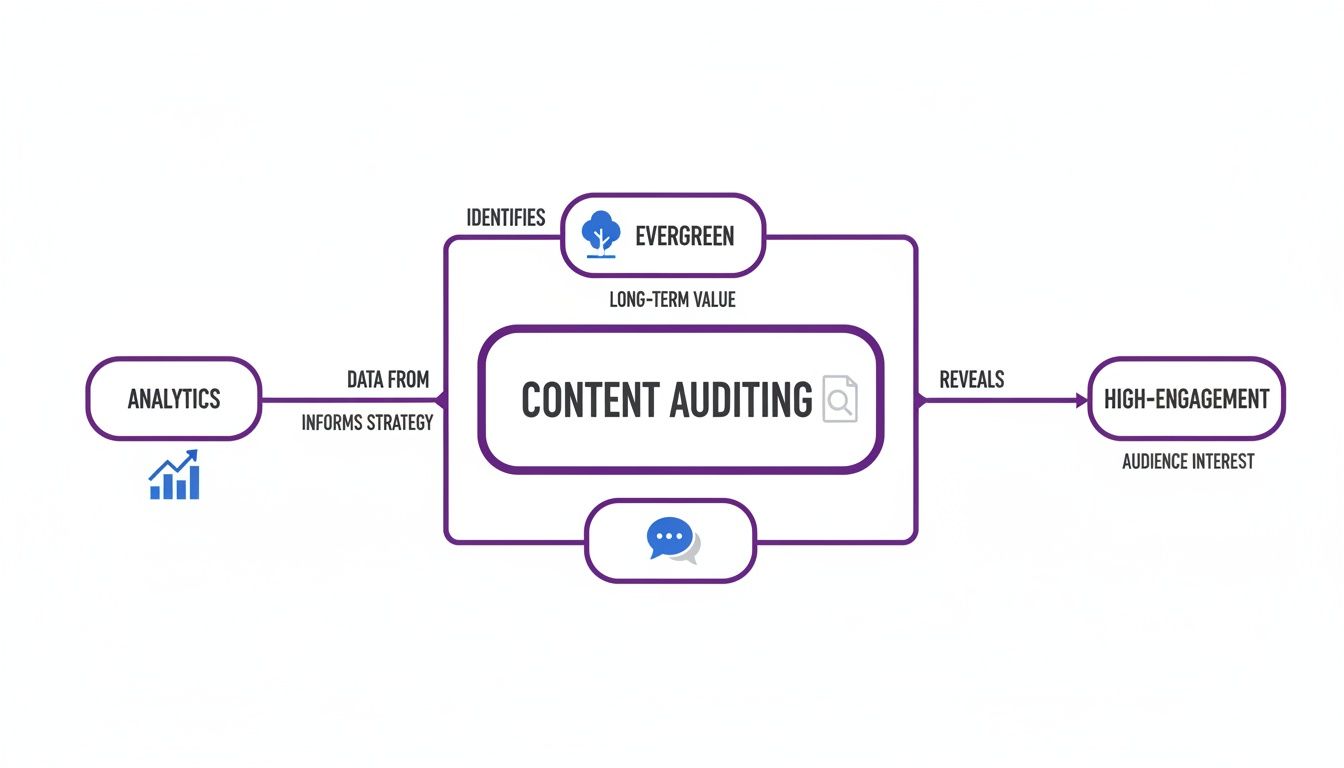
This is about making data-driven creative decisions. By analyzing what already resonates, you ensure every ounce of effort you put into repurposing is built on a foundation of success.
Let's get specific. How can that one video module be totally reimagined?
- For Short-Form Video (Reels/Shorts): Pull the three most impactful takeaways from the lesson. Don't just clip them. Re-record each one as a punchy, 60-second vertical video with on-screen text. Suddenly, one lesson becomes three pieces of social media fuel.
- For Your Paid Newsletter: Transcribe a key section where you break down a complex idea. Then, enrich it. Add a personal story you didn't include in the video or a "behind-the-scenes" insight. This gives your paid subscribers exclusive value they can’t get anywhere else.
- For a Lead Magnet: Take the practical, step-by-step process from the lesson and distill it into a slick PDF checklist or a one-page worksheet. Offer it for free to capture new email subscribers.
- For Your Community: Find a controversial or thought-provoking statement from your lesson. Post it as a question inside your Zanfia community to spark a real conversation among your members.
See the pattern? Each new piece keeps the original's core value but repackages it perfectly for a different context and goal.
Content Repurposing Matrix From Original to New Format
To make this process less "stare at a blank page" and more systematic, I use a simple matrix. It's a brainstorming tool to help you map your original content types to new formats, forcing you to think beyond the obvious.
This table is a guide to help you identify potential new formats for your existing pillar content, matching original types with effective repurposed outcomes.
| Original Content Type | Repurposed Format Idea 1 | Repurposed Format Idea 2 | Repurposed Format Idea 3 | Pro Tip |
|---|---|---|---|---|
| Comprehensive Blog Post | Multi-part email mini-course | Script for a detailed YouTube video | A series of informative social carousels | Pull out each H2/H3 as a separate mini-topic. |
| Course Video Module | 3-5 short clips for social media | An audio-only version for a private podcast feed | Key slides turned into a LinkedIn carousel | Transcribe the audio to find tweet-worthy quotes. |
| Webinar Recording | An in-depth case study blog post | A "Top Questions Answered" FAQ guide | Attendee testimonials as social proof graphics | The Q&A section is often the most valuable part. |
| Podcast Episode | Key quotes as graphic cards for Instagram | A written article summarizing the discussion | A short animated video explaining one core concept | Don't just transcribe; rewrite it for readers. |
| E-book | Break chapters into individual blog posts | A live Q&A session with readers in your community | A workbook or companion guide (upsell) | Each chapter can be its own mini-campaign. |
Don't treat this matrix as a rigid set of rules. Think of it as a creative launchpad. The goal is to unlock the hidden potential in everything you create.
This entire approach shifts your mindset from "create, publish, done" to "create once, distribute forever." It’s how you build a powerful content engine that delivers massive impact without burning you out.
For a creator on a unified platform like Zanfia, this integrated system is a game-changer. The short-form video you post on Instagram leads someone to a lead magnet, which automatically enrolls them in a welcome sequence that pitches your paid community—all from one dashboard. Suddenly, your process for training video creation becomes infinitely more valuable, because you know each video can fuel your marketing for weeks to come.
This method transforms each piece of content from a single broadcast into a web of interconnected touchpoints, guiding your audience deeper into your world and closer to becoming a paying customer.
Build Your Repurposing Workflow and Production Calendar

A brilliant repurposing strategy is just a nice idea until you build a real system to make it happen. You've done the hard work of finding your high-potential content—now it's time to create a repeatable, low-friction process to give it new life. Without a solid plan, you'll end up scrambling, and all those time-saving promises of repurposing will simply disappear.
The goal here is to get out of the "what should I post today?" trap and into a structured, predictable system. This means adopting a specialized content calendar and getting really smart about production with techniques like batching. It's all about creating a workflow that maximizes your output without leading to burnout.
Map Your Content on a Repurposing Calendar
Your standard content calendar is fine for telling you what goes live and when. A repurposing calendar, however, is a game-changer. It visually connects one big "pillar" piece to all the smaller assets that will spin off from it. This one shift in perspective changes everything.
Start by slotting in your main piece of content. Let's say it's a new course module, "The Foundations of Copywriting," scheduled for the first Monday of the month. From there, you map out all the derivative content.
- Week 1: Publish the pillar course module inside your Zanfia community. You'll announce it with a detailed post in the community and send a heads-up to your email list.
- Week 2: Drop 3 short-form video clips on your social channels, with each one sharing a killer tip from the module.
- Week 3: Publish a deep-dive blog post that expands on a single concept from the course, and make sure to embed one of those video clips.
- Week 4: Send out a newsletter featuring a "Top 5 Questions Answered" section, based on the early feedback you've gotten on the module.
Suddenly, every single piece has a clear purpose. You've got a steady stream of value for your audience, and it all grew from a single, focused effort.
Supercharge Your Efficiency with Batch Processing
Batch processing is the secret weapon of every truly productive creator I know. Instead of making one graphic, then one video, then one social post in a disjointed way, you group all your similar tasks and knock them out at once. It’s a massive time-saver because it kills the mental fatigue of context-switching.
Let's apply this to our copywriting course module.
- Video Session: Right after you finish recording the main course video, sit down and immediately identify 5-7 clips that could work as short-form videos. Record all of them right then and there, using the same lighting and setup.
- Graphics Session: Fire up your design tool and create all the visuals for the month in one go. That means video thumbnails, social media quote cards, and the header image for your blog post.
- Writing Session: Now, write all the copy. Draft the social media captions for your video clips, write the newsletter, and get the community announcement post ready.
By batching your work, you can realistically turn one day of focused creation into a month’s worth of high-quality, repurposed content. Zanfia’s powerful automations can save you an additional 5–10+ hours per month by handling tasks like granting course access, sending welcome emails, and adding users to community channels automatically.
This isn't just a solo creator hack; it's a proven industry practice. Social media marketers get it—recent data from HubSpot's latest marketing report shows 48% share repurposed content across platforms with only minor tweaks. It’s a smart strategy that acknowledges overlapping audiences and boosts ROI. And when you consider that blog posts—a perfect source for repurposing—can deliver a 22.26% ROI, this efficient model becomes even more powerful.
For creators using an all-in-one platform like Zanfia, this entire workflow connects directly back to your business goals. The platform charges 0% platform fees, meaning you keep 100% of your revenue. This transparent model is especially attractive for creators tired of seeing commissions eat into their margins. We've got even more ideas for connecting these dots in our guide to marketing automation workflow examples.
Measure the True Impact of Your Repurposed Content
Churning out repurposed content can feel incredibly productive. But if you're not tracking what actually works, you’re just creating noise. Measuring the real impact goes way beyond vanity metrics like likes and shares; it’s about drawing a straight line from your efforts to actual business outcomes.
To really know how to repurpose content effectively, you have to close the loop with data. This means digging deeper than the surface-level dashboards and tracing the customer's journey from a repurposed Instagram Reel all the way to a lead magnet download or a product sale.
Track What Truly Matters
Your mission is to prove that repurposing isn't just about saving time—it’s about generating revenue. The first step is to shift your focus from feel-good engagement numbers to the metrics that tell the story of your business's growth.
These are the key performance indicators (KPIs) you should obsess over:
- Referral Traffic: How many people are actually clicking from your repurposed social content back to your website or sales pages?
- Lead Generation: Did that checklist you made from a blog post section actually get you new email subscribers? How many?
- Conversion Rate: What percentage of viewers who clicked the link in your repurposed video clip ended up buying your course?
- Cost-Per-Acquisition (CPA): How does the cost to acquire a customer through a repurposed asset stack up against your other marketing channels?
These are the numbers that give you a crystal-clear picture of your return on investment. If you're ready to get serious about this, our guide on how to measure content marketing ROI dives into even more advanced strategies.
Use UTM Parameters to Connect the Dots
The single most powerful tool in your measurement toolbox is the UTM parameter. Think of them as simple little breadcrumb trails you add to the end of a URL. They tell your analytics software exactly where a visitor came from, connecting a specific piece of content back to an action on your site.
Let's say you repurpose a blog post into both a LinkedIn carousel and a Twitter thread. Without UTMs, your analytics just shows vague "social" traffic. But with UTMs, you can see that the LinkedIn carousel drove 50 clicks and 3 sales, while the Twitter thread brought in 120 clicks but zero sales.
This level of granularity is a superpower. It tells you that carousels might be the perfect format for your LinkedIn audience when it comes to driving sales. You can double down on what works and stop wasting energy on what doesn't.
Platforms like Zanfia amplify this power. With its built-in analytics, you get deep visibility at every funnel stage, helping you identify bottlenecks and refine content to maximize engagement, retention, and revenue. It creates a perfect feedback loop between your marketing activity and your bottom line.
Analyze Native Platform Performance
While UTMs are your secret weapon for tracking off-platform actions, don't sleep on the insights hiding within each social channel. Native analytics are a goldmine for understanding which formats click with a specific audience.
For example, your video content might have incredible watch time on YouTube Shorts but completely bomb on Instagram. That’s a clear signal to tailor your video style for each platform instead of just cross-posting. Pay close attention to metrics like watch time, audience retention, and the click-through rates on your video thumbnails.
This data-driven mindset transforms content repurposing from a hopeful shot in the dark into a strategic, measurable growth engine. And it’s a trend that’s catching on. In the B2B world, 58% of marketers said their content marketing directly boosted sales in 2024—a huge leap from just 42% in 2023. By measuring what truly matters, you prove that repurposing isn’t just about efficiency; it's about real, sustainable growth.
Even with a solid workflow, it's natural to have a few lingering questions before you dive into repurposing. Let's clear up the common concerns we hear from creators so you can move forward and start executing.
Will Search Engines Penalize Me for Duplicate Content?
This is easily the most common—and most important—question. The fear is real, but thankfully, it's mostly unfounded.
The short answer: No, not if you do it right. Search engines like Google are smart. They can tell the difference between malicious copy-pasting designed to game the system and strategic repurposing meant to deliver value on different platforms.
When you turn a blog post into a YouTube video script, a podcast episode, or a carousel for Instagram, you’re creating entirely new, distinct assets. Each one is tailored for a different audience and a different context.
But what about republishing an article on Medium or LinkedIn? There's a simple fix. Use a canonical tag. This small piece of code points back to the original article on your website, telling search engines, "Hey, this is the master copy." This completely sidesteps any duplicate content issues and funnels all that valuable SEO authority back to your primary domain.
The key here is adaptation, not just duplication. Search engines reward you for making your insights accessible to more people in more formats.
How Much Should I Actually Change the Content?
There isn't a magic number, like "change 30%." The real guiding principle is to adapt for the platform. The goal is to make your content feel native and purpose-built for its new home, not like a sloppy copy-paste job.
Think about it this way:
- Blog Post to Twitter Thread: This is an exercise in extreme condensation. You're not copying paragraphs; you're extracting the most powerful hooks, key takeaways, and surprising data points, then rewriting them for brevity and punch.
- Blog Post to YouTube Video: This means writing an entirely new, conversational script. You have to think visually. Where can you add B-roll? What on-screen text will emphasize your points? The core ideas might be the same, but the execution is a complete reinvention.
- Course Module to Community Post: You can take a single powerful idea from a video lesson in your Zanfia course and turn it into a simple text prompt. Pose it as a provocative question to ignite a discussion within your community.
Always ask yourself: "How would this idea be best presented to the audience on this specific platform?" Sometimes it's a small tweak; other times, it's a ground-up rebuild.
What Content Should I Repurpose First?
To get the biggest and fastest return on your effort, start with your "pillar" or "evergreen" content. These are your heavy hitters—the comprehensive, timeless assets that already perform well. They are content goldmines, packed with insights you can slice and dice for weeks.
Zero in on these assets in your content library:
- Your most popular "ultimate guides" and in-depth tutorials.
- Data-driven reports or original research you've published.
- High-engagement webinar recordings or your most-watched online course modules.
- Detailed case studies that showcase real-world results.
Your analytics are your best friend here. Go find the blog posts with high, sustained organic traffic. Look for the videos with the best audience retention. That's your starting point. When you start with a proven winner, you drastically increase the odds that all the smaller pieces you create from it will also be high-value.
For a creator on a platform like Zanfia, a popular course module is the perfect place to begin. The platform’s smart video player automatically saves student progress, and built-in analytics will show you exactly which lessons get the most watch time. The integrated community tools reveal which topics spark the most conversation, giving you a clear roadmap that connects your repurposing strategy directly to what your paying customers already love.
Ready to stop the content creation treadmill and start working smarter? Zanfia provides the all-in-one platform to turn your best content into a thriving online business. With integrated tools for courses, communities, newsletters, and digital products—all with 0% platform fees—you can finally focus on what you do best: creating value. Explore how Zanfia can help you build and scale your business today.


