

How Do Internet Sites Make Money? A 2026 Creator’s Guide

You probably know this situation too well. You have expertise people ask you about all the time. Maybe it's fitness, tax strategy, language learning, design, recruiting, or a specialized business skill. You know your knowledge has value, but once you try to monetize it online, the options turn into a mess.
Someone tells you to run ads. Someone else says affiliate marketing is passive income. Another person pushes courses. Then newsletters, memberships, coaching, templates, gated communities, sponsorships, and digital downloads all get thrown into the same conversation as if they're equally easy to run. They aren't.
Most creators don't fail because they lack knowledge. They fail because they choose a revenue model that doesn't match their audience, or they build it on a stack of disconnected tools that creates friction everywhere. Payments sit in one system. Courses live in another. Community happens somewhere else. Invoicing becomes manual. Customer access breaks. The business starts feeling heavier than the money it's supposed to generate.
If you're still figuring out what kind of creator or expert business you want to build, this breakdown of what a content creator actually is is a useful starting point.
The answer to how do internet sites make money isn't mysterious. Sites make money in a handful of predictable ways. They either monetize traffic, sell something directly, or build recurring relationships that people keep paying for. The trick is choosing the model with the best mix of margin, operational simplicity, and control.
That last part matters more than is generally acknowledged. Revenue is only half the story. If a model needs huge traffic, constant maintenance, and five separate tools just to function, it may be technically profitable and still be a bad business.
Table of Contents
From Passion to Profit An Introduction to Online Monetization
A nutrition coach publishes useful articles every week. A software consultant records tutorials. A language teacher sends thoughtful email lessons. All three can build an audience. Only one question matters after that. How does attention turn into money without creating operational chaos?
A lot of people start with the wrong assumption. They think the internet rewards whoever works hardest or posts most often. It doesn't. It rewards people who match the right monetization model to the right audience and remove friction from the buying process.
Why most creators get stuck
The early stage usually looks productive from the outside. You're writing, filming, posting, emailing, and answering comments. But behind the scenes, there's no clear revenue engine. That's why many experts stay busy and still don't build a real business.
The problem isn't usually talent. It's fragmentation.
- Too many options: Ads, affiliate links, courses, communities, and subscriptions all sound viable until you try to run them together with no system.
- Too much borrowed infrastructure: Social platforms give reach, but they don't give ownership.
- Too little operational thinking: Creators chase the model with the loudest hype instead of the one they can run cleanly.
A monetization model isn't just a pricing choice. It's an operations choice.
The shift that changes everything
The strongest online businesses move from low-control monetization to high-control monetization. Early on, people often "rent" audience attention through ad-driven or platform-dependent models. Mature businesses "own" the transaction, the customer relationship, and the delivery system.
That shift changes your margins, your brand, and your day-to-day workload.
Here's the practical lens I recommend:
| Stage | Primary focus | Typical tradeoff |
|---|---|---|
| Traffic-first | Reach and visibility | Low revenue per visitor |
| Product-first | Direct sales | More setup and fulfillment responsibility |
| Relationship-first | Recurring revenue | Ongoing retention work |
Most creators should treat monetization as a progression, not a one-shot decision. Start simple. Build direct offers. Add recurring layers. Avoid complexity that doesn't create customer value.
Mapping Your Path An Overview of Website Revenue Models
There are plenty of ways to monetize a website, but they fall into three buckets that matter in practice. Traffic-based models, direct sales, and recurring revenue. Once you organize the options this way, the decision gets easier.
The broad opportunity is real. The creator economy was already large by 2017, with around 17 million Americans earning income from online content, surpassing the 12 million in manufacturing, and YouTube creator earnings reaching nearly $4 billion in 2017, up 20 percent year over year according to this video breakdown of creator economy growth.
If you want a broader strategic primer before choosing a model, this guide on what content monetization means in practice pairs well with the framework below.
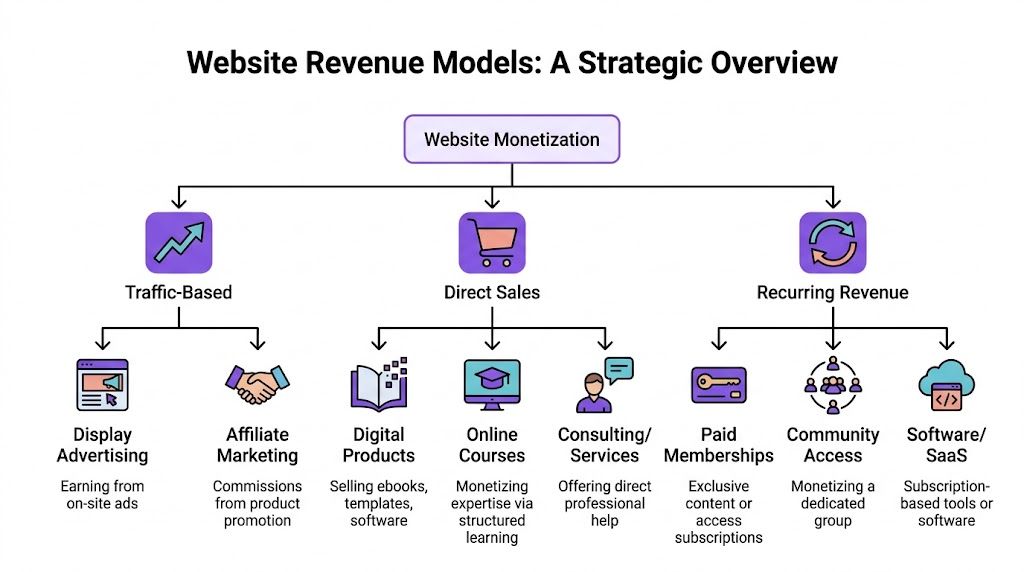
Traffic-based models
These models make money because people visit your site in volume.
Display advertising means you place ads on your pages and earn based on impressions or clicks. This is the classic publisher model. It works best when your content attracts broad search traffic and readers don't need a deep trust relationship before you monetize.
Affiliate marketing pays you a commission when readers buy through your referral links. This fits review content, tutorials, comparisons, and recommendation-heavy niches.
The upside is simple entry. The downside is dependence on traffic and external programs.
Direct sales
This monetization method warrants more attention from many serious creators. Instead of monetizing attention indirectly, you sell something you own.
That can include:
- Digital products: e-books, templates, playbooks, guides, downloads
- Online courses: structured lessons built around a transformation
- Consulting or services: direct expertise sold to a client
Direct sales usually create better margins and stronger brand control because the customer buys from you, not because an ad network or merchant allowed you to participate.
Recurring revenue
This bucket turns one-time buyers into ongoing customers.
A recurring model can include:
- Paid newsletters
- Memberships
- Private communities
- Software or SaaS
The operational logic here is different. You're not just making a sale. You're maintaining a relationship that has to stay useful over time.
The strongest model isn't the one with the most hype. It's the one your audience understands quickly and can buy with minimal friction.
A practical way to choose
If you're unsure where to start, use this cheat sheet:
| Model | Best for | Main challenge |
|---|---|---|
| Ads | High traffic publishers | Scale requirement |
| Affiliate links | Trusted recommendations | Reliance on external offers |
| Digital products | Experts with repeat questions | Packaging knowledge clearly |
| Courses | Educators and specialists | Delivery and student experience |
| Memberships | Ongoing value creators | Retention and engagement |
| Communities | Niche audiences with shared goals | Moderation and structure |
Not everyone requires all of these. They need one core model and one sensible complement.
Monetizing High Traffic with Ads and Affiliate Links
Traffic-based monetization looks attractive because it seems simple. Publish content, get visitors, add ads or links, and let the site earn while you sleep. That's the pitch. However, it's harder than it seems.
Display advertising is common because it's easy to activate. According to Coursera's overview of how websites earn money, Google AdSense pays publishers about 68 percent of ad revenue, and sites with 1.5 million to 10 million monthly pageviews typically generate between $3,000 and $20,000 per month from ads, while a site may need approximately 50 million monthly visitors to earn substantial income from ads alone. That's the core problem. Ads are a scale game.

If you're learning the affiliate side specifically, this walkthrough on how to make an affiliate link is a useful practical reference.
How ads actually work
Two common ad mechanics matter:
- PPC: pay per click. You earn when someone clicks an ad.
- CPM: cost per mille. You earn based on ad impressions.
On paper, this sounds clean. In practice, ad income depends on niche quality, traffic volume, user geography, session depth, and whether advertisers value your audience. Finance and technology audiences can command stronger rates than broad low-intent traffic, but the operational problem doesn't change. You still need a lot of attention flowing through the site.
Why affiliate marketing feels better than ads
Affiliate marketing often converts better than display ads because it fits user intent. Someone reading a product comparison, a tutorial, or a buying guide is closer to a decision. A well-placed recommendation can outperform generic banners because it feels relevant.
It also preserves more control over how your page looks. Ads clutter pages. Affiliate links can live naturally inside content.
Amazon typically offers around 4 percent commissions for affiliates, based on the verified data above. That's workable as a side stream. It's not a strong foundation unless you have either significant traffic or a niche where recommendations carry unusual buying power.
The hidden operational costs
The conversation around ads and affiliates usually focuses on revenue. That misses the part that hurts creators later. These models create content pressure.
To keep traffic-based monetization healthy, you usually need to keep doing some combination of the following:
- Publishing frequently: Traffic decays when content slows down.
- Maintaining rankings: Search positions shift, and old pages need updates.
- Optimizing placement: Ad locations, affiliate calls to action, and page layouts all affect performance.
- Protecting user experience: Too many monetization elements make your brand feel cheap.
This is why I rarely recommend building an expert business around ads first. It pushes you toward maximum pageviews instead of maximum value.
Practical rule: Use ads and affiliate links as support revenue, not as the center of an expertise business.
When this model makes sense
Traffic-based monetization is still valid in a few cases.
It works well when you run a media-style site, publish broad informational content, or have review-heavy articles that attract search traffic at scale. It also fits businesses that want to monetize free content before introducing paid offers.
But if you're an expert with a defined audience, ads and affiliate links are usually the shallow end of the pool. They monetize attention that you worked hard to earn, then hand most of the economics to someone else.
Selling Your Expertise Through Digital Products and Courses
A creator spends weeks publishing free advice, builds a loyal audience, then loses momentum trying to bolt together checkout tools, course hosting, email access, and customer support. That is the primary obstacle with digital products. Revenue potential is strong, but operations decide whether this model stays profitable.
Selling expertise works because it turns repeated advice into a product people can buy on demand. An accountant can sell a tax checklist. A designer can sell templates. A coach can package a method into a course. A consultant can turn repeat client questions into a paid resource. Done well, your site stops acting like a content warehouse and starts acting like a sales system.

If you are still shaping the offer, this guide on what counts as a digital product will help you define what you can sell.
Why expertise products produce better economics
The margin profile is usually better than traffic-based monetization because you are selling a result, not renting out attention. Analysts at I Will Teach You To Be Rich on how websites make money found that digital products let creators avoid the heavy traffic requirements of ad models and can produce much stronger revenue per engaged visitor.
That advantage only holds if delivery is efficient.
A digital product business still needs clear positioning, persuasive sales pages, and proof that the offer works. It also needs operations that do not eat the margin. If every sale triggers manual emails, access issues, invoice work, or refund friction, the business becomes harder to run than it should be.
What sells best online
The strongest offers usually do one of three things well:
- Save time: templates, checklists, swipe files, shortcuts
- Reduce uncertainty: guides, frameworks, implementation plans
- Build a skill: courses, workshops, structured learning libraries
Short products work when buyers want speed. Courses work when buyers need a sequence, examples, and accountability. Bundles work when your audience wants both a quick win and a deeper system.
If you are comparing software options, LinkJolt's roundup of best platforms to sell digital products is useful because it evaluates setup and selling requirements, not just feature lists.
The part creators underestimate
Direct sales look simple from the outside. The stack is not.
You need checkout, payment collection, file or lesson delivery, customer accounts, access control, support workflows, and reporting. Add subscriptions or payment plans, and the administrative load grows fast. Add courses, and now video hosting, lesson structure, progress tracking, and buyer permissions all matter. Every extra tool adds another failure point, another monthly fee, and another integration to maintain.
That is where creators give up margin. Not because the offer is weak, but because the system around the offer is fragmented.
Here is what the operation needs to handle well:
| Need | Why it matters |
|---|---|
| Checkout | Buyers abandon clumsy payment flows |
| Access control | Customers expect immediate delivery |
| Content hosting | Courses and downloads need reliable access |
| Pricing flexibility | Different buyers want one-time, recurring, bundle, or installment options |
| Analytics | You need to see where sales and engagement drop |
A short demo helps make this more concrete:
A better way to run this model
Serious creators should choose an integrated system early. Zanfia supports courses, paid newsletters, communities, knowledge libraries, subscriptions, e-books, and downloads under one login and custom domain. It includes 0 percent platform transaction fees, native video hosting, automations for access and customer flows, and invoicing connections with inFakt and Fakturownia. For creators selling in Poland, that matters because every disconnected tool adds cost, setup time, and support overhead.
The recommendation is simple. Package expertise into a product people can use quickly, then run it on infrastructure that keeps delivery, billing, and access in one place.
That is how digital products stay profitable.
Building Recurring Revenue with Memberships and Communities
One-time sales are good. Recurring revenue is better because it changes how stable the business feels month to month.
When someone buys a course, you earn once unless you sell them something else. When someone joins a membership, a paid newsletter, or a community with ongoing value, the relationship can keep producing revenue without forcing you back to zero each month. That's why recurring models are so attractive for experts with a clear niche.

What people actually pay for repeatedly
People don't pay every month for "content" in the abstract. They pay for one of these:
- Ongoing guidance: regular analysis, recommendations, curated updates
- Belonging: access to peers, discussion, accountability, support
- Fresh utility: new lessons, tools, templates, office hours, or expert commentary
- Convenience: everything they need in one organized place
This is why communities can be powerful. They combine information, accountability, and identity. A good community isn't just another content folder. It's a reason to stay engaged.
Why external communities weaken the business
A lot of creators make the same mistake. They sell on one platform, teach on another, and host the community in Discord or Facebook Groups. That setup can work at first, but it creates friction everywhere.
Customers ask where to log in. Discussions drift away from the core product. Branding becomes inconsistent. Searchability gets worse. Moderation gets harder. The more your value depends on interaction, the more damaging that fragmentation becomes.
A unified community model is stronger because the product and the conversation support each other. Someone buys a course, enters the related space, sees updates, asks questions, and stays inside the same environment. That's not just cleaner for users. It makes retention easier because the subscription becomes part of a habit.
Memberships create a moat
A digital product can be copied in broad form. A community can't be replicated so easily because the value comes from the people inside it, the norms, the archives, and the creator's ongoing presence.
That's why memberships often become the most defensible layer of an online business.
Consider the difference:
| Model | Customer experience | Business risk |
|---|---|---|
| Standalone course | Finish and leave | Revenue resets after each launch |
| Newsletter only | Read and forget | Harder to build peer connection |
| Community membership | Learn, discuss, return | Requires active structure and moderation |
A strong membership doesn't sell access to a chat room. It sells ongoing progress in a place members want to return to.
What to include in a recurring offer
Keep the structure tight. Most memberships get weak when creators add too much random content.
A solid recurring offer usually includes:
- A clear promise: what members get better at over time
- A regular rhythm: lessons, commentary, Q&A, prompts, or updates
- Organized spaces: topical channels beat one noisy feed
- Connection to products: courses, archives, and discussions should reinforce each other
If you already have an audience, recurring revenue is often the smartest second step after a first successful digital product. It raises lifetime value and reduces the pressure to chase constant new traffic.
Choosing Your Model and Measuring Success
Don't choose a monetization model because it's trendy. Choose it because it matches your audience behavior and your tolerance for operational complexity.
A tiny but engaged audience can support direct sales or memberships. A broad, low-intent audience often leans toward ads or affiliate links. A niche expert with repeat questions should usually package expertise first and layer recurring revenue second.
A simple decision framework
Use these four filters.
Audience size
If your traffic is large and broad, traffic-based models can contribute. If your audience is smaller but trusts you, direct sales usually make more sense.Audience intent
Readers looking for general information behave differently from buyers looking for a transformation. Transaction intent matters more than raw reach.Content type
Tutorials and reviews fit affiliates. Step-by-step teaching fits courses. Ongoing analysis fits newsletters or memberships.Operating style
Some people want a media business. Others want a lean expertise business. Those are not the same machine.
What to measure for each model
Vanity metrics waste time. Use metrics that connect directly to money.
| Model | Metrics that matter |
|---|---|
| Ads | CPM, RPM, quality of traffic |
| Affiliate links | Click-throughs, conversion by content type, commission mix |
| Digital products | Conversion rate, average order value, refund patterns |
| Courses | Sales conversion, completion behavior, upsell paths |
| Subscriptions | Monthly recurring revenue, churn, retention signals |
| Communities | Engagement quality, renewal behavior, offer expansion |
You don't need perfect analytics from day one. You do need enough visibility to see where buyers stall.
Why first-party data matters
The biggest platforms make money by understanding user behavior and acting on it. Smaller creators can use the same principle without becoming invasive. Verified data from Numerous on first-party data monetization notes that analyzing user behavior inside a course or community platform can help personalize upsell funnels and communications, with industry benchmarks showing conversion boosts of 20 to 30 percent.
That doesn't mean you need surveillance tactics. It means you should pay attention to what your own customers do.
Examples of useful first-party signals include:
- Course progress: who started, paused, or finished
- Community activity: who reads, posts, or disappears
- Offer behavior: which pages get interest but not purchases
- Content affinity: which topics pull the strongest response
My recommendation by creator type
If I were advising creators in a working session, I'd keep it blunt.
- New expert with a small audience: Start with one direct digital product.
- Established educator: Build a course, then add recurring access around it.
- Media-heavy publisher: Use affiliate links first, ads second.
- Consultant aiming for greater impact: Productize the most repeated advice before scaling services.
Don't optimize the wrong model. A better checkout won't fix an offer that should've been a membership, and more traffic won't fix a site that should've been selling expertise directly.
The right model feels simpler over time, not heavier.
The Modern Creator's Solution Unifying Your Business with Zanfia
Most monetization advice ignores operational drag. That's a mistake.
A creator can assemble a business from separate tools. One service for checkout. Another for courses. Another for community. Another for email. Another for invoicing. Another for analytics. It works, technically. It also creates more maintenance, more support questions, more design inconsistency, and more chances for the customer experience to break.
The alternative is a unified system. If you want a practical view of what that kind of setup looks like, this guide to a platform to sell digital products is worth reading.
What a unified stack actually changes
The biggest benefit isn't convenience for its own sake. It's margin protection and execution speed.
When one platform handles product pages, payments, content delivery, subscriptions, access logic, and community, you remove a surprising amount of invisible work. That matters whether you're a first-time creator or already earning serious money.
Key operational wins include:
- Zero platform transaction fees: Zanfia charges 0 percent platform fees on customer sales. Creators keep their revenue, with only payment operator fees applying.
- Native video hosting: Course delivery doesn't require bolting on a separate video tool.
- Single login experience: Courses, community, newsletters, and products can live under one account and one domain.
- Automations: Access grants, welcome emails, subscription renewals, and revocations can run automatically.
- Administrative cleanup: Invoicing can connect with inFakt and Fakturownia.
The time savings matter too. Zanfia's automation features can save 5 to 10+ hours per month, according to the author brief. That's not a vanity perk. That's time returned to content, sales, and customer support that improves the business.
Why experienced creators move this way
Once creators cross from side project into serious business, they stop caring about flashy hacks. They care about reliability, margin, and brand control.
That explains why the platform gets strong praise from established Polish creators and operators. Artur Kurasiński calls it “the most convenient and simplest solution for paid newsletters, courses and community on the Polish market”. Wojciech Pisarski says, “Without Zanfia, developing a paid newsletter and community in Poland would be much harder, it’s the best tool in the market”.
Those quotes matter because they speak to the core issue. Serious creators don't need more software. They need fewer moving parts.
The business logic is simple
If your monetization model depends on direct sales, recurring access, or both, then fragmented infrastructure taxes every part of the business. It taxes time. It taxes conversion. It taxes support. It taxes brand perception.
A unified platform doesn't create demand for a weak offer. Nothing does. But it does remove operational friction that steals profit from a strong offer.
Your First Steps to Monetization A Creator's FAQ
Do I need a big audience before I sell anything?
No. You need a clear problem and a useful offer. A small, specific audience often buys faster than a large unfocused one.
Should I start with ads, affiliate links, or my own product?
If you're an expert, start with your own product. Ads and affiliate links can complement the business later, but direct offers give you more control and a better customer relationship.
How much content do I need before launching?
Enough to prove you understand the problem and can explain the solution clearly. That could be a handful of strong articles, a focused email list, or a small library of helpful posts. You don't need a giant archive.
Can one website use multiple monetization models?
Yes, but don't stack everything at once. A sensible sequence is direct product first, recurring offer second, and support revenue like affiliate links only where it fits naturally.
What if I'm overwhelmed by the setup?
Then reduce moving parts. Most launch paralysis is really tool paralysis. Pick one platform, one offer, and one sales path. Complexity doesn't make you look established. It usually just slows you down.
Is it smart to study how other platforms monetize?
Yes, if you study the mechanics instead of copying surface tactics. For example, this breakdown of how Kickstarter makes money is useful because it shows how platform economics differ from creator economics.
What's the lowest-risk first offer?
A focused digital product. It can be smaller than a full course, easier to launch, and easier to validate. Once buyers respond, expand into a course, paid newsletter, or membership.
If you're ready to turn expertise into a cleaner digital business, Zanfia gives you one place to sell products, run courses, build a paid community, manage subscriptions, and keep your brand under your own domain without platform transaction fees.


