

How to Price an Ebook in 2026: A Data-Backed Guide

Pricing an ebook in 2026 is trickier than it looks. Set the price too low and readers assume the content is thin. Set it too high and they bounce before they even skim the table of contents. The real challenge isn’t picking a number, it’s picking the right number for the right buyer in the right sales channel.
This guide walks through the data behind ebook pricing this year, the difference between marketplace and direct-sale economics, how to price by ebook type, and the strategies that actually move sales without gutting your margins. If you’re publishing on Amazon, that’s one game. If you’re selling a $47 problem-solving guide from your own site, that’s another game entirely.
How Much Should You Charge for an Ebook?
The short answer: it depends on where you’re selling, what problem your ebook solves, and who’s buying. The long answer requires understanding that there is no universal ebook price. There are ebook price ranges, and each range corresponds to a specific buyer psychology.
Here’s the honest breakdown of what real ebook buyers pay in 2026:
- Fiction (marketplace): $0.99 to $9.99, with the sweet spot for indie authors between $2.99 and $5.99.
- Nonfiction and how-to (marketplace): $4.99 to $14.99, occasionally pushing into $19.99 for niche expertise.
- Direct-sale problem-solving guides: $19 to $97, with premium resources going as high as $197.
- Business and professional ebooks (direct): $47 to $297 when bundled with templates, worksheets, or community access.
Why the enormous range? Because a $2.99 romance novel and a $97 lead-generation playbook are not the same product. They’re not even in the same category. One is entertainment sold on impulse. The other is a business tool sold as an investment. Treating them the same is the number-one pricing mistake indie authors make.
The pricing question you should actually be asking is: What is my reader buying? Are they buying entertainment for an afternoon? Buying a solution to a problem that’s costing them money? Buying access to your expertise? Each answer points to a different price bracket.
The psychology of price perception
Pricing signals value. A $0.99 ebook signals disposable content. A $47 ebook signals a serious resource. Readers unconsciously calibrate expectations to the sticker price before they open the file. If your ebook overdelivers relative to its price, you get five-star reviews. If it underdelivers, you get refund requests, even if the content is objectively good.
According to research from Harvard Business Review on pricing and the psychology of consumption, buyers who pay more are also more likely to consume and act on what they purchased. That has direct implications for ebook authors: a $47 guide that gets read and applied builds your reputation. A $2.99 guide that gets downloaded and forgotten builds nothing.
Marketplace Pricing vs Direct-Sale Pricing ($2.99 vs $47)
This is the single biggest fork in the road for ebook authors, and most guides skip it entirely. Where you sell your ebook determines what you can charge. It’s not a preference, it’s a mechanical constraint of the platform.
The Amazon Kindle ceiling
Amazon’s Kindle Direct Publishing (KDP) offers two royalty tiers: 35% and 70%. To qualify for the 70% royalty, your ebook must be priced between $2.99 and $9.99. Below $2.99 or above $9.99, you drop to 35%. That single rule has shaped indie ebook pricing for over a decade. It’s why so many nonfiction ebooks land at $9.99. Not because that’s the optimal price, but because it’s the ceiling for the better royalty rate.
The result: Amazon has an invisible price ceiling of about $9.99 for most ebooks. Yes, you can price higher. No, most buyers won’t pay it, because Amazon has trained them to expect ebooks to cost less than a paperback. On Amazon, a $47 ebook looks broken.
Other marketplaces (Apple Books, Kobo, Barnes and Noble) follow similar patterns. They optimize for volume across millions of titles, not for premium single-author pricing. If you sell there, you play by their rules.
The direct-sale advantage
When you sell your ebook from your own website, the marketplace price ceiling disappears. There is no algorithm ranking you against 40,000 other books in your category. There is no shopper comparing your $9 guide to a competitor’s $5 guide two rows down. There is you, your reader, and your sales page. That changes everything.
Direct-sale ebook prices routinely hit $47, $67, $97, and higher, especially when the ebook solves a specific business problem. According to publishing insights from IngramSpark onhow to price your book, authors who position their work as a professional resource rather than a consumer product can command significantly higher prices than marketplace equivalents.
The tradeoff is traffic. Amazon sends you buyers automatically. Your own website does not. So the direct-sale model only works if you have (or are building) an audience: a newsletter, a social following, a paid ad channel, or a referral engine. If you’re a total unknown with zero audience, Amazon is a legitimate way to start. Just don’t confuse “starting on Amazon” with “maximizing revenue.”
The both-and strategy
Smart ebook authors do both. They publish a shorter, entry-level version on Amazon at $9.99 as a lead magnet and reputation builder. Then they sell the full, expanded version directly on their site at $47 or more, bundled with worksheets, templates, or a small community. Amazon becomes discovery. Direct sales become the profit engine.
Selling direct on Zanfia removes the marketplace price ceiling entirely. A problem-solving guide can be priced at $47 or $97 without being capped at $9.99. Cart 2.0 supports one-time payments, installments, discount codes, and order bumps, so you can split a $297 bundle into three payments of $99 or bolt a $27 template pack onto checkout without paying platform commission. That’s the mechanical difference between selling on someone else’s real estate and owning your own. And because Zanfia is built as an AI team for creators, with an assistant you can dictate to by voice and an MCP endpoint your own agents can plug into on higher plans (see the current Zanfia pricing), the checkout you launch today is one you can keep tuning by conversation rather than menu-diving.
Pricing by Ebook Type: Fiction, Guides, and Premium Resources
Ebook type is the second biggest pricing variable, right after sales channel. A blanket price like “charge $9.99” ignores the fact that different types of ebooks have wildly different buyer expectations.
Fiction ebooks
Fiction is the toughest category to price high, especially for new authors. Readers have infinite alternatives, and their default frame is entertainment cost per hour. If a Netflix subscription is $15 a month for hundreds of hours, a $14.99 ebook needs to justify itself as an experience.
Typical fiction pricing:
- New indie author, first book: $0.99 to $2.99. The goal is downloads, reviews, and audience.
- Established indie author, single title: $3.99 to $5.99.
- Series pricing: Book 1 at $0.99 or free, subsequent books at $4.99 to $6.99. This is the standard “loss leader” model.
- Established traditional publishers or bestsellers: $7.99 to $14.99, sometimes higher.
Fiction pricing is a volume game. Authors who make real money on fiction ebooks usually have a catalog of 5 to 20 titles and rely on backlist sales to a loyal reader base.
Guides and how-to nonfiction
This is where pricing starts getting interesting. A how-to ebook that solves a real, specific problem can be priced far higher than fiction, because buyers are paying for a solution, not entertainment.
Typical guide pricing:
- General how-to on Amazon: $4.99 to $14.99.
- Niche how-to on Amazon: $9.99 to $19.99, if the topic is specific and underserved.
- Problem-solving guide sold direct: $19 to $47, depending on the problem’s dollar value.
- Business/professional guide sold direct: $47 to $197.
The key phrase there is the problem’s dollar value. A guide that helps a freelancer land a $5,000 client is worth $47. A guide that helps a small business owner add $10,000 a month in revenue is worth $297. Buyers do not resist premium prices for problems that are actively costing them money.
Premium resources and bundles
The top of the ebook pricing pyramid is not really an ebook anymore. It’s a resource package: the ebook plus templates, worksheets, spreadsheets, checklists, video walkthroughs, or a small private community. These bundles routinely sell for $97 to $497 and, in specialized B2B niches, up to $997 or more.
The pricing logic here isn’t “what’s the ebook worth?” It’s “what’s the transformation worth?” A $497 bundle that helps a coach land three high-ticket clients has already paid for itself ten times over. The ebook is the delivery format. The transformation is the product.
Fiction versus nonfiction: a real pricing comparison
Consider two authors: Sarah writes cozy mysteries and prices her books at $4.99 each. She earns roughly $3.40 per sale after Amazon’s 70% royalty. To make $10,000 in a month, she needs about 2,942 sales.
Now consider Marcus. He wrote a 45,000-word guide on running paid Facebook ads for local service businesses. He sells it direct at $97 with a $37 order bump for his ad-copy template library. His average order value is around $115. He earns close to $110 after payment processing. To make $10,000, he needs about 91 sales.
Same effort in writing. Same effort in production. Radically different pricing potential because of category and channel.
Launch Pricing, Discounts, and Anchor Offers
Once you know your baseline price, the next question is how to structure your launch and ongoing promotions without training buyers to only buy on discount.
The launch price
A launch price should be your real price, discounted by 20% to 40% for a limited window (typically 3 to 7 days). This does two things: it rewards early buyers, and it creates urgency for anyone on the fence. Both are proven conversion drivers.
Do not launch at your baseline and then discount later. That trains your list to wait. Launch discounted, then raise to full price when the window closes. If your ebook’s real price is $67, launch it at $47 for 5 days, then move to $67.
Anchor pricing
Anchor pricing is the practice of showing a higher “reference” price next to your actual price so the actual price feels like a bargain. Marketers have used this for a century because it works.
For ebooks, anchor pricing looks like this:
- Bundle version: $147 (the anchor)
- Ebook plus templates: $97 (recommended)
- Ebook only: $47
Even if 80% of buyers pick the middle option, the $147 anchor makes that middle option feel like a smart deal. Without the anchor, the same $97 offer feels expensive. This is one of the most reliable pricing tricks in digital publishing.
Discount codes and coupons
Discount codes are useful, but they need boundaries. Reserve them for specific reasons: a partner promotion, a newsletter reward, a Black Friday campaign, a cart-recovery offer. If you email a 40% off code every two weeks, your baseline price becomes fiction. Buyers will simply wait for the next email.
A healthy discount rhythm looks like this: two to four major promotions per year (launch, Black Friday, end-of-year, midyear), plus targeted partner codes as opportunities arise. That’s it. If your ebook isn’t selling at full price, the problem is rarely the price. It’s the sales page, the audience, or the offer structure.
Order bumps and upsells
Order bumps are the highest-leverage pricing move in ebook sales, and most authors ignore them. An order bump is a small add-on offered at checkout, usually for $10 to $47, that complements the main ebook. Think: a template pack, a checklist, a printable workbook, an audio version.
Industry benchmarks suggest order bumps convert at 20% to 40% when they’re relevant and reasonably priced. On a $67 ebook with a $27 order bump converting at 30%, your average order value climbs to $75.10. That’s an 12% revenue lift with zero additional traffic, just a checkbox at checkout.
Zanfia’s Cart 2.0 supports order bumps natively with separate invoicing per add-on, along with subscription upsells if you want to offer ongoing access to a community or a paid newsletter alongside the ebook. Combined with discount codes and multi-quantity offers (useful for team licenses), you can test price points and offer structures without paying platform commission on any of it. You can even open the whole checkout in test mode first, buying your own product end to end before a single ad dollar hits the page.
Value-Based Pricing for Solution Ebooks
If your ebook solves a specific, measurable problem for a specific audience, ignore everything you’ve read about “average ebook prices.” You are not selling an ebook. You are selling a business tool, and the price should reflect the value of the outcome.
The 10x rule
Value-based pricing has one simple heuristic: your buyer should get at least 10x the value they paid. If your ebook helps a solo consultant win one $2,500 client, a $250 price is entirely defensible. If it helps a Shopify store add $20,000 in revenue over a quarter, $2,000 is defensible. The math anchors on the outcome, not on the file size.
This is uncomfortable for authors who’ve spent years in the fiction pricing world where $9.99 is the ceiling. But Kit’s data on creator pricing shows repeatedly that creators who anchor prices on outcomes earn more per customer while simultaneously attracting more serious, engaged buyers. Cheap prices attract cheap customers. Premium prices attract customers who show up and do the work.
Identifying your outcome
To price on value, you need to name the outcome specifically. “My ebook helps you grow your business” is not an outcome. “My ebook helps freelance designers add 3 to 5 retainer clients in 90 days” is an outcome. The second is priceable. The first is not.
Run this exercise: finish the sentence “After reading and applying this ebook, my reader will be able to __ within __ days/weeks.” If you can’t fill both blanks with specifics, your positioning isn’t tight enough for value-based pricing. Go back and narrow the promise.
Case study: two ebooks, same author
Consider an author who wrote a 25,000-word guide on cold email outreach. Version A was titled “The Cold Email Handbook” and priced at $19. It sold decently, maybe 100 copies a month.
The author repackaged it as “How B2B Consultants Can Land 3 Discovery Calls a Week Using Cold Email” and priced it at $147. Same content, tighter positioning, higher price. It sold 40 copies a month. Revenue went from $1,900 to $5,880. Same author. Same file. Positioning and pricing did the entire lift.
Testing and Adjusting Your Price Over Time
Pricing is never “set and forget.” Markets shift, audiences evolve, and what worked in year one won’t necessarily work in year three. Build a habit of reviewing your ebook pricing every quarter, not every year.
What to measure
Three metrics matter most for ebook pricing decisions:
- Conversion rate: What percentage of sales page visitors buy? If it’s under 1%, the sales page or price is off. If it’s above 4%, you might be underpriced.
- Refund rate: What percentage request their money back? Above 5% suggests price and content are misaligned. Under 2% means you’re delivering value.
- Average order value: What’s the actual revenue per customer including bumps and upsells? A rising AOV means your offer structure is improving.
You want conversion rates and AOV going up, refund rates staying low. If you raise your price and conversion drops but AOV rises significantly, the higher price is usually the right move.
A/B testing prices
Split-testing prices requires enough traffic to reach statistical significance. If you’re getting under 500 sales page visitors a month, forget it. Test copy, headlines, and testimonials instead. Save price testing for when you have real volume.
When you do test, change one variable at a time. Test $47 versus $67 with identical sales pages, same traffic sources, same time window. Don’t test $47 versus $97 with different bundles. That’s not a price test. That’s an offer test.
Raising prices with existing customers
Raising prices is normal and healthy. What’s not normal is ambushing existing customers with sudden increases. If you’re going up from $47 to $97, tell your list first. Give them a 48-hour window at the old price. This creates urgency (revenue), rewards loyalty (goodwill), and prevents backlash (reputation).
For subscription products or memberships that include your ebook, grandfather existing subscribers at their current rate. New buyers pay the new price. This is standard SaaS practice, and it works for creator products too.
How Zanfia helps authors sell ebooks
Zanfia is an AI team that runs a creator business, and a platform second. You get an assistant that knows the whole interface and can act on it by chat or by voice, an MCP endpoint that lets your own AI agents plug into your workspace on higher plans, and a branded storefront under your custom domain where the ebook actually lands. Platform commission on customer sales is 0% under the current model, so only the payment processor takes its standard cut.
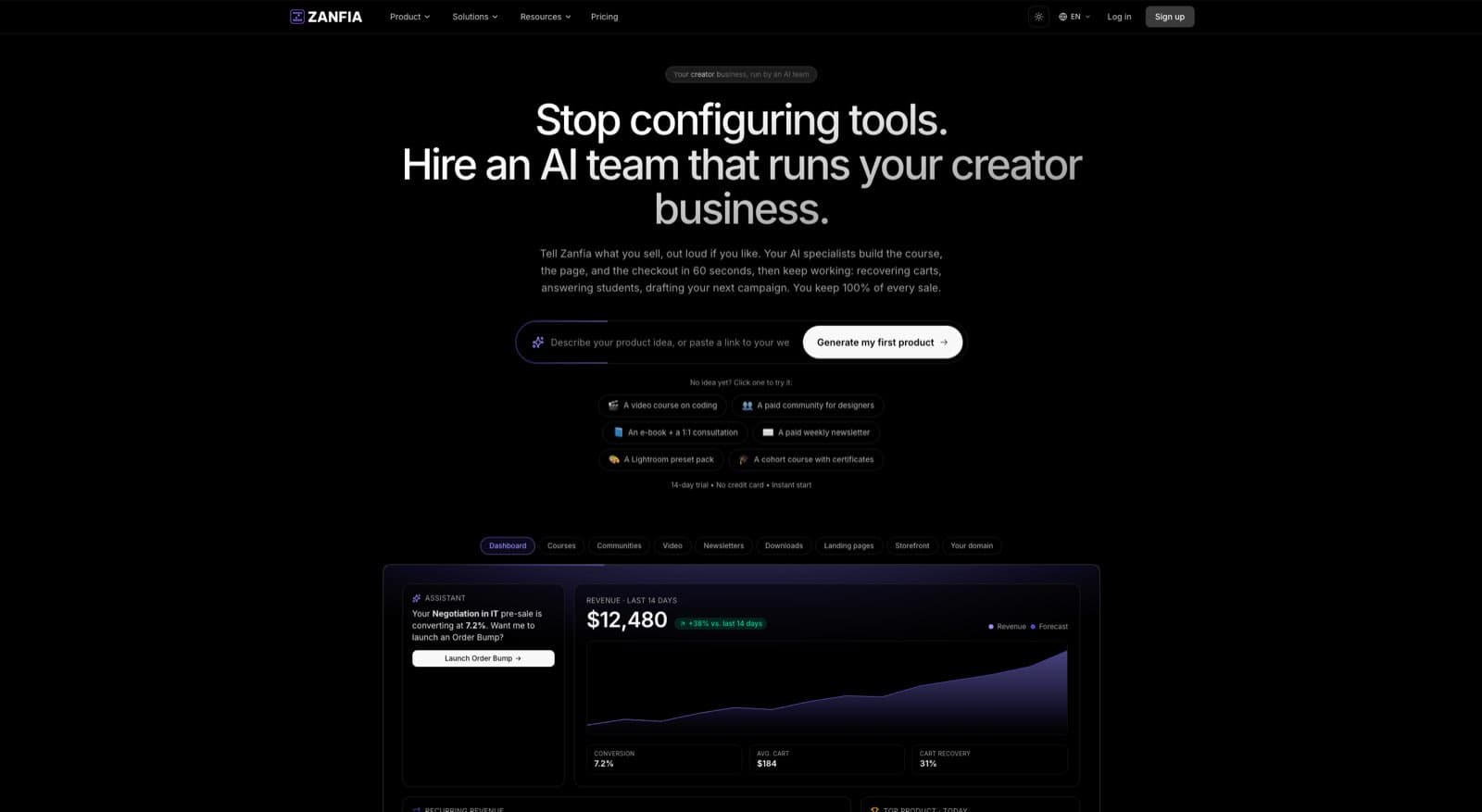
Here’s what that means practically for ebook pricing:
No marketplace price ceiling
Because you’re not competing inside someone else’s marketplace, you can price a solution ebook at $47, $97, or $297 based on the value of the outcome, not the algorithmic average of your category. The ceiling is set by your positioning, not by a royalty tier.
Flexible pricing structures
Cart 2.0 supports one-time payments, installments (for higher-ticket bundles), free trials, discount codes, and multi-quantity purchases (useful for teams or corporate buyers). If you want to sell a $297 ebook bundle as three payments of $99, you can. If you want to run a 30% off launch code for your newsletter, you can. You can dictate the whole change to the assistant instead of clicking through settings, and none of it costs platform commission.
Order bumps and subscription upsells
At checkout, you can offer a $27 template pack as an order bump alongside the main ebook. You can also offer a subscription upsell such as ongoing access to a paid newsletter, a community, or a knowledge base. Because Zanfia carries twelve product types under one brand, the ebook doesn’t sit in isolation. It sits alongside your other products, feeding your longer-term audience. Order bumps and upsells are packaged with the higher plans, so check the current Zanfia pricing to see what unlocks where.
Test mode before you launch
Before you send your first ad, open the checkout in test mode and buy your own ebook end to end. Conversion events fire to the test surfaces of your connected platforms and are tagged TEST in the events log, so live analytics stay clean while you verify that the price, the order bump and the thank-you flow all work exactly the way you promised on the sales page.
Payment processing
Cart 2.0 uses Stripe and PayPal for payment processing, with Apple Pay and Google Pay support built in. Buyers get the checkout experience they expect from any modern digital purchase, on desktop or mobile.
Community and newsletter integration
If you eventually want to expand from selling a single ebook to running a paid community or newsletter around your expertise, you don’t have to migrate platforms. Communities, paid newsletters, and knowledge bases are all built into Zanfia, so your ebook can become the front door to a larger creator business.
If you want to see how it fits together for your specific ebook, you can explore Zanfia’s pricing and features here. Every plan starts with a 14-day free trial, no credit card required, so you can build out a storefront and test your pricing structure before committing to a paid tier.
FAQ
What is the average price of an ebook in 2026?
The average marketplace ebook price sits between $4.99 and $9.99. Direct-sale ebooks average significantly higher, typically between $27 and $97, depending on the ebook’s category and audience.
Is $9.99 a good price for a Kindle ebook?
For most nonfiction ebooks on Amazon, yes. It’s the top of the 70% royalty range, which means you keep about $6.99 per sale. Fiction usually sells better between $2.99 and $5.99.
Can I really sell an ebook for $47 or more?
Yes, but only if two conditions are met: you’re selling direct on your own website (not a marketplace), and your ebook solves a specific, valuable problem. Fiction and general how-to books rarely support this pricing. Business, professional, and problem-solving guides frequently do.
Should I offer discounts on my ebook?
Yes, but strategically. Launch with a 20% to 40% discount for 3 to 7 days, then move to full price. Run two to four major promotions a year (Black Friday, launch anniversary, etc.). Avoid frequent discounting, which trains buyers to wait.
What’s the best price for a first-time author?
If you’re selling fiction on Amazon with no audience, start between $2.99 and $4.99. If you’re selling nonfiction with even a small audience (newsletter, social following), start at $9.99 on Amazon or $27 to $47 on your own website. The audience matters more than the category.
How do I know if my ebook is priced too low?
Three signals: conversion rates above 4% (you’re leaving money on the table), buyers asking “is that all?” in feedback, and no refund requests at all (usually means the price is so low the stakes feel trivial). If you see any of these, test a 30% to 50% price increase.
Should I use anchor pricing?
Yes. Show three options: a basic version, a recommended middle tier, and a premium bundle. Most buyers will pick the middle option, but the premium bundle makes the middle feel like a bargain. This is one of the most reliable revenue-lift techniques in ebook sales.
How often should I raise my ebook prices?
Review every quarter. Raise prices when your conversion rate has stabilized above 2%, your refund rate is under 3%, and you’re adding value (new bonuses, testimonials, updates). Small quarterly increases work better than large annual jumps.