

How to Run a Discovery Call That Closes 7 Out of 10 Prospects

Most coaches treat discovery calls like sales calls. That’s the first mistake. The best closers in the coaching industry treat them like medical consultations. A doctor doesn’t pitch surgery in the first thirty seconds. They diagnose. They ask questions. They earn the right to recommend treatment. That’s how you close 7 out of 10 prospects without sounding desperate or salesy.
If you’re closing 2 or 3 out of 10 right now, you don’t have a sales problem. You have a diagnosis problem. Your prospects are showing up confused about what they actually need, and you’re trying to sell them a solution before they’ve articulated the real pain. This guide walks through a framework that consistently produces 60-70% close rates for high-ticket coaches selling packages between $2,500 and $25,000.
Why most discovery calls fail (the diagnosis problem)
The average coaching discovery call follows a predictable script. The coach asks a few surface-level questions about goals, launches into a 20-minute pitch about their methodology, presents a price, then handles objections until the prospect either buys or escapes. Close rates with this approach hover around 15-25%, and the coaches who win are usually the ones with the loudest marketing, not the best framework.
The real problem is that prospects don’t buy coaching. They buy a specific outcome they believe they can’t get on their own. When you skip the diagnosis phase, you’re guessing at what they want. You end up pitching weight loss to someone whose real pain is the shame they feel in front of their kids. You pitch business strategy to someone whose actual block is imposter syndrome. The pitch lands flat because you didn’t connect to the real wound.
According to research published in Harvard Business Review on the end of solution selling, top performers don’t lead with their product. They lead with insight about the prospect’s situation that the prospect hasn’t fully articulated themselves. That’s the entire game in coaching sales: surface a pain the prospect couldn’t name, then position yourself as the only person who can guide them through it.
The diagnosis problem compounds because most coaches were trained by other coaches who also can’t sell. The industry recycles weak frameworks: “three-part close,” “value stack,” “urgency creation.” These tactics work on impulse buyers in low-ticket sales. They fall apart at $5,000+ where prospects need to feel deeply understood before they’ll commit.
The four reasons prospects don’t close
When you lose a discovery call, it’s almost always one of four reasons. They didn’t trust your competence. They didn’t believe the outcome was achievable for them specifically. They didn’t think the timing was right. Or they didn’t feel safe being vulnerable with you. Notice that price isn’t on this list. Price objections are almost always a cover for one of the four real reasons.
The 5-question framework that surfaces real pain
This framework borrows the diagnostic spirit of SPIN selling and the disqualification logic of the Sandler methodology. The structure: ask five questions in order, listen more than you talk, and don’t move to pricing until the prospect has articulated their pain in their own words. Your job in the first 30 minutes is to make them feel more understood than any other coach they’ve ever talked to.
Question 1: What made you book this call today, specifically?
Not “what brought you here” or “tell me about yourself.” The word “today, specifically” forces them to identify the trigger event. Was it a fight with their spouse? A failed launch? A health scare? The trigger event is the emotional core of the sale. Without it, you’re working with vague aspirations.
Listen for the language they use. If they say “I’ve tried everything,” they’re signaling frustration with past programs. If they say “I know what to do, I just can’t make myself do it,” they’re telling you it’s an execution problem, not an information problem. These are dramatically different sales.
Question 2: Walk me through what’s been happening over the last 6 months
This question expands the emotional landscape. You’re looking for patterns: failed attempts, broken commitments, relationship strain, identity confusion. Coaches who skip this question never understand the deeper context, so their pitch feels generic.
Don’t interrupt during this answer. Take notes. Let them ramble. The gold appears in the third or fourth minute when they get past their rehearsed answer and start telling you the truth. A research summary in Forbes Coaches Council on why listening drives sales notes that prospects who feel deeply heard are 3-4x more likely to convert than those who get talked at.
Question 3: What have you tried already, and what specifically didn’t work?
This is your competitive intelligence gathering. You learn what they’ve already spent money on, which approaches have failed them, and where the gaps are. It also surfaces the prospects who are program-hoppers, the ones who’ve taken 12 courses and never finished any of them. Those are the people you should be cautious about coaching.
When they describe what didn’t work, listen for accountability language. Do they blame the program, the coach, the curriculum? Or do they take ownership of where they fell short? Coaches close better and get better results with prospects who can name their own failures without spiraling into shame.
Question 4: If we work together for six months and nothing changes, what’s the cost to you?
This is the pain question. Most coaches skip it because it feels manipulative. It isn’t. It’s the question that makes the prospect feel the consequences of inaction in their own body, which is the only thing that makes them willing to invest serious money.
Sit in silence after you ask this. Don’t fill the space. The prospect will give you a polite answer first, then a real answer about 15 seconds later. The real answer is what you reference later when handling objections. “You mentioned earlier that if nothing changes in six months, your marriage is probably over. That’s what we’re solving here, right?”
Question 5: If this works, what does life look like 12 months from now?
End on the vision question. You’ve taken them into the pain; now bring them back to the possibility. This question lets them visualize the outcome in concrete detail, which makes the investment feel reasonable. Someone paying $10,000 to save a marriage and rebuild their identity isn’t paying for coaching. They’re paying for the version of themselves on the other side.
Pricing presentation: the anchor + reveal sequence
Once you’ve completed the diagnostic phase, you’ve earned the right to discuss the work. The mistake most coaches make is presenting price too early, before the prospect has consciously agreed that the problem is worth solving at scale.
Use the anchor + reveal sequence. Start by anchoring the cost of inaction (which they just told you in Question 4). “If your business stays where it is for another year, you’re looking at another $200,000 in lost revenue, roughly. That’s just the financial cost.” Then introduce the investment relative to that anchor. “My six-month program is $12,000.” The $12,000 feels small against the $200,000 anchor.
The three-tier reveal
If you have multiple offers, present them in descending order of price. Most coaching sales literature gets this wrong and recommends ascending order. Descending works better because the highest tier sets the anchor, and the middle tier (where most clients land) feels reasonable by comparison.
Tier 1: $25,000 for 12 months with weekly 1:1, voice messaging access, and quarterly intensives. Tier 2: $12,000 for 6 months with bi-weekly 1:1 and group coaching. Tier 3: $4,500 for 3 months with monthly 1:1 and self-paced curriculum. Whichever tier they pick, you’ve trained their brain that $12,000 is the “normal” coaching price, not the premium one.
The silence rule
After you state the price, shut up. The first person to talk loses. New coaches get nervous and immediately start justifying. “Now I know that sounds like a lot, but…” Don’t do this. Let the silence sit for as long as it takes. The prospect needs to process the number internally before they can respond honestly. If you fill the silence, you signal weakness about your own pricing.
Handling objections without dropping price
Price objections almost always mask a deeper concern. Your job isn’t to overcome the objection. Your job is to find the real concern underneath. Then you address the real concern, and the price objection dissolves on its own.
“I need to think about it”
This is the most common stall in coaching sales. The response: “Totally fair. When people tell me they need to think about it, it’s usually one of three things. Either you’re not sure I’m the right coach for you, you’re not sure this is the right time, or you’re not sure you can afford it. Which of those is closest?” Then you address whichever one they name.
If they name affordability, ask: “Walk me through how you usually make decisions about investments in this range.” You’ll learn whether they need to consult a spouse, see a payment plan, or wait for a specific revenue milestone.
“I need to talk to my spouse”
This isn’t actually an objection. It’s a legitimate process step for any household making a multi-thousand-dollar decision. Don’t fight it. Instead, equip them. “That makes sense. Most couples want to make this decision together. What concerns do you think your spouse will raise? Let’s prepare answers right now so you can have a productive conversation.”
You’re now coaching them through the spouse conversation. By the end, they’re emotionally committed and you’ve given them the language to defend the investment.
“It’s too expensive”
Never drop your price. The moment you negotiate down, you’ve taught the prospect that your pricing is arbitrary, which destroys trust. Instead, scope down. “I hear you. The full six-month program isn’t a fit right now. What if we started with a 90-day sprint focused only on the one outcome you need most? That’s $4,500.” You’ve preserved your pricing integrity while creating a smaller entry point.
“Can I have a payment plan?”
Yes, but charge for it. “Pay in full is $12,000. Three monthly payments is $13,500.” The premium for payment plans reduces no-pay risk on your end and rewards full-payment clients (who tend to be more committed anyway). According to consumer research summarized in Pew Research data on buy-now-pay-later usage, payment plan adoption has tripled since 2020, which means prospects increasingly expect this option. You can provide it without compromising margin.
When to walk away (the 30% you should not coach)
If you’re closing 7 out of 10, the other 3 should be people you actively disqualify. This is the hardest discipline to develop, especially when you’re hungry for revenue. But coaching the wrong clients destroys your business in three ways: they don’t get results (which kills your testimonials), they consume disproportionate emotional energy, and they refund or chargeback at higher rates.
Disqualifier 1: They want to be saved, not coached
Listen for victim language during Question 3. If they describe every past failure as someone else’s fault, they will describe their failure with you the same way. These prospects need therapy, not coaching. Refer them to a licensed therapist and politely decline.
Disqualifier 2: They can’t articulate a specific outcome
If after all five diagnostic questions they still can’t name what success looks like 12 months out, they’re not ready. Coaching requires the prospect to have at least a fuzzy picture of where they want to go. Vague aspirations like “I want to feel better” or “I want to figure out my purpose” rarely produce satisfying outcomes.
Disqualifier 3: They’re broke and pretending not to be
Money objections that come early and stay rigid usually mean the prospect genuinely can’t afford the program. Forcing a sale here is malpractice. They go into debt, they don’t do the work because they’re stressed about money, they refund or chargeback, and your reputation suffers. Be honest: “It sounds like the timing isn’t right financially. Let’s reconnect in 6 months when you’ve stabilized things.”
Disqualifier 4: They have unrealistic timeline expectations
If they want to lose 60 pounds in 90 days, build a $1M business from $0 in 6 months, or fix a 15-year marriage in 8 weeks, you can’t deliver. Either reset expectations on the call (and risk losing the sale) or pass. Coaching clients who expect miracles always end in disappointment.
Follow-up that doesn’t feel desperate
Most prospects don’t close on the first call. They close on the second or third touch. Your follow-up sequence determines how many of those undecided prospects eventually convert. Done right, follow-up adds 15-25 percentage points to your close rate.
The 24-hour recap email
Within 24 hours of the call, send a personalized email that recaps their pain (in their own words from the call), the outcome they want, and the specific path you’d recommend. This isn’t a sales pitch. It’s a free strategic plan, which positions you as generous and competent.
End with a soft CTA: “If this matches what you’re looking for, here’s the link to enroll. If you want to talk through any of it first, here’s my calendar.” Two paths, no pressure.
The 4-day check-in
If they haven’t replied, send a 2-sentence message on day 4. “Hey, just checking in. How are you feeling about everything we discussed?” That’s it. No urgency, no scarcity tactics. The simplicity signals confidence.
The 10-day value drop
If still no response, send something useful unrelated to selling. A podcast episode that addresses one of their concerns. An article you found. A 3-minute Loom video addressing a question they raised. This breaks the sales frame and rebuilds the relationship.
The 21-day decision request
Around three weeks out, send a clear final message: “I want to respect your time and mine. Are you in or out? Either answer is fine, but I need to know whether to keep a spot open for you.” Forcing a yes-or-no eliminates the limbo prospects who waste cycles without ever committing.
How Zanfia handles bookings and intake forms
One of the operational reasons coaches lose discovery calls isn’t the conversation itself. It’s the friction around it. Prospects book, then forget. They show up cold without context. They want to pay you and discover your booking link, intake form, and payment processor are three separate tools that don’t sync. By the time they navigate all that, half of them ghost.
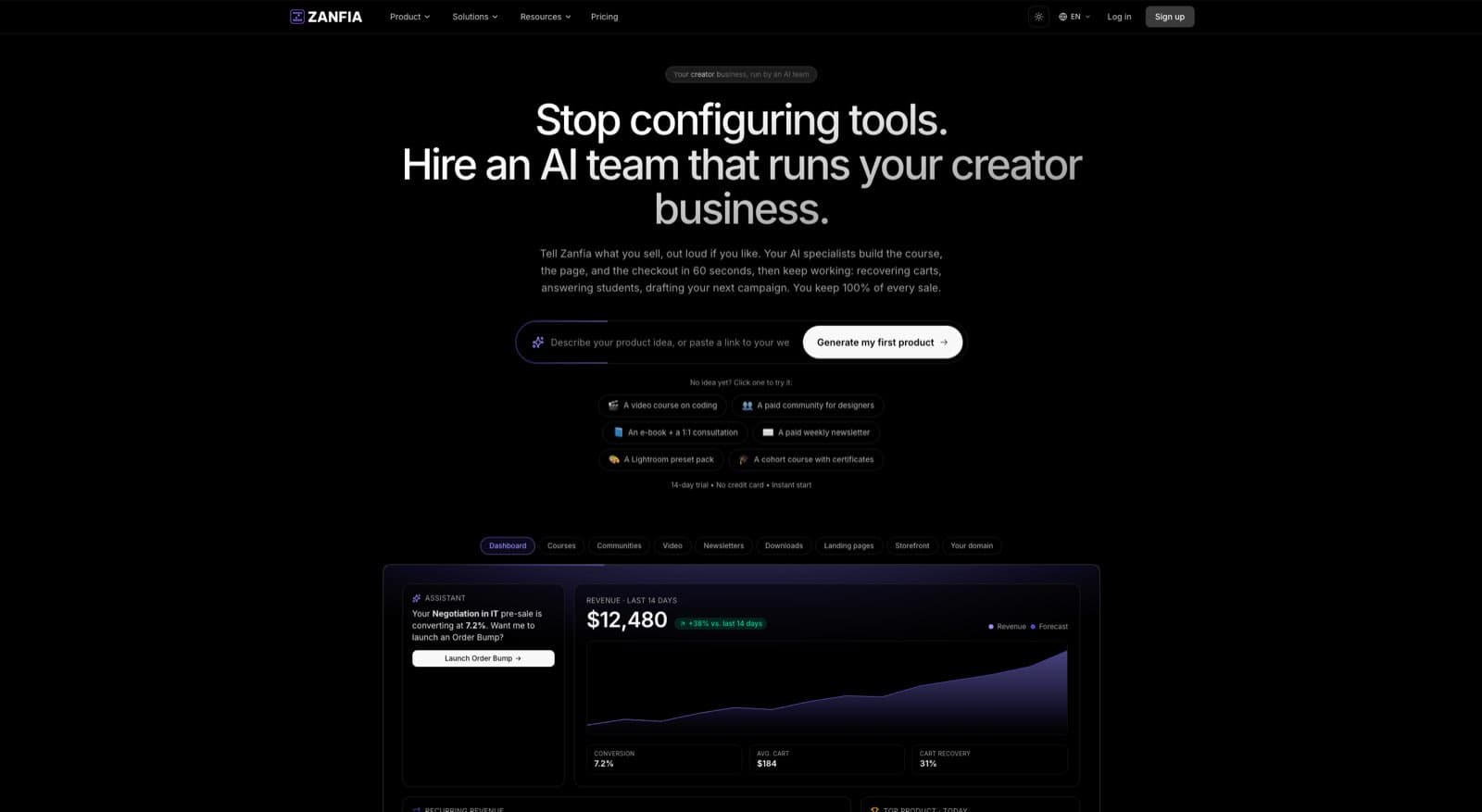
This is where Zanfia changes the workflow for coaches. Zanfia is an AI team that runs a creator business, and a platform second. Instead of clicking through settings, you tell the assistant what you need, by chat or by voice, and it performs the action inside the product. Bookings and consultations are on the roadmap and marked coming soon on the site; when they ship, prospects will schedule calls, complete intake forms, and pay you inside a single white-labeled flow under your own domain. By the time you read this it may already be available on your account, so check the current Zanfia pricing or your dashboard.
What this looks like in practice
You work on your own Zanfia subdomain, or map a custom domain. Today you can sell courses, communities, paid newsletters, digital products, ebooks, memberships and more under one brand; when the booking module launches, availability, call types and intake forms will live alongside them. Cart 2.0 handles payment with Stripe and PayPal, plus Apple Pay and Google Pay, and supports one-time charges, subscriptions and installments so a $600 program can be split into four payments at checkout.
Because Zanfia charges 0% platform transaction fees on customer sales (only the payment processor like Stripe takes its cut, roughly 2.9% + $0.30 in the US), you keep more revenue per booking compared to platforms that take 5-30% of every transaction. For a coach charging $300 per paid strategy call running 20 calls per month, that’s $720-1,800 saved annually versus typical commission-based booking platforms.
Intake forms that prep your discovery call
The five-question framework above works best when prospects have done some preparation. Once the booking module lands, an intake form on the booking page can ask them to write briefly about their current situation, what they’ve tried, and what success would look like. They show up to the call already in the diagnostic mindset, which compresses your first 10 minutes of fact-finding and lets you go deeper faster. In the meantime you can capture the same information through a checkout form on a paid strategy session or a signup form on a free consultation product.
Selling packages after the call closes
When the prospect commits on the call, you need to collect payment fast. Hesitation kills sales. With Cart 2.0, you dictate the offer to the assistant or configure it yourself, then send a checkout link that supports one-time payments, subscriptions, or installment plans (for the payment-plan close from earlier in this article), with order bumps and post-purchase upsells built into the same flow. Before you share the link, use test mode to buy your own product end to end so you know checkout and tracking fire correctly. The cart supports Stripe, PayPal, Apple Pay, and Google Pay for US-based coaches selling globally.
You can also bundle community access, course content, or downloadable workbooks with the coaching package. A common high-ticket structure: monthly 1:1 calls + access to a private community on Zanfia + a curriculum of pre-recorded modules + downloadable templates. All of this lives on your own white-labeled platform, so the prospect sees your brand, not the tool’s.
Mobile access for clients on the go
Coaching clients increasingly want to engage with their program on their phone. Zanfia’s native iOS and Android mobile app supports course content, paid newsletters, and knowledge bases, so your clients can review modules, read your weekly updates, and access reference materials between sessions without being chained to a laptop. Communities inside the app are rolling out per workspace.
If you want to see specific pricing or explore how Zanfia compares to stitching together Calendly, Stripe, Notion and Circle, the pricing page has current details. Plans start at $39/month, or $31/month billed annually, on Starter, with a 14-day free trial and no credit card required. One subscription, one platform, no commission on what you sell.
FAQ
How long should a discovery call be?
45-60 minutes for high-ticket coaching ($5,000+). Shorter calls don’t give you time to complete the five-question diagnostic and present pricing properly. Longer calls signal that you’re not respecting their time. Set the expectation in the booking confirmation so prospects block the full hour.
Should I offer free discovery calls or charge?
Free for prospects below $10,000 packages. Paid ($150-500) for packages above $10,000 or for established coaches with strong inbound demand. Paid discovery calls qualify hotter leads and reduce no-shows by 80%+, but they require a strong personal brand to fill the calendar.
What’s a realistic close rate for coaching discovery calls?
Beginners: 15-25%. Intermediate coaches with a framework: 35-45%. Experienced coaches with strong positioning and pre-qualified leads: 55-70%. The 7 out of 10 number in this article’s title is achievable for coaches with all three: a refined framework, a strong personal brand, and rigorous lead qualification before the call.
What if the prospect wants to negotiate the price?
Hold the line on price. Adjust scope instead. “The 6-month program is $12,000. If that’s not the right fit, I can offer a 90-day version at $4,500.” Never discount your headline price. It tells future prospects that your pricing is negotiable and damages your positioning.
How many follow-ups before I give up?
Three structured touches over 21 days. The 24-hour recap, the 4-day check-in, the 10-day value drop, and the 21-day decision request. If they don’t respond after the decision request, move on. Add them to your email list and let nurture content do the long-term work.
Should I record discovery calls?
Yes, with the prospect’s permission. Review your own calls to identify where you talk too much, where you skip diagnostic questions, and how you handle objections. Recording and self-reviewing 5-10 calls is the fastest way to improve close rates. Tools like Fathom or Otter integrate with Zoom and produce searchable transcripts.
What’s the most common discovery call mistake?
Pitching too early. Coaches feel pressure to start “selling” within the first 10 minutes. The opposite is correct: spend 30-40 minutes diagnosing, 10-15 minutes presenting the work, and 5-10 minutes handling objections and closing. The diagnostic phase is the sale; pricing is just the formality at the end.
The coaches who close 7 out of 10 aren’t doing anything magical. They’ve replaced the desperate pitch with a structured diagnostic conversation, they’ve built operational systems that reduce friction, and they’ve developed the discipline to walk away from the 30% who shouldn’t be coached. The framework works. The question is whether you’re willing to slow down enough on each call to use it.