

The Coach’s Signature Framework: How to Productize Your Method

You’ve been coaching for years. You’ve developed a way of working with clients that consistently produces results. Other coaches charge $200 an hour and burn out. You charge $5,000 for a 90-day engagement and clients refer friends before the program ends. The difference isn’t your years of experience or your certification stack. It’s that you’ve turned your method into something clients can name, recommend, and remember.
That something is a signature framework. And if you don’t have one yet, you’re selling time. Coaches with signature frameworks sell transformation.
This guide walks you through productizing your method: the structure that converts, the naming formula that sticks, the visual assets that justify premium pricing, and the delivery infrastructure that lets you scale without burning out. By the end, you’ll have a blueprint for turning the thing you do intuitively into the thing clients pay extra for.
Why a signature framework increases your revenue 40%
Walk into any coaching directory and you’ll see the same thing: hundreds of coaches offering vague packages with names like “Executive Coaching Program” or “3-Month Transformation.” They compete on price because they have nothing else to compete on. Then there’s the coach with the “Clarity Compass Method” or the “R.I.S.E. Framework.” That coach charges 40-60% more for the same time investment, and prospects pre-sell themselves before the discovery call.
The math is straightforward. A signature framework does four things that raw coaching hours cannot.
First, it converts your invisible expertise into a tangible product. Prospects can’t evaluate whether your 15 years of experience are better than another coach’s 12 years. They can evaluate whether your “5-Step Confidence Architecture” sounds like it will fix their specific problem. Concreteness wins.
Second, it justifies premium pricing through perceived intellectual property. According to Harvard Business Review research on the elements of value, customers consistently pay more for offerings that signal expertise and reduce decision risk. A named framework does both: it signals you’ve systematized your knowledge, and it reduces the buyer’s fear that they’re paying for unstructured conversations.
Third, it makes your work referable. Clients can’t recommend “coaching from Sarah” to their network in any specific way. They can absolutely recommend “Sarah’s Signature Method that took me from burnt-out manager to confident director in 90 days.” Frameworks create word-of-mouth language.
Fourth, it creates intellectual property you can productize beyond one-on-one delivery. The same framework that powers your $8,000 private coaching engagement can become a $497 group cohort, a $97 self-paced course, and a $27 ebook. One asset, four revenue streams.
The 40% revenue lift number isn’t arbitrary. Industry research compiled by Luisa Zhou on the 2026 coaching market shows coaches with productized methodologies report meaningfully higher average client values than coaches selling hourly or generic package pricing, even controlling for years of experience.
The 4-phase framework structure that sells
Most coaches who try to build a framework fail because they over-engineer it. They list 17 principles, 12 phases, and 9 sub-modules. Prospects glaze over. A signature framework that actually sells follows a simple structural rule: four phases, each with a clear input, action, and output.
Four is the sweet spot. Three feels too thin to justify premium pricing. Five or more feels like an MBA syllabus. Four phases mirror the natural arc of transformation: assess, design, execute, sustain. Clients can hold four phases in working memory and tell their friends about them.
Here’s the template that works across coaching niches:
Phase 1: Assessment / Diagnosis. What’s the current state? What’s broken, missing, or misaligned? This phase establishes credibility because it shows you can see what the client cannot. Tools: assessment questionnaires, audits, baseline metrics.
Phase 2: Design / Strategy. Given the diagnosis, what’s the target state and the path to it? This phase positions you as an architect, not a cheerleader. Tools: custom roadmaps, prioritization matrices, decision frameworks.
Phase 3: Execution / Implementation. Where the actual behavior change happens. Weekly accountability, real-time problem-solving, course corrections. This is where most coaches sell only hours. The framework reframes those hours as structured progress through defined milestones.
Phase 4: Integration / Sustainability. What systems, habits, or environment changes ensure the gains stick after the engagement ends? Most coaches skip this phase, which is exactly why clients regress and stop referring. Tools: relapse prevention plans, peer accountability structures, 90-day check-ins.
Each phase needs three components to feel real and not generic:
- A defined input: what the client brings or completes before the phase starts
- A signature action: the unique method or exercise you use during this phase (this is where your IP lives)
- A measurable output: what the client walks away with at the phase’s end
Example for an executive coach: Phase 2 might be “Leadership Architecture Design.” Input: completed 360-degree feedback. Signature action: the “Influence Mapping” exercise (your proprietary tool). Output: a written 12-month leadership development plan with three priority shifts.
Write your framework this way and prospects can see exactly what they’re buying. Vagueness disappears. Premium pricing becomes obvious.
Naming your framework (the 3-word formula)
The name is where most coaches sabotage themselves. They pick something cute (“The Butterfly Method”), something generic (“The Success System”), or something so personal it means nothing to prospects (“The Jennifer Method”). A great framework name follows a 3-word formula and does specific work.
The formula: [Distinctive Adjective] + [Concrete Noun] + [System / Method / Framework / Blueprint / Architecture].
Examples that work:
- The Clarity Compass Method
- The Revenue Architecture Framework
- The Confident Leader Blueprint
- The Burnout Reset System
- The Aligned Career Method
Each name does three things. The adjective creates emotional resonance (Clarity, Confident, Aligned). The noun grounds the framework in something concrete and visual (Compass, Architecture, Blueprint). The system word signals that this is a repeatable methodology, not advice.
Avoid these naming traps:
Acronyms that don’t work as words. The “R.I.S.E. Framework” is fine if RISE actually means something. The “P.E.R.F.O.R.M.E.R. System” makes prospects work too hard. If you can’t say it cleanly in conversation, it’s not memorable.
Your name in the title. “The Sarah Method” works only if you’re already famous. Otherwise, it makes the framework sound like a personal brand exercise, not a tested methodology.
Jargon nobody googles. “The Synergistic Paradigm Integration Process” sounds impressive in a conference room and bombs in a discovery call. Use words your prospects actually use when they describe their problem.
Test your name three ways before committing. Say it out loud five times: does it feel awkward? Send it to ten past clients and ask if it sounds like what they experienced working with you. Search Google and trademark databases to confirm it’s not already in heavy use in your niche.
One more tip: the name should hint at the outcome, not the process. “The Calm Confidence Method” sells the result (calm + confidence). “The 7-Step Cognitive Restructuring Process” sells the process. Results sell better.
Visualizing your framework (diagram + workbook)
A framework that only exists as words is half-built. The visual representation is what makes prospects believe it’s real and what makes clients actually use it during engagements. You need two assets minimum: a single-page framework diagram and a client-facing workbook.
The framework diagram is your hero visual. It appears on your sales page, in your discovery call deck, in your proposal documents, and in every piece of marketing collateral. It needs to do two things: communicate the four phases at a glance, and look professional enough that prospects assume you’ve invested seriously in your methodology.
Effective framework diagrams share common traits:
- Linear or circular flow: show the phases in sequence (left-to-right, top-to-bottom, or as a cycle). Avoid scattered layouts that confuse the eye.
- One visual metaphor: a compass, a pyramid, a flywheel, a staircase, an arc. The metaphor reinforces the framework’s core idea.
- Brand consistency: two or three colors max, your fonts, your visual language. A polished diagram signals a polished methodology.
- Naming each phase clearly: phase name + one-line description. No more text than that on the main diagram.
If you’re not a designer, hire one for $300-$800 on Dribbble or 99designs. This is the highest-leverage design investment in your entire coaching business.
The workbook is the second asset. This is what clients actually fill out during engagements. A great workbook does three things: structures the work, captures the client’s specific situation, and creates a tangible artifact they keep after the engagement ends.
Build the workbook section by section, matching your four phases. Each phase gets a workbook chapter with:
- A short intro explaining the phase goal
- Two to four guided exercises (worksheets, prompts, decision matrices)
- A reflection page summarizing what they discovered
- An action commitment for the next phase
The workbook does double duty as a deliverable. Clients pay more when they see a 40-page custom workbook than when they see “weekly Zoom calls” on a proposal. The workbook IS the productization.
For tools, plain Google Docs or Notion templates work for early clients. As you scale, move to designed PDFs (Canva, Figma) or interactive web-based workbooks. The medium matters less than the structure.
Embedding the framework in your offers
A signature framework is wasted if it only shows up on your About page. To capture the 40% revenue lift, the framework needs to be embedded in every layer of your offer architecture, from lead magnet to flagship engagement.
Here’s how to stack it across price points:
Lead magnet ($0): A short PDF or video introducing the framework concept. “The 4 Phases of [Outcome]: A Framework for [Audience].” This educates prospects on the structure and pre-sells the methodology. The CTA is a discovery call or a low-ticket entry product.
Low-ticket entry product ($27-$97): An ebook, mini-course, or template pack that teaches Phase 1 in detail. Clients get real value, experience your teaching style, and self-qualify into higher tiers. According to Entrepreneurs HQ coaching industry statistics, coaches who offer entry-level digital products see higher conversion rates into premium services compared to those who only sell high-ticket coaching directly.
Self-paced course ($297-$997): Full framework taught in video modules with the workbook included. No live access to you. This serves prospects who can’t afford coaching but want the methodology.
Group cohort ($1,500-$4,000): Same framework, delivered live over 8-12 weeks with cohort calls, peer accountability, and limited Q&A access to you. Higher leverage per hour of your time than 1:1.
One-on-one engagement ($5,000-$25,000): Full framework delivered with custom application to the client’s situation, weekly private sessions, and ongoing access. This is your premium tier and where the framework justifies the price.
Certification or licensing ($10,000+): For mature frameworks, teach other coaches to deliver your methodology. This is the highest-leverage tier and creates a long-term licensing revenue stream.
The same framework runs through all six tiers. Each tier is the same intellectual property, packaged for a different price point and access level. This is the leverage that productization unlocks. You stop selling time and start selling progressively deeper access to a tested system.
One critical implementation detail: name each tier consistently. If your framework is the “Aligned Career Method,” your offers should be “The Aligned Career Foundations Course,” “The Aligned Career Cohort,” “The Aligned Career Private Intensive.” Repetition reinforces the methodology as the central asset.
Trademark and IP protection basics
Once your framework starts generating real revenue, protecting it becomes important. This isn’t paranoia. It’s basic business hygiene that prevents copycats, supports your premium positioning, and creates a defensible asset.
Three levels of protection matter for coaches:
Trademark the framework name. A federal trademark in the US costs $250-$350 in filing fees plus optional attorney costs ($500-$1,500). It gives you legal exclusivity to use that framework name in your service category. Without a trademark, anyone can launch a competing program with the same name. With a trademark, you can send cease-and-desist letters and protect your brand equity.
You can file directly through the USPTO website for the $250 base fee, or use services like LegalZoom or Trademark Engine for guided filing. For most coaches, the DIY route works fine for a simple word mark.
Copyright your written materials. Your workbook, course videos, ebook content, and proprietary exercises are automatically copyrighted the moment you create them. However, formal copyright registration with the US Copyright Office ($65 per work) gives you stronger legal standing if someone copies your content. Register your flagship workbook and main course as a baseline.
Add a copyright notice to all materials: “© 2026 [Your Name / Company]. All rights reserved.” Include language stating that reproduction without permission is prohibited.
Document your methodology privately. Beyond formal IP protection, maintain an internal “methodology document” that records:
- When you developed each phase and exercise
- Client results across cohorts (anonymized data)
- Iterations and refinements over time
- Source inspirations and how your method differs
This documentation serves three purposes. It establishes prior art if anyone challenges your IP. It helps you train future coaches if you license the methodology. And it forces continuous refinement of your approach.
A practical caveat: don’t get so protective that you can’t market the framework. The whole point of productization is that clients name, share, and recommend it. Aggressive enforcement against people who quote your framework name in genuine recommendations will hurt your brand more than it protects it. Reserve legal action for clear competitive copying, not casual mentions.
How Zanfia hosts your framework + course + community
The hardest part of selling a signature framework isn’t building the framework. It’s delivering it consistently across multiple price tiers without your operational stack falling apart. Most coaches stitch together five or six tools: a course platform for the self-paced version, a community tool for the cohort, a separate scheduling tool for one-on-one sessions, a payment processor, an email tool, and a file hosting service for workbooks. Each tool charges monthly fees. Each integration breaks. Each tier feels disconnected to clients.
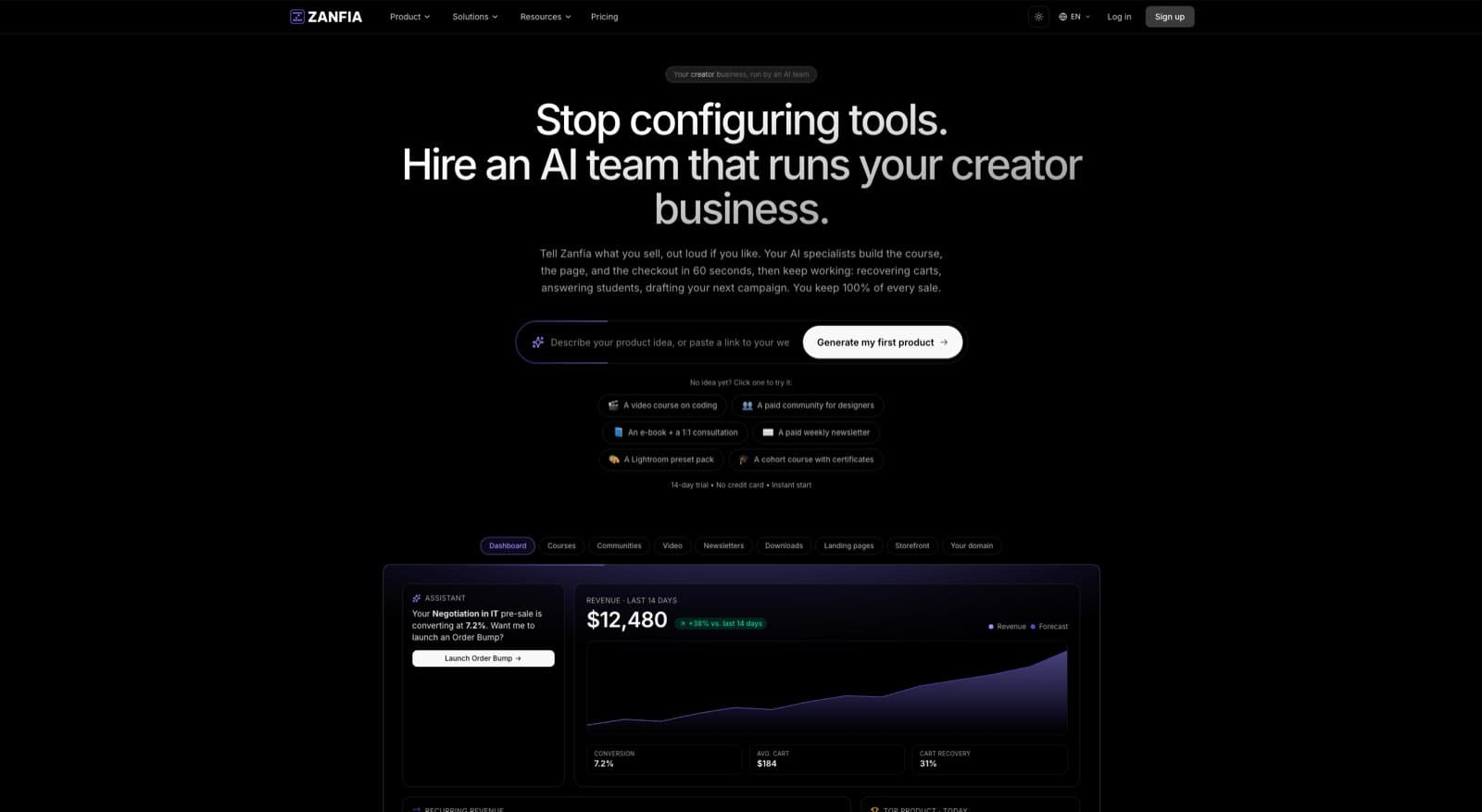
This is where Zanfia earns its place in a coach’s toolkit. Zanfia is an AI team that runs the operational side of a creator business, and a platform second. The AI assistant knows the entire application and can perform any action available in the interface, by chat or by voice, so you dictate what needs to happen instead of clicking through menus. That work lands on a platform designed for creators productizing their methodology across multiple offer tiers, and it pulls the entire delivery infrastructure into one white-labeled experience.
Here’s how the pieces map to a signature framework practice:
Self-paced course tier. Zanfia’s native video hosting eliminates the Vimeo Pro or Wistia subscription that most course platforms force you to buy separately. You upload your framework training videos, organize them into modules matching your four phases, and use time-locked module unlocking so clients progress through the methodology in the intended sequence (no skipping ahead to Phase 4 before completing Phase 1). The smart video player remembers progress automatically, which matters when clients revisit modules during their engagement. Auto-generated transcripts and video chapters give clients search and skim inside long lessons, and quizzes with pass-rate analytics tell you where cohorts stall.
Cohort and community tier. Each cohort gets its own community space inside your Zanfia platform, with topic-based discussion channels, announcement-only channels for your weekly framework lessons, and group-based organization that separates one cohort from another. Because the community is native to the same platform that delivers your course content, clients don’t bounce between Circle or Discord and your course portal. They see your framework, your workbook downloads, your live session recordings, and their peers in one branded experience.
Knowledge base for advanced clients. Long-running engagements often accumulate resources: case studies, advanced exercises, recordings of past Q&A sessions. Zanfia’s knowledge base feature lets you build a searchable internal library that 1:1 and high-tier clients access as part of their engagement. This becomes a major retention tool.
Digital products and workbooks. Your framework workbook, supplementary ebooks, template packs, and lead magnets all get delivered through Zanfia’s secure file delivery, with pay-per-download pricing for low-ticket products and bundled access for premium tiers. Twelve product types (courses, communities, newsletters, memberships, knowledge bases, downloads, digital content, services, events, consultations, bundles and custom) live under one brand, so a coach can package a lead magnet, a book, a course, a cohort and a 1:1 engagement without stitching separate tools together.
Consulting bookings. Bookings and consultations, with availability windows, buffers and a post-purchase “Book your session” button, are marked coming soon on the Zanfia product menu. By the time you read this the module may already be open on your account, so check the pricing page or your dashboard.
Checkout that supports your offer architecture. Zanfia’s Cart 2.0 supports one-time payments (low-ticket products), subscriptions (community memberships), installments (premium engagements), and free trials (cohort previews). Split a $6,000 private intensive into four monthly payments, or add an order bump so the workbook attaches to the checkout at half the standalone price. Test mode lets you run a real checkout flow, tagged TEST in the events log, before the first live sale. Payment runs through Stripe and PayPal, with Apple Pay and Google Pay wallet support for higher mobile conversion.
White-label custom domain. Your framework deserves to live at yourname.com or methodname.com, not at a generic platform subdomain. Zanfia gives you full domain control, so the entire client experience feels like your brand, not a hosted store. Custom domain and removing Zanfia branding are plan-dependent, so check the current Zanfia pricing for what unlocks where.
0% platform commission. Most platforms that bundle courses, community, and checkout take a percentage of every sale on top of subscription fees. As of publication, Zanfia charges only the SaaS subscription (predictable monthly cost) and 0% on customer sales. Only the standard payment processor fees apply. For a coach selling a $4,000 cohort to 20 clients, that fee structure preserves $4,000-$6,000 per cohort that would otherwise go to a platform.
Mobile app delivery. Zanfia’s native iOS and Android app means your self-paced course and knowledge base clients can engage with your framework from their phone, which dramatically improves completion rates and perceived value for premium tiers. Community functionality in the mobile app is rolling out to workspaces.
Bring your own AI agents. Zanfia exposes an MCP endpoint, so AI assistants can act on your workspace directly. If you already work with Claude, ChatGPT or another agent, it can create products, update prices and pull student progress on your behalf, without a separate integration project. MCP availability depends on the plan, see the current Zanfia pricing.
If you’re already running your coaching practice across five tools, consolidating to one platform built specifically for this use case usually pays for itself within the first cohort. Zanfia starts at $39/month, or $31/month billed annually, on the Starter plan, with a 14-day free trial and no credit card required. For coaches earlier in their productization journey, starting on Zanfia means you build your offer architecture once, on infrastructure that scales from $97 ebook to $25,000 private intensive without needing to migrate later.
Explore Zanfia for coaches and see how the platform fits a framework-based practice at zanfia.com, or check pricing for your specific tier mix at zanfia.com/pricing.
FAQ
How long does it take to develop a signature framework?
If you’ve been coaching for at least two years, the framework already exists in your head. The work is extracting and structuring it, which typically takes 30-60 hours of focused effort over 4-8 weeks. Start by mapping the patterns across your last 10 client engagements: what did you always do in the first session, the middle weeks, and the closing phase? That pattern is your draft framework. Refine it through 2-3 iterations with current clients before committing to public marketing.
Can I copy a successful coach’s framework structure?
You can absolutely study the structural patterns (four phases, named methodology, visual diagram) without copying the actual content or framework name. Frameworks are protectable as branded IP, but the underlying pedagogical approach (assess, design, execute, sustain) is common across coaching disciplines and not proprietary. Build your own framework using proven structural principles, but populate it with your unique methodology and language.
What if my coaching is too intuitive to systematize?
This is the most common objection from experienced coaches, and it’s almost always wrong. Intuition is pattern recognition built from thousands of hours of practice. The patterns exist whether you’ve named them or not. The exercise of productization forces you to articulate what you already know, which has two benefits: it lets you scale, and it usually makes you a better coach because you become conscious of your own methodology. Start with three past clients and ask yourself: what did I do for all three of them, in what order?
Should I get my framework certified or accredited?
For most coaches, no. ICF certification or similar credentials apply to you as a coach, not to your framework. Framework accreditation programs exist (mostly through training organizations), but they’re rarely a buying factor for clients. Your trademark, your client results, and your visible methodology matter more than third-party framework accreditation. Invest in the IP protection basics and skip the accreditation rabbit hole unless your specific niche demands it (some corporate or therapeutic contexts do).
How many frameworks should one coach have?
One signature framework, full stop. Coaches who try to maintain three or four competing frameworks dilute their positioning and confuse prospects. Pick the core methodology that produces your best client outcomes, name it, productize it across tiers, and let it carry your entire practice. You can develop secondary tools (assessments, mini-frameworks for specific situations) that live inside the main framework, but one umbrella methodology should anchor your brand.
What if I want to evolve my framework over time?
You should. Frameworks improve through iteration. Version your framework explicitly (the Clarity Compass Method 2.0, for example) when you make substantial changes, and keep the core name and structure consistent. Major rebrands of a framework can confuse existing clients and lose marketing momentum, so evolve incrementally rather than reinventing every two years. The best frameworks deepen over a decade of refinement.