

Consulting Retainer Pricing 2026: $2K, $5K, or $15K/Month?
Pricing a consulting retainer in 2026 is the single hardest number you’ll set this year. Charge too little and you’re stuck answering 2 AM Slack messages for the price of a part-time intern. Charge too much without packaging clarity and prospects ghost your proposals. The good news: the market has matured. Three tiers — essential, standard, comprehensive — now anchor how serious buyers expect retainers to be priced, scoped, and delivered.
This guide breaks down what each tier delivers, how value-based pricing is overtaking hours-based models, and how to package a retainer that closes without endless back-and-forth. Whether you’re a solo strategist transitioning from project work or a boutique firm building recurring revenue, you’ll leave with concrete pricing anchors and a proposal framework you can use this week.
The 3-tier retainer ladder: essential, standard, comprehensive
The consulting retainer market in 2026 has consolidated around three pricing tiers. This isn’t accidental — it mirrors how buyers internally budget for outside expertise and how procurement teams categorize advisory spend.
The ladder looks like this:
- Essential advisory: $2,000–$5,000 per month. Light-touch strategic input, async-first, 5–10 hours of capacity.
- Standard support: $5,000–$15,000 per month. Operational and strategic blend, mixed sync/async, 10–25 hours.
- Comprehensive partnership: $15,000–$50,000+ per month. Embedded advisory, fractional executive scope, 25+ hours with stakeholder access.
Each tier serves a distinct buyer. Essential is for founders and department heads who need a thinking partner. Standard is for growth-stage companies needing both strategy and execution oversight. Comprehensive is for organizations effectively buying a fractional C-suite role without the equity or full-time commitment.
According to the NMS Consulting 2026 fee guide, independent consultants with 10+ years of experience now command median retainers in the $7,500–$12,000 range, with specialist verticals (regulatory, M&A, AI strategy) pushing well past $20,000. The bottom of the market — sub-$2,000 advisory — has largely collapsed into productized one-off engagements rather than ongoing retainers.
Why three tiers, not five
Earlier guidance recommended laddering five or more retainer options. That’s been replaced by the three-tier model for one reason: buyer cognitive load. When prospects face more than three monthly commitment options, decision paralysis kicks in and close rates drop. The three-tier ladder maps cleanly to budget categories most companies already maintain (line-item, departmental, executive).
Each tier should also map to a clear buyer persona. If your essential and standard tiers both target the same kind of client, you’ll cannibalize the higher option. Differentiate by outcomes and scope of access, not just hours.
What $2K–$5K essential advisory actually delivers (5–10 hours)
The essential tier is the entry point for ongoing engagement. It’s deliberately lightweight and designed to be the consultant’s most leveraged offering, not their cheapest.
Typical inclusions:
- One 60-minute strategy call per month. Agenda set by the client 48 hours in advance.
- Async Slack or email access with a defined response SLA (usually 24 business hours, Monday–Thursday).
- Document review — pitch decks, marketing plans, hiring scorecards, contracts. Capped at two reviews per month.
- Monthly written brief summarizing observations, recommended priorities, and one decision the client should make before next month.
- Light introductions — one or two warm referrals per quarter from the consultant’s network.
What essential is not: implementation support, deliverable production, team training, or board-level representation. The moment a client expects you to build the spreadsheet, draft the email sequence, or run the workshop, you’ve drifted into standard tier territory and need to renegotiate.
Who buys essential retainers
Solo founders running ~$500K–$2M annual revenue businesses are the dominant buyer. They’ve outgrown free advice from peers but can’t justify a $10K monthly commitment. Department heads at mid-size companies also use this tier to keep a specialist on call without going through procurement for project SOWs every quarter.
Essential retainers work best when both parties commit to a 6-month minimum. Anything shorter and the consultant burns onboarding time without amortization; anything longer locks the client into a relationship that may have stopped delivering ROI.
Common essential-tier mistakes
The fastest way to lose money on essential retainers is scope creep through Slack. A client sends three quick questions on a Tuesday. Each takes 20 minutes to answer well. Multiply by four clients and you’ve spent half a day on “async support” that wasn’t budgeted into the 5–10 hour cap.
The fix: log every async interaction in a simple tracker, send a monthly utilization summary to the client, and have a pre-written script for what happens when capacity is exceeded (upgrade to standard, pay an overage rate, or defer to next month).
What $5K–$15K standard support looks like (10–25 hours)
Standard is where the bulk of mature consulting retainers cluster in 2026. It’s substantial enough that the client treats you as a real team extension, and structured enough that you’re not on the hook for unlimited delivery.
What’s typically included:
- Weekly 30–60 minute strategy or working sessions with the founder or department lead.
- Async access with same-business-day response SLA on critical items.
- Stakeholder participation — joining one recurring leadership or team meeting per week.
- Deliverable review and light production — drafting frameworks, reviewing strategic documents, contributing to OKRs or quarterly plans.
- Vendor and hiring input — interviewing key hires, evaluating tool selections, helping scope agency or freelance engagements.
- Quarterly business review with a written assessment of progress, risks, and recommended pivots.
The standard tier creates a working rhythm. Clients know when they’ll see you, what to bring, and what to expect in return. That predictability is what justifies the price jump from essential.
The standard-tier sweet spot
For most independent consultants and small boutique firms, the standard tier is the highest-margin offering. Pricing typically lands at $7,500–$12,000 for solo practitioners and $10,000–$15,000 for those with a small team or named specialist support.
Standard retainers also tend to have the longest tenure. Clients who progress from essential to standard often stay 18–36 months because the consultant becomes embedded in operating cadence. According to the Schmidt Consulting Group retainer pricing 2026 report, the median tenure for standard-tier engagements has extended from 14 months in 2022 to 22 months in 2026 — a direct result of the tier being designed for sustained partnership rather than one-off bursts.
When to push a standard client up to comprehensive
Two signals matter. First, when async messages consistently exceed weekly sync time, the client effectively needs an embedded advisor. Second, when the client starts looping you into hiring decisions, board prep, or investor conversations, you’re operating at a fractional executive level and should price accordingly.
The conversation is simple: “Based on the last quarter, your team is engaging me as a fractional [CMO/COO/Head of X]. That’s outside the standard tier’s scope. Here’s what comprehensive looks like and why it makes sense.”
What $15K–$50K comprehensive partnerships include (25+ hours)
Comprehensive retainers are functionally fractional executive engagements. The consultant is named in the client’s org chart, attends leadership meetings as a peer, and is empowered to make decisions within a defined scope.
Standard inclusions:
- 2–3 days per week of capacity equivalent (25–40+ hours), split across sync meetings, deep work, and async leadership.
- Membership in client’s leadership ops — Slack channels, executive standups, board prep meetings.
- Team management — overseeing direct reports, contractors, or vendor agencies within the consultant’s function.
- Strategic deliverables ownership — quarterly strategy, GTM plans, hiring scorecards, executive-level reporting.
- Board and investor communication when relevant — co-authoring updates, participating in fundraising prep, representing the function in board meetings.
- External representation — speaking on behalf of the company at industry events, partner meetings, or candidate interviews.
Comprehensive retainers in 2026 are increasingly the norm for venture-backed startups between Series A and B. They’ve raised enough to need senior leadership but not enough (or not the maturity) to commit equity to a full-time hire. Fractional CMOs, CFOs, and COOs at this tier routinely earn $20,000–$40,000 per month, with $50,000+ retainers concentrated in specialized verticals like AI, regulated industries, and pre-IPO operational scaling.
Comprehensive isn’t just “more hours”
A common pricing mistake is treating comprehensive as standard with the cap removed. It isn’t. The comprehensive tier requires the consultant to own outcomes, not just contribute thinking. That distinction changes the math.
When you own outcomes, you absorb risk the client used to carry — hiring the wrong agency, missing a launch window, choosing the wrong pricing model. That risk premium is what justifies the 3x–5x multiple over standard tier pricing.
It also means the consultant should have explicit authority. A comprehensive retainer without decision rights is just standard with extra meetings, and clients will eventually notice the disconnect.
The capacity ceiling
Most independent consultants can sustain only one or two comprehensive retainers simultaneously. The cognitive load of being deeply embedded in multiple client organizations isn’t linear — context switching at that depth compounds. Pricing comprehensive too low leads directly to burnout because you’ll be forced to take on too many clients to hit revenue targets.
A useful rule: if your comprehensive tier doesn’t replace the equivalent salary plus 40% of a full-time senior leader in the same role, you’re underpriced. The premium exists because clients are buying flexibility (no long-term commitment, no equity, no severance risk) — and that flexibility is worth real money.
Value-based vs hours-based retainer pricing in 2026
The shift from hours-based to value-based retainer pricing accelerated dramatically in 2024–2025 and is now the dominant model in 2026. Hours-based pricing — where the retainer is calculated as hourly rate × estimated hours per month — still exists, but mostly for entry-level advisors and specialized regulated work (legal-adjacent consulting, technical audits).
Why hours-based pricing is fading
Three reasons. First, AI-augmented consulting workflows have collapsed the time required to produce many deliverables. A market analysis that took 20 hours in 2022 now takes 4 hours of consultant time plus LLM-assisted research. Billing by the hour punishes the consultant for becoming more efficient.
Second, hours-based billing creates adversarial conversations. Clients scrutinize timesheets, question whether a call “really took 90 minutes,” and slow down decision-making to avoid “wasting consultant time.” The relationship degrades.
Third, hours don’t correlate with value. A 15-minute conversation that prevents a $200,000 hiring mistake is worth more than a 40-hour deliverable nobody implements. Pricing should reflect outcomes, not effort.
How value-based retainers actually work
Value-based retainers price the engagement against the client’s expected outcomes. The conversation isn’t “how many hours per month” — it’s “what’s the value of having this expertise on tap, and what scope of access does that fund?”
Three common structures:
- Outcome-anchored retainer: Base monthly fee plus performance bonuses tied to specific KPIs (revenue milestones, hiring completions, fundraising close).
- Access-priced retainer: Flat monthly fee for defined access (weekly call, async availability, stakeholder participation) — the consultant manages scope, the client buys time and attention.
- Capability-anchored retainer: Priced against the cost of building the capability in-house (e.g., 60% of a full-time hire’s loaded cost), with the flexibility premium baked in.
Most 2026 retainers blend elements of all three. The pure outcome-anchored model works best when KPIs are measurable and within the consultant’s control. The access model dominates standard and essential tiers. The capability model is the strongest frame for comprehensive engagements.
The Harvard Business Review analysis of value-based pricing in professional services notes that firms transitioning from hours-based to value-based models report 30–40% margin expansion within 18 months, primarily because pricing conversations focus on impact rather than input.
How to transition existing hours-based clients
Don’t change the price mid-engagement without a scope change. Wait for the natural renewal window (usually quarterly or annual) and present the new structure as an evolution: “Based on the past year, here’s what we accomplished together. Going forward, I’m moving to access-based pricing because it’ll give you more flexibility without watching the clock. Here’s the new structure.”
Most clients welcome the change because hourly billing creates friction on their end too.
How to package and propose a retainer that closes
The proposal stage is where most retainer deals die. Not because the pricing is wrong, but because the proposal asks the buyer to do too much cognitive work.
A retainer proposal that closes follows a tight structure:
1. Outcomes section (not deliverables)
Lead with what the client will experience or achieve, not what you’ll produce. Replace “weekly strategy calls and async support” with “a clear monthly priority, faster decision-making on hiring and vendor choices, and an experienced sounding board before every major commitment.”
This isn’t fluff — it’s how buyers internally justify the spend to whoever holds the budget. Give them the language.
2. Tiered options
Present three tiers, with the standard tier in the middle and visually emphasized as the recommended option. The essential tier should be priced just low enough to feel accessible but not so low that anyone picks it for cost reasons alone. The comprehensive tier anchors the value of the standard tier.
Always price tiers so the middle option is the obvious answer for ~70% of buyers. This isn’t manipulation — it’s how the brain processes options.
3. Scope guardrails
Explicitly state what’s not included. Counterintuitively, this builds trust. Buyers who’ve been burned by vague consulting engagements are scanning your proposal for the catch. Pre-empt it.
Examples: “Does not include team training or workshop facilitation,” “Does not include hands-on deliverable production beyond review and feedback,” “Does not include weekend or after-hours availability except for genuine emergencies.”
4. Commitment and exit terms
State minimum term (3, 6, or 12 months) clearly. Include a 30-day exit clause after the minimum term — this dramatically reduces decision friction. Buyers will only commit to a retainer they can exit; the irony is they almost never actually leave once embedded.
5. One-page format
The best retainer proposals fit on one page (two maximum). If your proposal needs an appendix, you’re over-explaining. Trim until every sentence either creates value, removes risk, or makes the decision easier.
According to Forbes Coaches Council research on consulting proposals, single-page retainer proposals close at roughly 2.3x the rate of multi-page proposals, largely because they force the consultant to be clear about what matters.
How Zanfia helps consultants productize and bill recurring retainers
Building a retainer practice that scales means solving three operational problems most consultants underestimate: recurring billing without chasing invoices, a private space for client materials and frameworks, and a clean way to manage consulting sessions in one place.
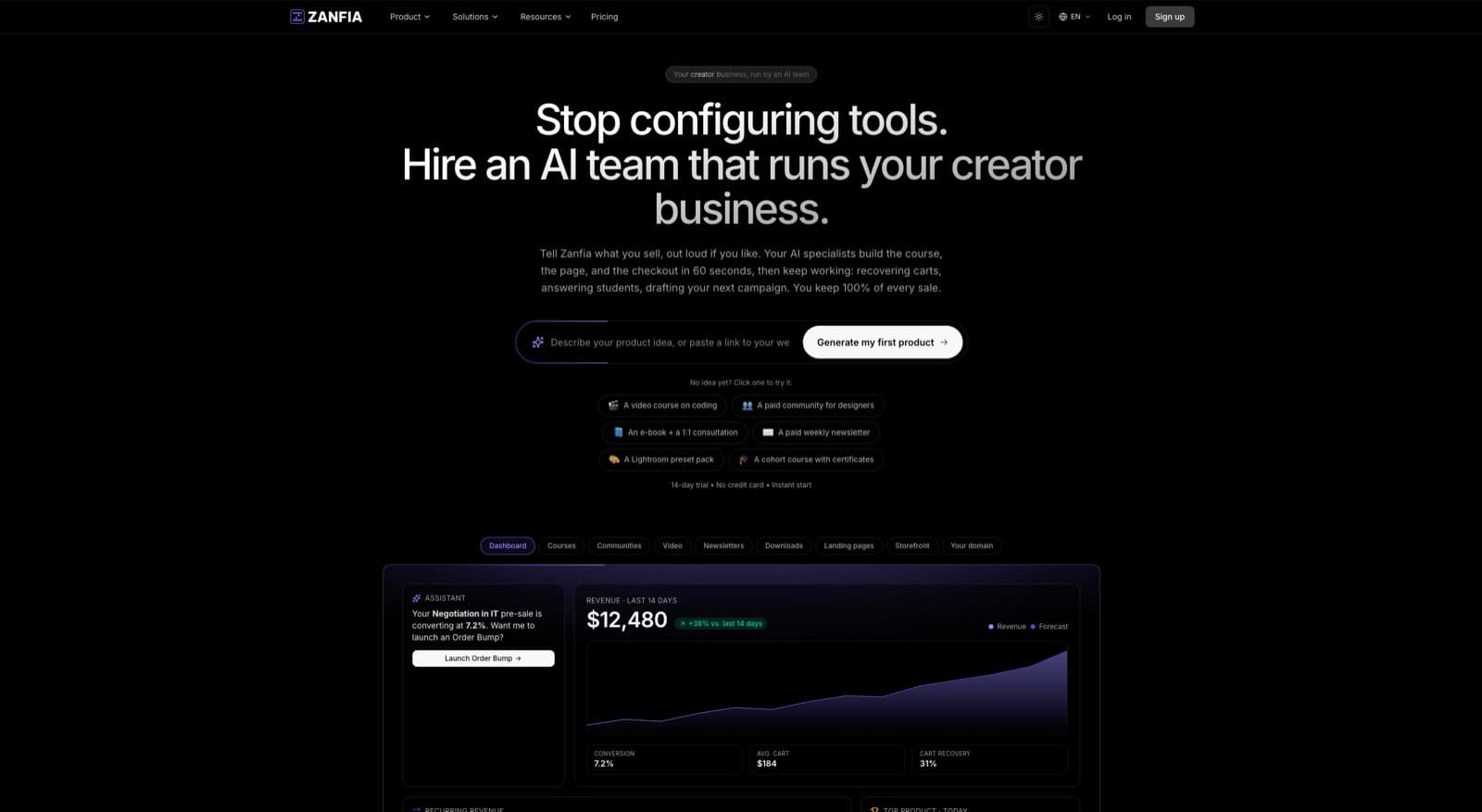
Zanfia is an AI team that runs a consulting practice, delivered as an all-in-one platform under your own brand and your own domain. Rather than configuring a stack of tools, you tell the assistant what you want done — by chat or by voice — and it performs any action available in the interface, from spinning up a retainer checkout to updating a client-only knowledge base. That work lands inside a checkout built to sell, so the recurring revenue side of your practice actually converts.
Recurring subscription billing through Cart 2.0. Zanfia’s checkout supports subscription pricing, installments and one-time payments natively, with Stripe and PayPal as payment processors and Apple Pay and Google Pay for one-click client signups. You set the retainer price and the billing cadence (monthly, quarterly, annual), and Zanfia handles the recurring charge. Order bumps with separate invoicing let you cleanly bill add-ons like quarterly workshops or special projects without breaking the retainer’s primary invoice trail. Before you go live, test mode lets you run a real test purchase on your own checkout — conversion events fire to test surfaces only, no production data is recorded — so you catch a broken flow before a paying client does. As of publication Zanfia charges 0% platform commission on customer sales; only standard payment processor fees apply.
Member-only knowledge base for your client portfolio. Zanfia’s knowledge base feature lets you build a searchable, article-based library that only your retainer clients can access. Use it for the frameworks you reuse across clients, your standard onboarding playbook, evergreen strategic templates, or recorded sessions clients can revisit. Instead of formatting each new framework by hand, you can dictate it to the assistant and have it drop into the right client library — the productized layer of your retainer, compounding in value without compounding in your delivery time. Advanced AI capabilities like the full Assistant and the MCP endpoint (which lets your own AI agents act on the workspace) depend on the plan you choose, so check the current Zanfia pricing for what unlocks where.
Native consulting bookings in the same workspace. Bookings and Consultations are labeled coming soon on the product menu today. When they ship, retainer clients will be able to schedule their monthly or weekly sessions directly from your branded space, with payment handled in the same system — no bouncing between Calendly, Stripe and a separate client portal. By the time you read this it may already be live, so check the pricing page or your dashboard. In the meantime you can still sell the retainer through Cart 2.0 and continue scheduling with the tool you use today.
Beyond the core three, Zanfia’s white-label setup means each consultant gets their own subdomain (or maps their own custom domain), so the entire experience reads as a premium consulting practice rather than a third-party tool. Twelve product types live under one brand — courses, communities, paid newsletters, knowledge bases, downloads, bundles and more — so if you decide to productize a framework into a self-serve offer alongside the retainer, it sells from the same checkout. The native iOS and Android mobile app supports the knowledge base, paid newsletters, and any course content you’ve productized.
For consultants transitioning from project work to recurring retainers, Zanfia removes the friction of stitching together a separate billing system, client portal, knowledge management tool, and scheduling app. Every plan includes a 14-day free trial, no credit card required. Explore Zanfia’s pricing or see how the platform works.
FAQ
What’s the average consulting retainer in 2026?
The median monthly retainer for independent consultants with 10+ years of experience landed at approximately $8,500 in early 2026, with the standard tier ($5,000–$15,000) representing the largest segment of active engagements. Specialized verticals (AI strategy, regulatory, M&A advisory) routinely command 50–100% premiums over this median.
Should I charge hourly or monthly for retainer work?
Monthly. Hourly billing creates adversarial conversations about utilization, punishes you for becoming more efficient, and disconnects pricing from value delivered. Use access-based or capability-based monthly pricing instead, and reserve hourly billing for genuine one-off project work that doesn’t fit a retainer.
What’s the minimum length for a consulting retainer?
Six months is the practical minimum for essential and standard tiers. Anything shorter and you’ll burn onboarding time without amortization. Comprehensive retainers typically run 12 months minimum because the depth of embedding requires substantial ramp time on both sides.
How do I raise prices with existing retainer clients?
Tie price increases to scope changes or natural renewal windows (quarterly or annual). Frame the change around evolution of the engagement — added access, new capabilities, expanded outcomes — rather than “my rates went up.” Most clients accept 10–20% annual increases when paired with clearly articulated value expansion.
How many retainer clients can one consultant handle?
For essential tier, 8–12 concurrent clients is sustainable. For standard tier, 4–6. For comprehensive, 1–2 maximum. Pushing beyond these limits creates context-switching costs that degrade delivery quality and eventually erode client retention.
What’s the biggest retainer pricing mistake consultants make in 2026?
Pricing the essential tier too low. Consultants treat the entry tier as a loss leader to attract clients who’ll upgrade. In practice, low essential pricing attracts the wrong clients (those who’ll never upgrade), occupies capacity that could serve higher-tier work, and signals low value to better-fit prospects. Price essential at a level you’d be happy to deliver long-term, not at a discount you’ll resent within six months.