

A Guide to Creating Effective Rules in the Community

Before you can build a thriving, profitable online space, you have to lay the groundwork. That groundwork is your set of community rules. This isn't about being a drill sergeant; it's about building the essential architecture for trust and preventing the kind of chaos that sends good members running for the hills.
Why Clear Rules Are the Bedrock of a Thriving Community
Ever joined a group that was a total free-for-all? It might have started with a burst of excitement, but it doesn't take long for the spam, off-topic rants, and personal attacks to take over. That kind of environment doesn't just feel messy, it actively repels the exact people you want to attract and keep.

When your members feel safe and respected, they open up. They share insights, ask thoughtful questions, and actually form the connections that make a community sticky. This psychological safety is the secret sauce for long-term retention. It’s what separates a forgettable Facebook group from a premium destination people are happy to pay for.
The Direct Impact of Rules on Retention and Profitability
This isn't just theory; well-defined community rules have a real, measurable impact on your bottom line. The global online community platform market is exploding, on track to hit $736.9 million by 2025. That’s a loud and clear signal that people are craving structured, well-managed online spaces.
In fact, communities with explicit, enforced guidelines often see 40-50% higher retention rates. Why? Because members feel secure enough to invest their time and money, whether that’s in a paid newsletter or a high-ticket course, without worrying about wading through spam or dealing with trolls.
A community built on a foundation of clear rules and mutual respect doesn't just survive; it thrives. It becomes a place where members feel a true sense of belonging and are eager to deepen their engagement, whether that's by buying a new course or upgrading to a premium subscription.
Setting the Stage for Success
For any digital creator, the ultimate goal is to build a self-sustaining ecosystem where community, content, and commerce all work together. Clear rules are the framework that holds it all up. They protect the integrity of your brand and ensure every interaction adds value instead of detracting from it.
This is where a platform like Zanfia earns its place. Zanfia is built as an AI team that runs a creator business: an assistant that knows the whole application and can perform anything available in the interface, by chat or by voice, plus an MCP endpoint so your own AI tools can act on your workspace (advanced AI capabilities are available on higher plans, see the current Zanfia pricing). Courses, communities, paid newsletters and digital products all live under one white-label domain, and the checkout is built to sell: order bumps, installments that let you split a $600 course into four payments, subscription upsells, and a test mode so you can buy your own product before launch to verify everything works. You’re not just selling a product; you’re inviting people into a premium, well-run world where they can learn and grow.
If you're serious about building a sustainable online business, this is a non-negotiable first step.
How to Draft Community Guidelines That Actually Work
Staring at a blank page trying to write your rules in the community can feel impossible. It's a tricky balance. Go too corporate, and you sound like a lawyer. Go too vague, and the rules become meaningless.
The secret isn't to start with the rules at all. It's to start with your community's purpose. What's the one core thing you want members to achieve or experience?
Once you nail that down, you have your north star. If you're building a space for new graphic designers to get feedback, your rules will naturally focus on constructive criticism. If it's a networking group for founders, you'll need clear guidelines on self-promotion. Every rule you write should serve that mission.

Suddenly, writing rules stops being a chore and becomes a strategic part of designing your community's culture. You're not just listing what people can't do; you're actively defining what a great member experience looks like.
Start with Positive Framing
How you word your rules matters more than you think. Negative framing ("Don't be rude") can feel aggressive and immediately put people on the defensive. It's an instant vibe killer.
Flip it around. Positive rules ("Be respectful and constructive") encourage the behavior you want to see and establish a collaborative tone from day one. Think of it like giving directions: "Turn right" is a lot more helpful than "Don't turn left." Your guidelines should be a map to good interactions, not just a list of roadblocks.
I've found that most community friction points fall into a few key areas:
- Respect and Kindness: This is non-negotiable. It's the bedrock of any healthy space.
- Content Relevance: People are here for a reason. Keeping conversations on-topic is crucial.
- Self-Promotion and Spam: You need to define clear boundaries before it becomes a problem.
- Privacy and Confidentiality: Members need to feel safe sharing, so protecting their information is key.
Focusing on these pillars lets you get ahead of the most common issues, ensuring your community stays valuable for everyone involved.
The Non-Negotiable Core Rules
While every community has its own unique flavor, some rules are pretty much universal. These form the backbone of your guidelines, creating a safe and productive environment for everyone.
1. Treat Everyone with Respect This is about more than just banning insults. It's about fostering a culture where members assume good intent, engage with ideas instead of attacking people, and can disagree without being disagreeable. A great way to phrase this is: "We’re all here to learn and grow. Disagree with ideas, not people. Personal attacks, hate speech, and harassment will not be tolerated."
2. Keep Discussions Relevant Your members joined for a specific purpose. Off-topic chatter can quickly derail conversations and drown out the value. A simple fix is to create dedicated spaces for those side conversations. Platforms like Zanfia let you set up topic-based discussion channels or an admin-only announcement channel where members can read and react but only admins post. A straightforward rule could be: "Please post in the appropriate channels. This helps everyone find the information they need."
3. No Unsolicited Self-Promotion This one is always a delicate balance. A total ban on self-promo can feel stifling, but a free-for-all turns your space into a spam-fest no one wants to be in. The best solution I've seen is to create a dedicated time or place for it. For example: "Share your latest project in our #Showcase channel on Fridays! Please refrain from posting promotional links in other channels."
When you're looking for inspiration, don't forget to look at existing legal frameworks. A platform's Terms Of Service, for instance, can give you a solid foundation for what's considered standard acceptable conduct online.
Clear rules aren't about restricting freedom; they're about creating a predictable environment where everyone knows how to contribute positively. This predictability builds trust and encourages deeper engagement.
From Draft to Actionable Guidelines
Once you have your core ideas down, it's time to polish them into a document that people will actually read. Ditch the legal jargon. Your guidelines should be so clear that a new member can understand them in two minutes flat. Use simple sentences, bullet points, and clean headings.
To see just how much tone can shape the feel of your rules, check out our guide with several real-world community guidelines examples you can steal from.
The table below shows how you can adapt the same basic rules for different community vibes, from a laid-back creator space to a buttoned-up professional network. It’s a great way to see how your brand voice should carry through into your rules in the community.
Community Rule Templates From Welcoming to Strict
Here are a few templates you can adapt based on the vibe you want to create. Notice how the core principle stays the same, but the language changes everything.
| Rule Category | Welcoming & Casual Tone Example | Professional & Focused Tone Example | Strict & Formal Tone Example |
|---|---|---|---|
| Respect | "Let's keep things positive! Be kind and supportive of your fellow creators." | "Maintain a professional and respectful tone in all discussions. Constructive criticism is welcome; personal attacks are not." | "All communication must remain respectful. Any form of harassment, hate speech, or discriminatory language will result in an immediate and permanent ban." |
| Relevance | "Try to keep posts in the right channels so we can all find what we're looking for!" | "To maintain the value of this community, please ensure your posts are relevant to the channel's designated topic." | "Content must strictly adhere to the designated channel topic. Off-topic posts will be removed without notice." |
| Promotion | "Got something cool to share? Post it in our #Shoutouts channel on Fridays!" | "Self-promotion is limited to the #Marketplace channel. Unsolicited promotional links in other discussions will be removed." | "Any form of unauthorized self-promotion, advertising, or solicitation is strictly prohibited and will lead to account suspension." |
At the end of the day, remember that your guidelines are a living document. Launch with a solid foundation, pay attention to what your members are saying, and don't be afraid to tweak the rules as your community grows and changes.
Communicating Your Rules for Maximum Buy-In
Let’s be honest: drafting the perfect set of guidelines is only half the battle. If your members never see them, even the most thoughtful rules in the community are completely useless. Great communication is what turns a simple document into a shared culture, making sure everyone is on the same page from day one.
The trick is to make your rules impossible to miss. Don't just tuck them away in some forgotten corner of your community. You need to strategically place them at key moments in the member's journey, right when they're most receptive to learning the ropes.
Making Your Rules Unmissable
Your main goal here is to weave the rules into the very fabric of the community. New members are most open to guidelines during their first few interactions, so that's your golden opportunity to set the tone.
Here are the most effective places to put your rules so they actually get read:
- During Onboarding: This is the single most powerful moment. Requiring new members to check a box saying they've read and agree to the guidelines before they even get in is a total game-changer.
- In the Welcome Email: Follow up and reinforce the message immediately. Your automated welcome email should include a friendly reminder of the community's core values and a direct link to the full rulebook.
- As a Pinned Post: In any community platform, that pinned post or announcement channel is prime real estate. Make your guidelines the very first thing people see when they enter a main discussion area.
- In a Dedicated Section: Create a permanent, easy-to-find "Community Guidelines" or "Start Here" page. This becomes a constant reference point for both new and long-time members.
Platforms built for creators, like Zanfia, make this seamless. The visual automation builder can handle the whole onboarding sequence: when someone buys your course or subscription, they’re automatically added to the right community channels, sent a welcome email with the rules, and given a custom consent checkbox at checkout. You can even dictate the setup by voice to the assistant instead of clicking through menus. It's a simple step that guarantees compliance from the very beginning.
Introducing New Rules to an Existing Community
Adding or changing rules in an established group can feel like walking on eggshells. If you handle it poorly, you risk backlash from members who feel like you're pulling the rug out from under them. The secret to avoiding this? Total transparency.
Never just spring a new rule on your community without explaining yourself. Instead, frame the change as a response to community needs and a step toward making the space better for everyone.
Announcing a new rule isn't just a declaration; it's a conversation. Explain the 'why' behind the change, listen to feedback, and show your members that you're evolving the space with them, not just dictating to them. This approach builds trust and reinforces a sense of shared ownership.
For instance, if you need a new rule about AI-generated content, you could post an announcement explaining that you want to preserve the quality of genuine, human-to-human interaction. It's worth noting that if you use Zanfia's community AI agent, everything it publishes is labeled as AI by default, so your members always know when they're reading machine-written content. By giving that context, you shift the focus from a restriction to an act of protecting the community's core value.
The Power of Automated Onboarding
Ultimately, the best strategy for getting buy-in is to make rule agreement a mandatory part of joining. This isn't about being a stickler; it's about setting crystal-clear expectations right from the start. When someone has to actively agree to the rules, they're making a conscious commitment to uphold the community's standards.
This simple process eliminates the "I didn't know" excuse and gives you the clear authority to enforce guidelines fairly and consistently. Modern platforms are designed to handle this for you. With Zanfia, the automation triggers cover purchase, subscription renewal, plan change and access ending, so you can grant course access after payment, add buyers to the right community channels, and trigger a welcome email sequence that includes rule acknowledgment, all without lifting a finger. You can even tell the assistant, out loud, to build the flow for you.
This saves countless hours and ensures every single member starts on the same page, which leads to a healthier, more engaged community. For more ideas on boosting member activity, check out our guide on proven community engagement strategies.
Enforcing Your Rules Fairly and Consistently
Having well-written rules in the community is a great start, but they don't mean much if you don't enforce them. This is where your commitment to fairness and consistency really gets put to the test.
When you enforce rules sporadically, you destroy trust. Members feel singled out, wondering why one person got away with something while another got a warning. It’s a fast track to a disengaged or, worse, a toxic environment.
To get this right, you need a clear, tiered system for handling violations. This isn’t about punishment; it’s about education and course correction. A solid enforcement strategy creates a predictable, safe space where everyone knows the boundaries and the consequences for crossing them.
This decision tree gives you a solid framework for how to communicate your rules, whether your community is brand new or has been around for years.
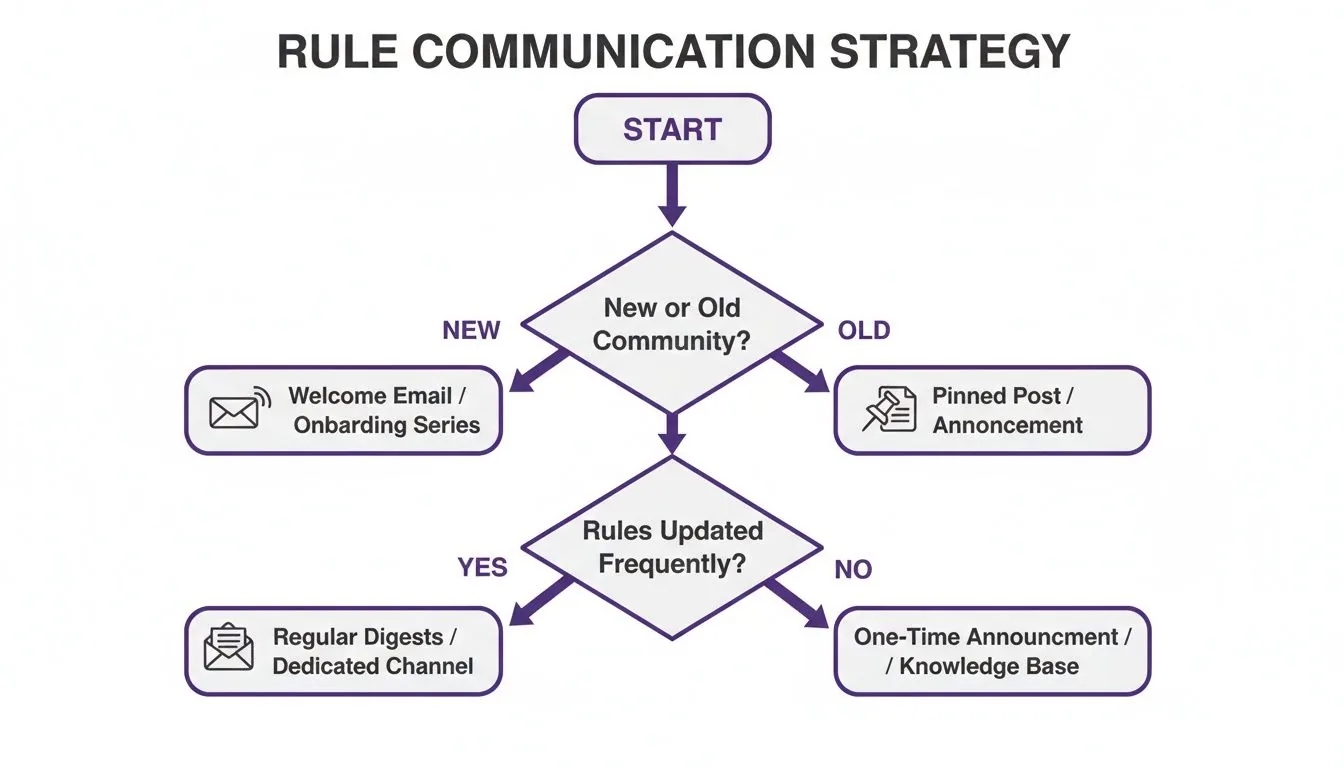
The big takeaway here is that your communication has to adapt. New members need a clear welcome packet, while established ones just need a heads-up on changes via a pinned post. Everyone should know where to find the guidelines.
Creating a Tiered Enforcement System
A tiered approach lets your response match the severity of the offense. It gives you a clear playbook, moving from a gentle reminder all the way to a permanent ban, and makes sure every action you take is justifiable and consistent.
More importantly, it removes emotional, in-the-moment decision-making and protects your moderators from accusations of bias.
Here’s a practical, multi-level framework you can adapt:
- Private Reminder & Warning: For a first-time, minor offense (like posting in the wrong channel), a private message is almost always the right move. It avoids public shaming and gives the member a chance to fix their mistake gracefully.
- Public Reminder & Content Removal: If the behavior continues or is more public (like heated language in a debate), a gentle public reminder is often needed. Follow it up by removing the offending content. This reinforces the rules for everyone who's watching.
- Temporary Suspension (Timeout): For repeat offenses or more serious issues like spamming, a temporary suspension, say for 24 hours , gives the member a "cool-down" period. It’s a clear signal that the behavior is unacceptable.
- Permanent Ban: This should always be your last resort. Reserve it for the most serious violations like harassment, hate speech, or a clear pattern of willful, persistent rule-breaking.
Document everything. Keep a private log of every violation and the action you took. This record is invaluable if a member disputes a decision or if you need to show a pattern of behavior to justify a ban. For a deeper dive into these responsibilities, explore our guide on what is community management.
Handling Real-World Scenarios
Theory is one thing; putting it into practice in the heat of the moment is another. Let’s walk through a couple of common situations you'll almost certainly face.
Scenario 1: The Overeager Spammer A new member joins and immediately starts flooding channels with links to their website. They aren’t being malicious, just clueless about the norms.
- Action: Start with Tier 1. Send them a private message.
- Example Script: "Hey [Name], welcome to the community! I noticed you shared a few links to your site. To keep our discussions focused, we have a rule against unsolicited self-promotion. We'd love for you to share your work in our dedicated #Showcase channel on Fridays! You can review all our guidelines here [link]. Thanks!"
This approach is friendly, educational, and redirects their energy in a positive way without making them feel unwelcome.
Scenario 2: The Heated Debate Gone Wrong Two long-time, respected members are debating a topic, but it gets personal. Name-calling and insults start flying.
- Action: This needs a swift Tier 2 response.
- Example Script (Public): "@[User1] and @[User2], let's bring the temperature down. We encourage passionate debate, but personal attacks violate our community guidelines. Please keep the discussion focused on ideas, not people."
- Follow-Up: Remove the insulting comments. If the behavior continues, don't hesitate to send a private warning (Tier 1) or even issue a temporary suspension (Tier 3) to both parties.
Consistency is your greatest asset in moderation. When members see that rules apply equally to everyone, regardless of their status or popularity in the community, they trust the system. That trust is the foundation of a healthy, self-regulating culture.
Ultimately, your job as a creator is to build a valuable space where people feel safe enough to engage. Zanfia supports this by putting your community, courses and paid content under one white-label domain, with 12 product types living under a single brand. When everything is in one place, you can manage access from a single dashboard: a customer buying your Pro tier immediately unlocks the right community channels and course library, and a failed payment revokes access without an awkward conversation. Zanfia currently charges 0% platform commission on customer sales, so what your members pay flows straight to you (minus your payment processor's standard fee).
Enforcing rules isn't just an administrative chore; it's an act of protecting the value of the product your customers are paying for.
Using Automation to Streamline Community Moderation
Let's be honest: your time is your most valuable asset as a creator. Manual moderation is a black hole for that time. If you're personally checking every new member, policing every discussion, and manually adjusting access levels, you're on a fast track to burnout.
This is where automation stops being a "nice-to-have" and becomes absolutely essential.
Modern platforms are built to do the heavy lifting for you. Instead of drowning in admin chores, you can design systems that enforce your rules 24/7, creating a fair and consistent experience for everyone while you focus on what you do best.
Automating Access Based on Rules
One of the biggest wins with automation is managing who gets to see what.
Imagine you have a few membership tiers: a public group, a paid "Pro" level with exclusive content, and a "Mastermind" tier with direct coaching. Trying to manage those permissions by hand is a complete nightmare waiting to happen.
This is exactly where an integrated platform like Zanfia shines. The visual automation builder just handles it all for you, with triggers covering purchase, subscription renewal, plan change, failed payment and access ending in 14, 7, 3 or 1 days.
- Granting Access: A member signs up for your Pro tier. Instantly, the system unlocks the private Pro channels and gives them access to the right course library. No delay, no manual clicking.
- Revoking Access: Someone's subscription ends or their payment fails. Their access to those premium spaces is immediately and automatically revoked. This enforces your rules in the community around paid content without you ever needing to have an awkward conversation or flip a switch.
Because Zanfia is designed AI-first, you don't have to build these flows by clicking through configuration screens. Tell the assistant, by chat or by voice, what you want to happen when someone buys or cancels, and it performs the setup for you. This kind of setup saves creators a ton of time, we often hear reports of saving 5–10+ hours per month, and it completely removes the risk of human error.
Technology isn't here to replace your judgment as a community leader. It's here to act as a tireless assistant, handling the repetitive tasks so you can apply your human touch where it matters most: building relationships and fostering genuine connection.
To really dial this in and make your whole operation more efficient, it's worth looking into effective workflow automation strategies.
Using Analytics to Proactively Moderate
Automation isn't just about reacting to rule-breakers; it’s also about spotting trouble before it starts.
Instead of waiting for a flagged post, you can use built-in analytics to get a feel for your community's overall health. By watching discussion trends, you can quickly see which channels are getting a little too heated or which topics consistently send conversations off the rails.
This data-driven approach lets you get out ahead of problems. You can pop in with a friendly reminder about the rules, draft a new guideline to cover an emerging issue, or assign more moderators to a channel that's blowing up.
For small business owners, this level of control is everything. Clear rules on content sharing and subscriptions can boost retention by as much as 50%, turning lurkers into loyal, paying members.
In more established markets, communities that use automated rule enforcement see a 2.4x higher ROAS on their ads compared to those relying on traditional social media. You can find more user engagement data on major platforms over at Statista.com.
By combining smart automation with sharp analytics, you build a well-oiled machine that protects your community, your sanity, and your bottom line. If you're curious about finding the right platform for this, check out our guide to community management software.
Your Toughest Community Rule Questions, Answered
As you grow your community, you're going to run into some tricky situations with rules and moderation. It’s just part of the job. Knowing how to handle these moments with confidence is what separates a thriving community from one that fizzles out. Let's tackle some of the most common questions we see from creators.
Should I Let the Community Vote on New Rules?
This is a really tempting idea. On the surface, it feels democratic and seems like a great way to get buy-in from your members. But in my experience, it can backfire, badly.
Opening up your rules to a popular vote often creates more problems than it solves. It can stir up factions, lead to endless debates, and leave you with a watered-down set of guidelines that don't really protect anyone.
A much better approach is to ask for feedback, not votes. When you're thinking about a rule change, announce it. Explain why you're considering it. Then, open up a dedicated thread for people to share their thoughts and concerns. This way, your members feel heard and respected, but you still hold the authority to make the final call for the community's long-term health.
How Do I Handle a Popular Member Who Breaks the Rules?
Ah, the classic moderation nightmare. A well-loved, highly engaged member starts bending or even breaking the rules in the community. Your first instinct might be to look the other way to avoid a public blow-up or upsetting their fans.
Don't do it.
Nothing kills trust faster than inconsistent enforcement. The moment your members see there’s one set of rules for the "in-crowd" and another for everyone else, you've lost them. The fairness of the entire system comes into question.
You have to apply your moderation process equally to everyone, no matter their status. Handle it privately first, just like you would with any other member. Be respectful but firm. Clearly state which rule was broken and what the consequence is. Your quiet, consistent action will send a powerful message to everyone else that this is a safe and fair space for all.
What if I Make a Moderation Mistake?
You will. It's not a matter of if, but when. We all do. You'll misunderstand a comment, act too quickly, or just get the context wrong. When it happens, the best thing you can do is own it.
If the mistake was public, apologize publicly. It doesn't have to be a big dramatic post. A simple, "Hey everyone, I made a mistake in how I handled this situation earlier. I've spoken with [Member Name] privately to apologize, and I'm reviewing our process to prevent this from happening again" can work wonders.
This isn't a sign of weakness; it's a sign of integrity. It turns a potential disaster into a massive trust-building opportunity.
Your members don't expect you to be perfect, but they do expect you to be fair. Owning your mistakes builds more trust than pretending you never make them.
Can Rules Evolve Over Time?
They absolutely should. In fact, if they aren't, you might have a problem. A community is a living thing. The simple rules you needed for your first 50 members probably won't cut it when you hit 5,000. As you grow, new challenges and weird edge cases will pop up that your original guidelines never saw coming.
Make it a habit to review your rules every six to twelve months. Dive into your moderation logs. Are you seeing the same problems over and over? Maybe it's time for a new, specific rule. Is one rule causing more confusion than it's worth? It might be time to clarify it or scrap it.
Don't be afraid to update, add, or remove rules to better fit where your community is today. Just make sure you communicate any changes clearly and explain the "why" behind them.
Building a community with clear, fair rules doesn’t have to feel like a constant battle. With the right platform, you can stop policing and start creating. Zanfia gives you the tools to build a secure, branded space where your rules are woven into the member experience from day one, from automated onboarding you can set up by voice, to managing access for different subscription tiers, all with 0% in platform fees today. Zanfia starts at $39/month (or $31/month billed annually) on Starter, which includes a 14-day free trial with no credit card required.
Discover how Zanfia can help you build and manage your community