

Sell an Ebook in 2026: The Creator’s Direct-Sales Guide
Most advice about how to sell an ebook is backwards.
It tells you to upload to Amazon first, accept the platform’s rules, accept the revenue split, and hope the algorithm notices you. That’s fine if your goal is to “have a book for sale.” It’s weak if your goal is to build a business.
A serious creator should think like an owner, not like a tenant. You want the sale, the customer relationship, the brand control, and the ability to sell the next thing without starting from zero. That means direct sales should be your default. Marketplaces can help with discovery, but they should not own your entire strategy.
Why Selling Your Ebook on Amazon Is a Bad First Move
The ebook opportunity is large. The global ebook market is projected to reach $15.14 billion in revenue by 2026, fueled by over 1 billion consumers worldwide, according to this ebook market analysis. That’s exactly why starting on Amazon alone is a mistake.

Amazon trains new creators to think small. You focus on uploading a file, choosing a category, and waiting for sales. You stop thinking about customer acquisition, email capture, upsells, bundles, and retention. That’s not publishing strategy. That’s dependency.
The real cost isn't just the commission
Marketplace fees hurt, but the bigger problem is what you give up in exchange. When someone buys from a marketplace, you usually don't control the buyer relationship. You don't control the post-purchase experience. You don't control the environment where your product is presented.
That creates three business problems:
- You lose margin: A slice of every sale disappears before you reinvest in ads, design, or better content.
- You lose customer access: You can't build a strong owned audience if the platform stands between you and the buyer.
- You lose brand authority: Your ebook appears inside their storefront, under their rules, beside competing offers.
Sell one ebook on a marketplace and you made a sale. Sell one ebook directly and you may have gained a customer.
Amazon is useful later, not first
If you're unknown, the instinct is to borrow Amazon’s audience. That feels safe. It often isn't. You’re entering a crowded shelf where your pricing, presentation, and follow-up options are constrained from the start.
A better first move is to set up a direct sales path, validate demand, and own the buyer relationship. Then, if you want broader reach, add marketplaces as a secondary channel. That's a much healthier sequence.
If you're comparing your options, this guide on where to sell ebooks is a useful starting point.
Prepare Your Ebook for a Premium Launch
Most weak ebook launches fail before the cart opens. The problem usually isn't traffic. It's product quality.
If you want to sell an ebook at a strong price, the product has to feel finished. Not “good enough.” Finished. Buyers can forgive a short ebook. They won't forgive sloppy writing, amateur formatting, or a cover that looks like it came from a free template made in a rush.
Start with demand, not your draft
Before you polish anything, confirm that the topic has digital demand. One clear signal is niche appetite. Romance accounts for 58% of Amazon bestsellers in ebook-heavy listings, which makes one point obvious: category demand matters, and niche selection is not guesswork. If your topic has strong digital buying behavior, you're working with the market instead of fighting it.
That doesn't mean you should write romance. It means you should study how buyers in your niche behave. Do they buy quick tactical guides, deep frameworks, templates, playbooks, or transformation-focused content? That question should shape the ebook before you write the first polished sentence.
For a practical creation workflow, review this guide on how to create an ebook to sell.
What premium buyers notice immediately
A premium ebook launch usually comes down to four visible signals.
- The cover Your cover is sales copy in visual form. If it looks generic, buyers assume the content is generic too. Pay a designer or use a skilled cover specialist. Don't let a weak thumbnail destroy a strong idea.
- The edit Self-editing is not enough. You need at least a serious proofread, and ideally an editorial pass that tightens structure and clarity. Readers don't describe this as “good editing.” They describe it as “this was easy to follow.”
- The format PDF works well for fixed-layout guides, workbooks, checklists, and visually structured material. EPUB is better when you want flexible reading across devices. In many cases, giving buyers both is the smart move.
- The legal basics Include a copyright notice, author attribution, and any license terms that matter. This won't stop theft completely, but it signals professionalism and protects your work better than doing nothing.
Practical rule: If you wouldn't be proud to charge a premium price for the current version, it's not ready.
Treat the landing page as part of the product
Creators often obsess over the manuscript and then throw together a weak sales page in an afternoon. That's careless. The landing page is where your positioning gets tested.
Your page should answer five questions fast:
- Who is this for
- What painful problem does it solve
- What result does it help create
- Why should the buyer trust you
- Why should they buy now
If you need examples of structure and conversion elements, this resource on designing your ebook landing page is worth reviewing before launch.
Build the asset stack before launch day
Don't launch with just one file and a buy button. Launch with a proper asset stack.
| Asset | Why it matters |
|---|---|
| Final manuscript | Gives buyers the core transformation they paid for |
| Clean cover | Improves perceived value immediately |
| Sales page copy | Converts interest into revenue |
| Delivery files | Reduces support requests and refund friction |
| Follow-up email | Sets up the next sale or engagement step |
A premium launch isn't about making the ebook longer. It's about making the buying decision easier.
Choose Your Sales Engine Direct Platforms vs Marketplaces
This is the decision that shapes everything after launch. Not just where your ebook lives, but how much money you keep, what customer data you control, and whether one product can grow into a broader digital business.
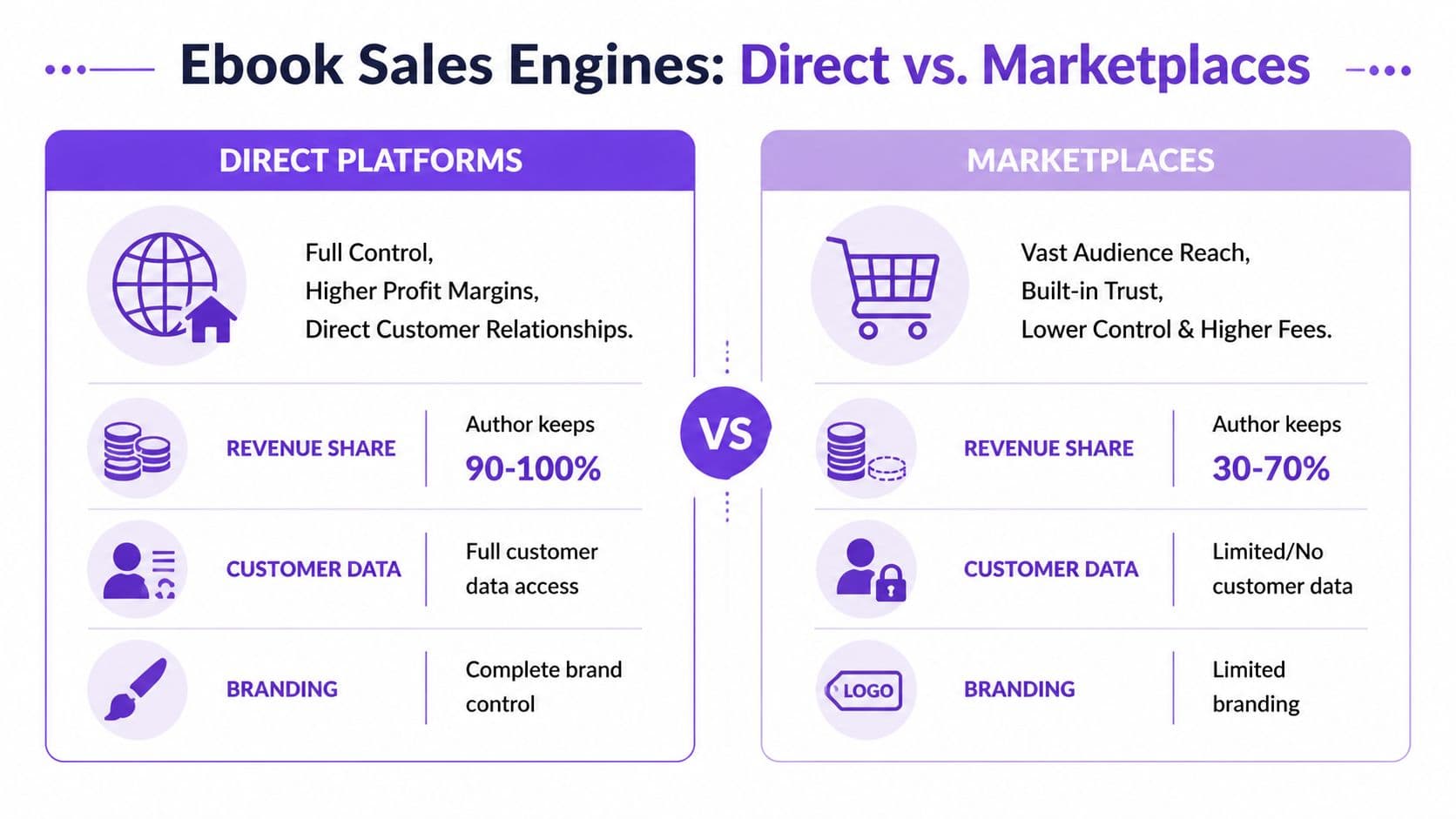
Most creators compare platforms the wrong way. They ask, “Which site makes uploading easiest?” The better question is, “Which sales engine helps me keep more revenue and turn one buyer into repeat revenue?”
Marketplaces optimize for the platform
Marketplaces are simple to join. That's their appeal. They package trust, traffic, and payments into one system.
But they also standardize you.
You operate inside someone else’s storefront, under someone else’s fee structure, with limited room to shape the customer journey. You get distribution, but you trade away control. That trade can make sense later. It usually doesn't make sense as your only channel.
Direct platforms optimize for the creator
The more profitable model is direct sales. According to this comparison of ebook selling options, many marketplaces take 30-70% in commissions, while direct sales can let creators keep 100% of revenue minus payment processor fees. The same source notes that building a direct audience can increase customer lifetime value by 2-5x compared with anonymous marketplace buyers.
That changes the math immediately.
If you sell directly, your ebook is no longer an isolated product. It becomes the first step into your ecosystem. You can sell the download, then offer a workshop, then a course, then a newsletter, then a membership. The first transaction becomes the front door.
A practical comparison
| Model | Strength | Weakness | Best use |
|---|---|---|---|
| Marketplace | Built-in buyer familiarity | Lower control and weaker customer ownership | Discovery |
| Direct platform | Better margins and audience ownership | Requires you to think like an operator | Core business |
| Hybrid | Discovery plus retention | Needs a deliberate funnel | Mature creator setup |
The wrong platform doesn't just take money. It blocks the next sale.
When direct sales make the most sense
Direct sales are the better fit if any of these are true:
- You teach a method: Buyers may want templates, community, office hours, or deeper training later.
- You have a niche audience: Even a modest audience is valuable if you can reach it directly.
- You care about branding: Premium positioning falls apart when everything lives inside a generic marketplace listing.
- You want predictable growth: Owned channels are easier to improve than borrowed visibility.
If you’re evaluating tools, this roundup of platforms to sell digital products helps frame the trade-offs.
What to look for in a direct sales setup
Most direct tools promise freedom. Many still create operational clutter. The better setup should handle sales, access, communication, and admin in one place.
Here’s the short checklist:
- Keep the revenue: Avoid platform cuts where possible.
- Sell under your own brand: Your domain matters.
- Support multiple offer types: Ebook sales often lead to bundles, subscriptions, or courses.
- Automate delivery and follow-up: Manual fulfillment doesn't scale.
- Handle payments cleanly: Administrative friction kills momentum.
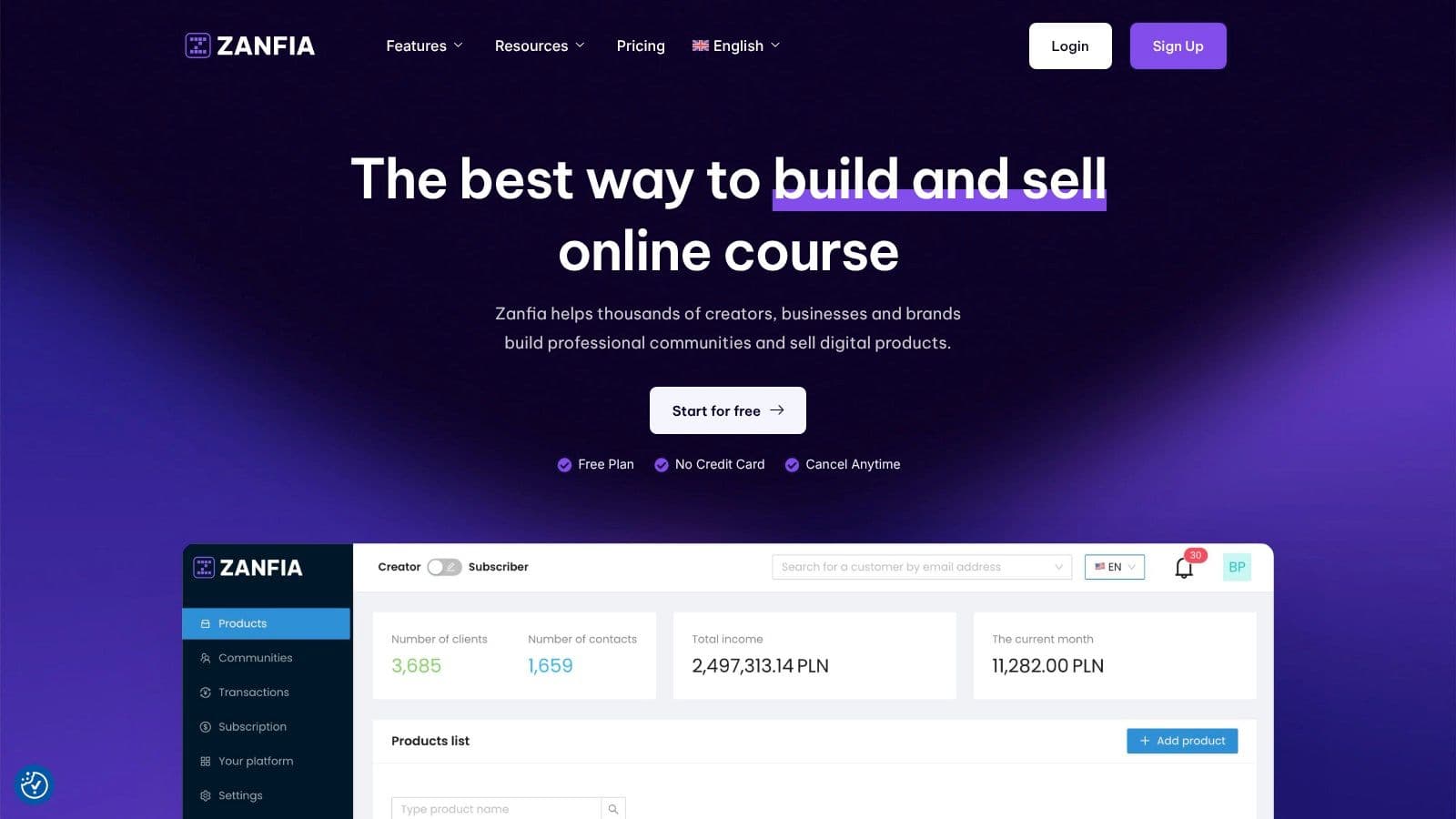
One option in this category is Zanfia, and it is worth describing as more than a download store. Zanfia is an AI team that runs the creator business, exposed as a platform: the assistant knows every screen and can act on it, so the creator dictates work by chat or by voice instead of clicking through menus, and any capability available in the interface is also available to outside AI agents through the MCP endpoint. That work lands in a checkout built to sell, with 0% platform commission on customer sales (only Stripe or PayPal fees apply), order bumps, installments and upsells, plus a test mode so you can run a real purchase of your own product before launch day. And an ebook does not have to be a standalone file: the same workspace covers 12 product types, so the same buyer can move from a download into a bundle, a course, a community or a paid newsletter under one brand and one domain. Availability of specific AI capabilities depends on the plan, see the current Zanfia pricing. Zanfia offers a 14-day free trial, no credit card required.
The hybrid model is usually the smartest path
You don't need to become ideological about this. Amazon can still play a role. Use marketplaces for visibility if they fit your niche. Use direct sales to keep the margin, own the relationship, and build the backend of the business.
That split is much healthier than handing everything to a marketplace and hoping the volume makes up for the leakage. In most cases, it won't.
Set Your Price Packaging and Launch Strategy
Most creators underprice their ebook because they're pricing their effort instead of the outcome.
That’s amateur thinking. Buyers don't care how long it took you to write. They care how much time, confusion, and trial-and-error it saves them.

According to Zanfia’s ebook pricing guide, you should price based on value, not page count, and a $49 ebook that saves a reader 10 hours of frustrating research can be a strong deal. The same guidance recommends A/B testing price points and using analytics to improve the decision instead of guessing.
Price the result
A short ebook with a precise solution can be worth more than a long ebook full of fluff. If your guide helps a freelancer land better clients, helps a coach package an offer, or helps a small business fix one expensive problem, the value isn't in the file size. It's in the shortcut.
Ask yourself these questions:
- What problem does this remove
- What expensive mistake does it help prevent
- What outcome does it accelerate
- How much frustration does it save
If the answer is meaningful, stop apologizing for the price.
For a deeper framework, this article on how to price digital downloads is useful.
Use packaging to increase order value
A single-price ebook is often the floor, not the ceiling. Strong creators package the same core knowledge into multiple buying options.
Here’s a simple structure that works well:
| Offer | What it includes | Why it works |
|---|---|---|
| Basic | Ebook only | Low-friction entry point |
| Plus | Ebook + templates or bonus video | Better value perception |
| Premium | Ebook + community access or deeper support | Captures buyers who want implementation help |
Different buyers want different levels of support. Some want the information. Others want the shortcut plus context. Packaging lets you serve both without writing a different ebook for each person.
If buyers hesitate at your price, the issue may not be the number. It may be weak positioning.
Your launch needs urgency and validation
A launch without urgency drifts. A launch with a deadline converts.
The most reliable validation method is pre-selling. If people will pay before the ebook is fully finished, you have signal. If they won't, that's useful too. It tells you to adjust the angle before sinking more time into production.
Use a launch sequence with:
- A clear promise: One specific transformation beats broad education.
- A deadline: Open and close dates force decisions.
- A reason to buy early: Bonus access, better pricing, or extra materials.
- Visible progress: Share what’s included so buyers know what they’re getting.
A practical breakdown of launch positioning and offer structure can help before you set pricing. This video is worth watching:
Test price like an operator
You don't need a complex pricing lab. You need discipline.
Track where people click, where they abandon, which traffic source buys, and whether the bundle outperforms the standalone product. If people land on the page and don't buy, revise the offer, page structure, proof, or call to action before you slash the price.
The creators who make real money selling digital products don't guess. They test.
Build Your Audience and Drive Consistent Sales
An ebook doesn’t fail because the file is bad. It usually fails because nobody was waiting for it.
That’s why audience building starts before the manuscript is done. If you want to sell an ebook consistently, build demand before launch and keep nurturing it long after the first promotion ends.
Pre-launch beats post-launch panic
According to Hostinger’s ebook launch guide, successful launches usually require marketing over months, not days. The same guide says pre-selling is the most reliable way to validate demand, and that launch urgency tactics like a 30% discount can lift sales during the promotional window.
That’s the opposite of the common beginner approach, which is: finish the ebook, post about it twice, then wonder why nobody bought.
A better sequence looks like this:
- Build interest around the topic.
- Collect email subscribers around the problem your ebook solves.
- Share useful snippets, examples, or mini-lessons.
- Pre-sell the ebook before it’s finalized.
- Launch with a deadline and a reason to buy now.
Your email list is the real sales asset
Social platforms are fine for reach. They are weak as your primary sales engine because you don't control the audience or the rules.
Email is different. When someone joins your list, you can educate them, segment them, and sell repeatedly without renting attention every time. If you need a practical primer, this guide to EmailScout for growing your email list covers the mechanics well.
Use a lead magnet that attracts buyers, not just freebie collectors. A checklist, mini-guide, or paid micro-product usually qualifies interest better than generic free content.
An audience of interested buyers beats a large crowd that ignores you.
What to send before and after launch
Most creators go silent because they don't know what to say. That's avoidable. Your emails don't need to be theatrical. They need to be useful and specific.
Good pre-launch emails often include:
- A sharp lesson: Teach one useful idea from the ebook’s core topic.
- A mistake breakdown: Explain where people get stuck and why.
- A behind-the-scenes note: Show your method, framework, or draft logic.
- An offer preview: Explain who the ebook is for and who it isn't.
After launch, keep going. Share buyer wins, answer objections, publish follow-up insights, and connect the ebook to your next offer. If you stop marketing after launch week, you’re wasting the asset.
For lead generation ideas that connect naturally to a paid ebook, this collection of lead magnet examples is useful.
Borrow audiences the smart way
You don't have to build everything alone. Cross-promotions, affiliate relationships, creator bundles, newsletter swaps, and partnerships can bring qualified buyers much faster than posting into the void.
The rule is simple. Partner with people who serve the same audience through a complementary angle. If your ebook teaches client onboarding, partner with someone teaching proposal writing or service packaging. If your ebook helps language learners, partner with a teacher, a newsletter, or a niche creator with adjacent content.
When those buyers enter your own email list or branded environment, you’re no longer chasing one-off sales. You’re building a repeatable channel.
After the Sale Automation Analytics and Optimization
A sale is not the finish line. It’s the start of the system.
If the post-purchase experience is messy, buyers feel it immediately. If the funnel leaks, your numbers show it. If admin work stacks up, you stop promoting because fulfillment becomes annoying. That’s why the creators who sell an ebook successfully treat operations as part of the product.
Watch the funnel, not just the revenue
Revenue tells you what happened. Analytics help explain why it happened.
Start with a few practical questions:
- Where did the buyer come from
- Which page got the click
- Where did visitors drop off
- Which offer sold better
- Did the follow-up email create another action
If people visit the sales page and leave, the problem may be the offer, the proof, the pricing presentation, or the call to action. If email traffic converts and social traffic doesn’t, stop treating all traffic sources as equal. Push harder on what already works.
Automation protects your time and the buyer experience
Automation sounds abstract until you use it well. If you want a clear non-technical explanation, this guide on what marketing automation is is a good baseline.
In practice, for ebook sales, automation should handle tasks like:
- Instant delivery: Buyers get access immediately after payment.
- Follow-up onboarding: A welcome email explains what to do next.
- Segmentation: Buyers of one product can receive relevant future offers.
- Access control: If part of the offer includes time-based access, the system should manage it.
- Admin cleanup: Order records shouldn't become manual chores.
That’s where an integrated platform earns its keep. In Zanfia, the AI team does the setting up: you can dictate the flow ("when someone buys the ebook, send the welcome email, tag them as buyer, invite them to the community") and the assistant configures it inside the visual automation builder. Outside AI agents can trigger the same actions through the MCP endpoint. Delivery, follow-up, segmentation and access control run on their own, and the same workspace ties them to a checkout with order bumps, installments and upsells, so an ebook buyer can move straight into a bundle or a course without leaving your brand. Availability of specific AI capabilities depends on the plan, see the current Zanfia pricing. That time saving is not glamorous. It is profitable, because time spent on admin is time not spent selling.
Good automation feels invisible to the buyer and obvious to the operator.
Keep improving the asset
Your ebook store is not static. Update the sales page. Test the headline. Improve the welcome email. Add a better bonus. Tighten the delivery flow. Review what buyers ask after purchase, then use that to strengthen the offer.
That’s how a simple download starts behaving like a business asset instead of a one-time launch.
Frequently Asked Questions About Selling Ebooks
Why is Amazon a poor first sales channel for a new ebook?
Amazon puts your book on a crowded shelf where pricing, presentation, and follow-up are constrained, and the marketplace stands between you and the buyer. That costs you margin, customer access, and brand authority. It's a reasonable secondary channel later, but a weak default when you're trying to build a business rather than just list a file.
How should I price my ebook if it's short?
Price the outcome, not the page count. A short guide that removes a specific expensive problem or saves a reader hours of research can justify a premium price, and a $49 ebook that saves 10 hours of frustrating research can be a strong deal. If buyers hesitate, the issue is usually weak positioning on the page, not the number itself.
Should I sell one ebook at one price, or offer tiers?
A single price is usually the floor, not the ceiling. Package the same core knowledge into a Basic (ebook only), Plus (ebook plus templates or a bonus video), and Premium tier (ebook plus community or deeper support). Different buyers want different levels of implementation help, and tiers let you serve both without writing separate books.
How do I validate the ebook before I finish writing it?
Pre-sell it. Open a launch sequence with a clear promise, a deadline, and a reason to buy early, then see if people pay before the manuscript is fully done. If they do, you have real signal; if they don't, that tells you to adjust the angle before you sink more time into production.
PDF or EPUB, which format should I deliver?
PDF works well for fixed-layout guides, workbooks, and checklists where visual structure matters. EPUB is better when readers want flexible reading across devices and screen sizes. In many cases the smart move is giving buyers both, so they can pick the format that fits how they actually read.
Should I use WordPress instead of a managed platform
Use WordPress if you want maximum technical responsibility. You'll need to manage plugins, checkout flow, delivery logic, updates, and the inevitable friction when tools stop playing nicely together. A managed platform is the better choice if you want to launch faster and spend your time on product and sales instead of maintenance.
Can I sell to international customers
Yes, if your setup supports international payments cleanly. Zanfia supports Stripe and PayPal, plus Apple Pay and Google Pay through a Stripe-linked cart, so international checkout is workable. Payment flexibility matters because friction at checkout costs sales.
What if I don't have an audience yet
Then don't wait for a big audience. Start with a narrow problem, build a small email list around it, and pre-sell before writing the full ebook. That's lower risk than disappearing for months and launching to silence.
Is an ebook enough on its own
Sometimes. But the stronger move is to treat the ebook as the first paid step. It can lead into a newsletter, community, workshop, or course if the topic supports deeper implementation.
If you want to sell an ebook without giving away margin, brand control, and customer ownership, build the direct path first. Zanfia gives creators one workspace where an AI team runs the business: dictate the setup by chat or voice, let outside agents work through the MCP endpoint, sell downloads, courses, communities and newsletters under your own domain, and route every buyer through a checkout built to sell (order bumps, installments, upsells, test mode before launch) with 0% platform commission on customer sales. There is a 14-day free trial, no credit card required. That setup makes far more sense than stitching together a fragile stack or handing the whole business to a marketplace.