

Substack vs Patreon: Which is Best for Creators in 2026?
You have paying interest, but the offer is still fuzzy.
A few readers want a premium newsletter. Your biggest fans ask for a members area, bonus content, or direct access. At that point, the Substack vs Patreon decision stops being a simple tool comparison and starts becoming a business model decision.
Substack and Patreon both solve part of the problem. Substack gives writers a clean way to publish and charge for access. Patreon gives creators a familiar membership system built around tiers and patron support. The catch is that each platform brings a real trade-off. Substack can feel narrow once your offer expands beyond newsletters, and Patreon's percentage-based fees can take a meaningful cut as recurring revenue grows.
That trade-off matters more than many creators expect. The right platform should fit the business you plan to run six months from now, not just the content format you publish today. A writer adding courses, an educator building a private community, a podcaster selling bonus feeds, and a creator packaging multiple offers do not need the same setup. They need pricing control, delivery tools, customer data, and room to grow without rebuilding everything later.
For creators who want a clearer foundation, it helps to define the business first. This guide on what being a content creator actually means as a business is a useful starting point. If you are still comparing publishing options more broadly, this list of top writing platforms for 2025 gives helpful context before you commit.
Here's the quick comparison:
| Area | Substack | Patreon |
|---|---|---|
| Best fit | Writers and newsletter-led publishers | Multi-format creators and membership businesses |
| Core model | Paid newsletter subscriptions | Tiered memberships and patron support |
| Fees | Platform fees plus payment processing. Costs rise with subscriber revenue. | Percentage-based platform fees plus payment processing. Costs rise as membership revenue grows. |
| Community depth | Basic comments and newsletter discussion | Better support for member interaction, gated spaces, and community perks |
| Discovery | Strong built-in newsletter discovery and referrals | Less native discovery, more reliance on your own audience |
| Analytics focus | Subscriber growth, open rates, click-through rates, free-to-paid conversion | Members, revenue, churn, upgrades, downgrades, engagement |
| Content flexibility | Best for text and email-first publishing | Better for video, audio, art, and mixed-format offers |
| Selling mechanics | Simple paid subscription with limited checkout customization | Tier-based access with add-ons tied to membership plans |
That comparison explains why more established creators start looking past the Substack or Patreon binary. If one platform limits what you can sell and the other keeps taking a percentage as you grow, an all-in-one option with 0% platform commission like Zanfia becomes a serious business consideration, not a fringe alternative.
The Creator's Crossroads: Choosing Your Monetization Path
A lot of creators don't start with a platform problem. They start with momentum.
You publish consistently. People reply. A small group asks how they can support your work. Someone asks for premium content, a members area, or direct access. That's when the easy part ends. Monetization forces you to define your product, not just your content.

Substack and Patreon sit at the center of that choice because they represent two different instincts. One says, "I want to publish and get paid for my writing." The other says, "I want to build a paying inner circle around my work." Both can work. Both can also box you in if your business model evolves faster than the platform.
I see this hesitation most often in creators who are no longer experimenting casually. They've moved beyond posting for attention alone. They want stable recurring revenue, clearer packaging, and less dependence on social platforms. If that's you, it helps to first define what kind of creator business you're building. This primer on what a content creator is is useful because it frames monetization as a business design decision, not a posting habit.
If you're still surveying the market, this guide to top writing platforms for 2025 is also worth reading because it puts Substack into a broader publishing context rather than treating it as the only serious option.
Practical rule: If your paid offer is mainly access to your writing, start by evaluating publishing flow. If your paid offer is mainly access to you, your community, or layered perks, evaluate membership mechanics first.
That distinction clears up most of the confusion in substack vs patreon debates.
Understanding the Core Philosophies of Substack and Patreon
Substack and Patreon often get compared like they're close substitutes. They aren't. They solve different jobs.
Substack as a publisher's operating system
Substack is built around the idea of independent publishing. Its center of gravity is the written piece, delivered by email, archived on the web, and supported by a simple paid subscription layer. The product experience assumes that the content itself is the value.
That matters because it shapes everything else. The interface prioritizes writing, sending, and growing a readership. The monetization model is deliberately straightforward. The audience relationship feels more like reader and publisher than fan and creator.
For essayists, analysts, journalists, and founder-writers, that philosophy makes sense. It reduces setup friction. It also encourages a clean offer. Free readers get access to some posts. Paid readers access more.
Substack tends to fit creators who want to say, "Subscribe to my work."
For readers comparing newsletter-first options, this overview of best email newsletter platforms helps place Substack in the wider array of publishing tools.
Patreon as a membership machine
Patreon starts from a different premise. It assumes the relationship is the product.
The platform is designed for creators who want to package access in layers. That can mean bonus episodes, behind-the-scenes posts, patron-only conversations, private community spaces, early releases, or direct interaction. Content matters, but access design matters just as much.
That's why Patreon often feels more natural for podcasters, YouTubers, musicians, artists, educators, and creators who publish across formats. The platform doesn't ask, "What article are you sending this week?" It asks, "What does each tier get, and why would someone stay subscribed?"
Patreon works best when members feel they're joining something, not just unlocking a file.
Why this difference matters in practice
A lot of platform frustration comes from a mismatch between business model and platform philosophy.
If you're a writer trying to run a low-friction paid publication, Patreon can feel overly structured. You end up designing tiers and perks when what you really need is distribution and reading flow.
If you're a community-led creator trying to nurture retention through layered access, Substack can feel sparse. You can publish well, but you may find yourself patching in extra tools or reducing your offer to fit the product.
That's why the best substack vs patreon decision usually starts with one question: are you selling content access or membership participation?
A Deep Dive into Revenue Models and Pricing
A creator hits the same point sooner or later. Revenue starts working, subscriptions pick up, and the platform choice stops feeling theoretical. It becomes a margin decision.
Substack and Patreon both charge platform fees, plus payment processing. The difference is how those fees behave as your business grows, and whether the product around those fees gives you enough value to justify the cut.

What Substack takes
Substack's model is easy to understand. It takes a flat percentage of paid subscription revenue, then your payment processor takes its share.
That simplicity is useful at the beginning. A solo writer can price a newsletter, start charging, and understand the basic economics without comparing plans or feature gates. In practice, the trade-off shows up later. As revenue rises, the platform keeps taking the same percentage, while the product itself stays relatively narrow.
I see this issue most often with creators who outgrow a pure newsletter model. They want member tiers, richer customer journeys, bundled products, or better control over how the business runs. The fee may still be tolerable. The bigger problem is paying a recurring platform cut while still needing other tools to fill product gaps.
What Patreon takes
Patreon approaches pricing differently. The platform fee depends on the plan, and payment processing sits on top of that.
For some creators, that structure works. If the business depends on tiered memberships, gated perks, community access, and mixed-format publishing, Patreon can justify a higher operational footprint because the product supports that style better than a newsletter-first system.
But there is a real cost to that flexibility. Percentage-based pricing means Patreon continues to participate in your upside. If you build a healthy recurring membership business, your software bill scales with your success. That may be acceptable early on. It gets harder to defend once monthly revenue becomes predictable and you start treating your creator business like an asset instead of a side project.
Why fee comparisons are often too shallow
A lot of Substack vs Patreon comparisons stop at the headline percentage. That overlooks the core decision.
What matters is retained revenue relative to what the platform helps you do. If Substack takes a cut but leaves you piecing together a fuller business elsewhere, your true cost is higher than the platform fee. If Patreon supports more formats but still claims a percentage of every member payment, you need to ask whether those features are worth surrendering long-term margin. This guide on how to maximize your content monetization is useful if you want to evaluate payout logic more carefully.
Offer design matters too. Recurring revenue works very differently for newsletters, memberships, courses, and hybrid creator products. This breakdown of membership and subscription business models is a practical reference if you are pricing beyond a simple monthly subscription.
A short walkthrough helps:
The practical pricing takeaway
Substack makes sense when the business is a paid publication and the main priority is simplicity.
Patreon makes sense when the business depends on tiering, perks, and membership packaging across multiple formats.
There is also a third path, and for many serious creators it is the more durable one. If both platforms force a compromise, Substack through feature scarcity and Patreon through ongoing percentage fees, an all-in-one option with 0% platform commission on customer sales becomes easier to justify. As of publication, Zanfia charges 0% platform commission on every plan, so creators keep more of every sale while running the tools in one place. That works especially well when the business needs a checkout built to sell: order bumps, upsells, installments that let a $600 course split into four payments, and a test mode that lets a creator buy their own product end to end before the first real order.
Comparing Content, Community, and Growth Features
A creator can make the wrong platform choice even with a good offer.
I see it happen when a writer tries to force a membership business into Substack, or when a podcaster builds a simple paid publication inside Patreon and ends up managing more structure than the product needs. The platform should match how the audience consumes value and why they keep paying.
Content formats and delivery
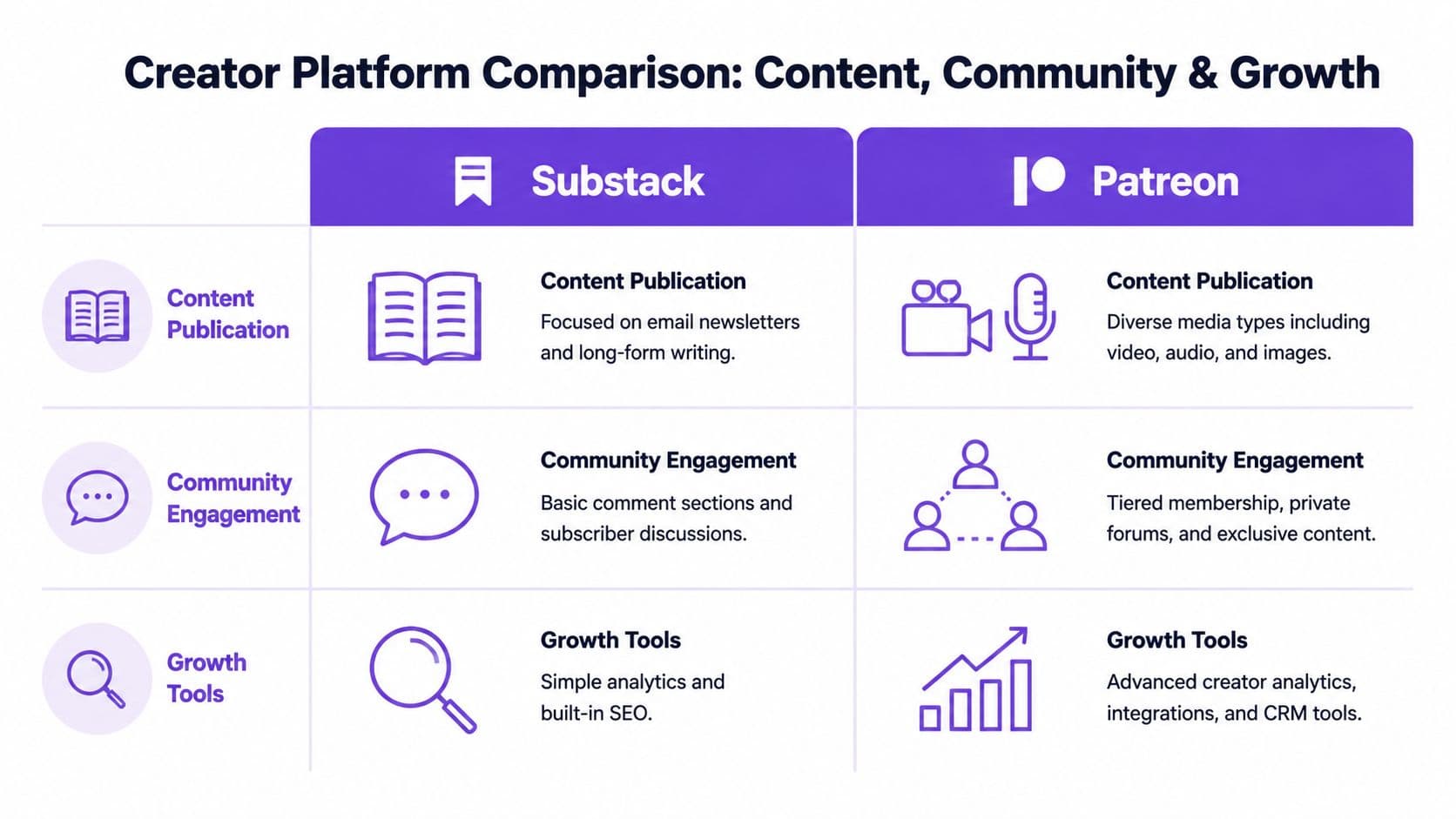
Substack works best when the product is a publication first. Email is the center of gravity. That gives writers a clean workflow for publishing, sending, archiving, and charging readers without building extra layers they may never use.
That same simplicity creates limits. A creator selling lessons, files, gated resources, audio, and segmented member experiences can outgrow Substack fast. The content exists, but the business model starts pushing against the edges of the tool.
Patreon handles mixed-format publishing better. It gives creators more room to package bonus episodes, behind-the-scenes posts, downloads, and access-based perks without forcing everything through the newsletter model.
A simple test usually gets to the answer quickly:
- Reader habit is the product . Substack fits better.
- Access, variety, and perks are the product . Patreon fits better.
- You want one system for content, customer journeys, and automations . An all-in-one setup is often the smarter long-term move, especially if you expect operational complexity to grow. Tools for creator workflow automation and business operations become more relevant once you are managing more than posts and paywalls.
Community depth and member experience
Community is where the gap becomes obvious.
Patreon is built for membership behavior. Tiers, access rules, private interaction, and community perks all support a model where people pay to feel closer to the creator or to get a different level of participation. That matters when retention depends on belonging, recognition, or exclusive access.
Substack supports conversation, but the interaction model stays relatively light. For some businesses, that is enough. A writer with thoughtful comments and a strong publishing cadence may not need anything more.
For many membership businesses, it is not enough. If members stay because they join events, access different experiences, enter private spaces, or receive benefits tied to their plan, Patreon usually maps to that retention logic more naturally.
This is also where the trade-off gets sharper. Patreon gives creators more community mechanics, but those mechanics sit inside a fee structure that keeps taking a share as the business grows. Substack lets creators keep the setup simple, but many will eventually want features it does not provide.
Growth mechanics and discoverability
Substack has a real advantage on growth for writer-led businesses. Its recommendation loops and newsletter network can help readers discover related publications inside an environment already built around subscription behavior. For an essayist, analyst, or niche operator, that can reduce the amount of external funnel-building required early on.
Patreon usually performs differently. It is stronger as a monetization layer for attention you already own from YouTube, podcasts, social channels, or an existing audience list. It can convert fans into members well, but it is less useful as a discovery engine.
That distinction matters because growth and retention are connected. Substack can help with top-of-funnel audience development for publications. Patreon can support stronger retention for community-driven memberships. Neither platform covers both sides especially well for creators building a broader business with content, community, products, and lifecycle marketing under one roof.
What works and what breaks
The better question is not which platform has more features. The better question is which platform supports the reason people pay you.
| Situation | Better fit | Why |
|---|---|---|
| Essayist, analyst, writer-led brand | Substack | Publishing cadence and paid newsletter mechanics line up cleanly |
| Podcaster with bonus episodes and a private member space | Patreon | Access control and membership packaging fit the offer |
| Artist selling behind-the-scenes access and tiered rewards | Patreon | Perks and member status are part of the product |
| Founder writing to a niche professional audience | Substack | Email delivery and in-network discovery support repeat readership |
| Creator building content, memberships, digital products, and customer journeys together | All-in-one platform like Zanfia | An AI team runs the day-to-day work, the creator dictates by chat or voice, and the checkout is built to sell with order bumps, installments, and 0% platform commission on customer sales |
Common failure points show up fast:
- Using Substack as a full membership engine when retention depends on layered access and active community participation.
- Using Patreon as a publication hub when the business mainly needs simple writing, reading, and subscription conversion.
- Adding tiers before the offer is clear . More packaging creates more admin work.
- Relying on native discovery to fix weak positioning . No platform can solve an offer that is vague or hard to explain.
The real trade-off
Substack gives creators clarity by keeping the model narrow. Patreon gives creators more membership tools, but asks for a continuing share of revenue in return.
That leaves a meaningful gap in the market.
Creators who want more than a newsletter, and who also want to stop giving up percentage-based platform fees, usually need a third option. That is why all-in-one platforms with 0% platform commission on customer sales are getting more attention. They let creators run content, community, products, and customer relationships in one place while keeping more ownership over the business itself. Zanfia is compelling for exactly that reason: an AI team runs the recurring work, the creator dictates it by chat or voice through the assistant, and the checkout is built to sell with order bumps, upsells, and installments.
Analytics, Integrations, and Admin Workflow
A creator usually feels this section of the decision later than they should. Revenue starts climbing, the offer gets more complex, and suddenly the question is no longer "Which platform helps me publish or monetize?" It becomes "Which platform helps me run the business without adding manual work every week?"
That is where the differences get expensive.
What each dashboard helps you manage
Patreon and Substack surface different metrics because they are built for different operating models.
Patreon is set up more like a membership business dashboard. It focuses on member counts, revenue movement, churn, upgrades, downgrades, and community activity, according to WMtips' comparison of Patreon and Substack. Those are the numbers you watch when retention and tier performance drive growth.
Substack is closer to a publishing dashboard. It centers on subscriber growth, open rates, click rates, and free-to-paid conversion. For a writer or analyst whose business rises and falls on editorial performance, that focus is useful. It keeps attention on what improves a paid newsletter.
Neither view is wrong. Each one reflects the type of business the platform expects you to build.
Integrations set the limits on your operation
Patreon generally fits better into a broader creator stack. Earlier comparisons note connections with tools like Discord and WordPress, which matter if your business already spans a site, a private community, a podcast feed, and member-only resources.
Substack is simpler. That can be an advantage if the business is mainly newsletter-first and the goal is to keep the toolset light. But simplicity has a cost. Once creators need segmented automations, cross-sells, product-specific journeys, or handoffs between tools, the platform starts to show its edges.
This is the operational gap many creators miss at the buying stage.
Substack keeps admin lighter by limiting what you can build natively. Patreon gives you more membership mechanics, but often at the cost of a more layered setup and ongoing platform fees. If you are stitching together content, community, products, and automations, you eventually start asking a more strategic question: why accept either feature scarcity or a recurring revenue cut?
Workflow reality for operators
Weekly review habits make the contrast obvious.
A Substack creator usually checks which posts were opened, which links earned clicks, and which emails converted free readers into paid subscribers. That workflow is clean and editorial.
A Patreon creator is usually watching a different set of issues. Which tier is losing members? Where are downgrades happening? Which benefits are driving retention? That workflow is more operational because the business model itself is more layered.
Admin burden rarely shows up in a pricing table. It shows up in repetitive tasks, disconnected tools, and manual follow-up. If that is already a pain point, this guide to workflow automation tools for creators and small teams is worth reviewing before you commit to a platform that creates extra maintenance.
A practical rule:
- Choose Substack if the main job is publishing, audience growth, and converting readers into paid subscribers.
- Choose Patreon if the main job is managing memberships, retention, and tier-based community access.
- Look beyond both if you want stronger business ownership, fewer tool handoffs, and 0% platform commission on customer sales without giving up the ability to run content, products, and customer journeys together.
That last group is larger than many creators expect. It includes the people who have already proven demand and now need infrastructure, not just a newsletter tool or a patron page.
Beyond the Binary: The All-in-One Power of Zanfia
Substack and Patreon dominate the conversation because each solves a familiar creator problem. Substack simplifies paid publishing. Patreon strengthens membership and community mechanics.
But many serious creators outgrow both frames.
They don't just want a newsletter or a patron page. They want a business they control under their own brand, on their own domain, with products that work together instead of living in separate tools. That's the gap where Zanfia becomes relevant.

Why some creators need a third option
The limitation with Substack is feature scarcity. It's elegant when the business is primarily a newsletter. It's less elegant when the creator also wants courses, digital downloads, a branded member area, structured community channels, and more operational control.
The limitation with Patreon is percentage-based monetization. It can be the right engine for membership businesses, but many creators eventually start asking a sharper question: why keep giving away a platform cut on every sale once the business is established?
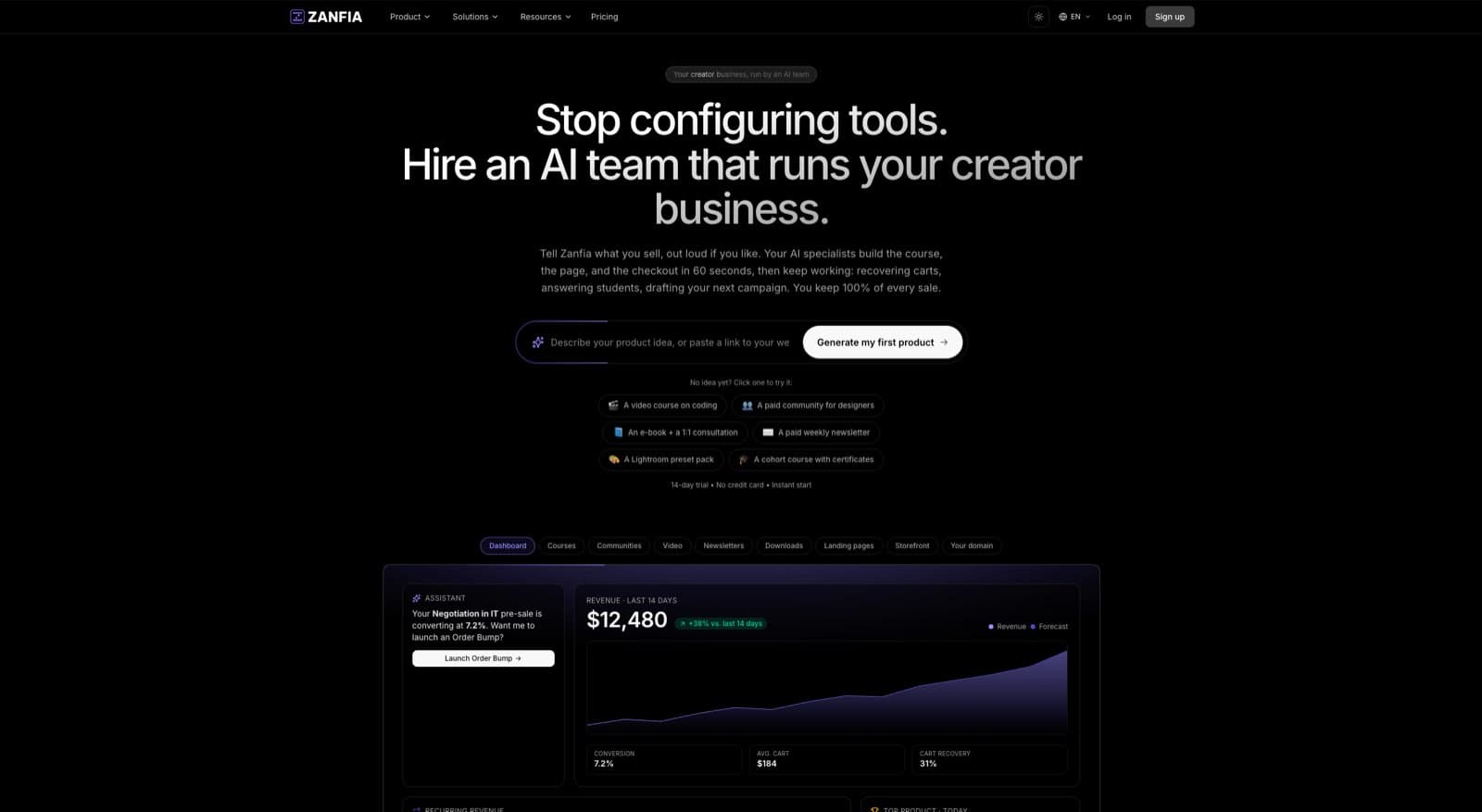
Zanfia answers both issues with a different operating model: instead of positioning itself only as a course, community, or newsletter tool, it is set up as an AI team that runs the creator business, with a platform underneath.
What Zanfia changes
Zanfia is an all-in-one platform for creators, experts, businesses, and brands who want to build under their own domain with full brand control. Instead of piecing together tools, creators can run paid newsletters, online courses, knowledge libraries, communities, subscriptions, e-books, and downloads inside one system, and the assistant can perform any action available in that system by chat or by voice, so a creator can dictate a new price, a new bundle, or a new community post instead of clicking through it.
The economics are the first standout point. As of publication, Zanfia charges 0% platform transaction fees on customer sales. Creators keep the revenue and only pay the fees charged by the payment processor itself (in the US, that typically means Stripe or PayPal at their standard rates).
That changes the long-term math for creators who are tired of watching commissions stack up as revenue grows.
Business control instead of platform compromise
Zanfia also addresses a problem that often appears after growth. Brand dilution.
On marketplace-style platforms, the audience interacts with the platform brand as much as the creator brand. Zanfia takes the opposite approach. Custom domain support and white-label options are part of the product, so the customer experience stays anchored to the creator's own identity. Availability of the deeper white-label controls depends on the plan, see the current Zanfia pricing.
That matters most for experts and premium brands. If you've spent years building authority, you usually don't want your paid product to feel like a rented profile inside someone else's ecosystem.
Community, courses, and operations in one place
The strongest operational advantage is consolidation.
Zanfia combines community tools, courses, newsletter monetization, and digital product sales with a single login and a unified customer journey. The community layer includes topical discussion channels, read-only announcement channels, and group-based organization. Course access and community participation can work together instead of being split across separate systems. Communities also have a built-in AI agent that writes from the creator's own content, and everything it publishes is labeled as AI so members always know what came from the assistant.
Its course infrastructure is also unusually strong for creators who teach. Zanfia includes native video hosting, while also supporting integrations with YouTube, Vimeo, Wistia, and Bunny.net. The video player saves student progress automatically.
The checkout is built to sell. Courses can be sold as one-time purchases, subscriptions, installment plans that split a $600 course into four payments, or bundles, with order bumps and subscription upsells at checkout. Creators can also run a test purchase in test mode to buy their own product end to end before the first real sale, so tracking and delivery are proven before ads go live.
A creator business gets simpler when the buyer doesn't have to move between disconnected tools to read, learn, pay, and participate.
Automations that carry the operational load
Zanfia includes a visual automation builder that handles access, welcome flows, subscription changes, and entitlement management. Triggers cover new purchases, plan changes, renewals, failed payments, trial starts, and access ending in 14, 7, 3, or 1 day, so lifecycle work runs itself instead of sitting in a to-do list. Those workflows can save 5-10+ hours a month, which is exactly the kind of operational gain mature creators care about. For creators who want AI assistants to work directly with their workspace, Zanfia also exposes an MCP endpoint, available on higher plans, see the current Zanfia pricing.
Who Zanfia is for
Zanfia fits especially well for three creator profiles:
- Business Architects who already earn meaningful revenue and need a cleaner, more integrated setup.
- Craft Masters who operate at a premium level and want infrastructure that matches their brand.
- Potential Explorers who have expertise but feel blocked by technical complexity.
For creators who want ownership, margin protection, and one coherent system where an AI team handles the recurring work, that's a meaningful alternative to the usual substack vs patreon debate.
Making Your Final Choice: A Creator's Decision Framework
A creator has 1,000 paying supporters, solid momentum, and a growing product mix. Then the friction starts. Substack feels too narrow once the business expands beyond writing. Patreon keeps more of the business than expected once revenue climbs. That is usually the point where the decision becomes clear.
The right choice starts with the business model, not the platform brand.
Choose based on what customers are really paying for
Substack fits best when the paid product is the writing itself. Readers subscribe for essays, reporting, analysis, or a consistent publishing habit. If that is the core offer, Substack keeps the operation simple and the value proposition easy to understand.
Patreon fits better when the subscription is built around access and layered benefits. Audio, video, community interaction, bonus drops, and tiered perks all make more sense there than on a newsletter-first platform.
Many creators sit between those two models. They sell writing, community, courses, downloads, and events together. That is where the Substack vs Patreon comparison starts to break down, because neither platform was designed to run the full business cleanly. One is constrained by feature scope. The other takes a percentage as revenue grows.
The framework I use with clients
I would answer these questions in order:
- What is the main paid product? Writing, access, teaching, community, or a bundle.
- Why does a member stay? New issues, direct interaction, structured learning, status, or belonging.
- How many products do you plan to sell within the next 12 months? A newsletter-only setup is very different from a business that will add courses, digital products, or a member hub.
- How much brand control do you need? Some creators are comfortable renting attention inside another platform. Others need their own customer experience, domain, and sales flow.
- How sensitive is your model to fees? If you expect meaningful subscription revenue, percentage-based platform fees become a margin decision, not a rounding error.
If the goal is a more owned membership business, a member website builder for creators is often the better category to evaluate than newsletter tools by themselves.
A practical decision map
| If this sounds like you | Best direction |
|---|---|
| "People pay for my writing, and I want the simplest publishing workflow." | Substack |
| "People pay for access, perks, and content across multiple formats." | Patreon |
| "I want one branded system for newsletter, community, courses, and digital products, an AI team that runs the day-to-day work by chat or voice, and 0% platform commission on customer sales." | Zanfia |
Where creators make the wrong call
They optimize for setup speed instead of business fit.
That mistake is common early on. A creator picks the tool that feels easiest this month, then spends the next year patching around limits, adding extra software, and accepting fees that were tolerable at low revenue but painful later. The platform looked simple. The business became messy.
Choose for the shape of the business you want to run a year from now.
Substack is a reasonable answer for a writer with a focused paid newsletter. Patreon is a reasonable answer for a membership creator whose offer depends on tiers and perks. But creators building a branded business with several revenue streams usually need something both platforms only partly provide.
FAQ
Should I choose Substack or Patreon if my paid offer is mainly access to my writing?
Start by evaluating Substack's publishing flow. The article's practical rule is that when the paid offer is primarily access to your writing, publishing simplicity matters more than membership mechanics. Substack is built around independent publishing with email at the center, which fits writers, essayists and founder-writers running low-friction paid publications.
When does Patreon make more sense than Substack?
Patreon fits when the paid offer depends on tiering, perks and membership packaging across multiple formats. It assumes the relationship is the product, so it works better for podcasters, YouTubers, musicians, artists and educators who publish across formats. If retention depends on belonging, recognition or exclusive access, Patreon's mechanics support that model more naturally than Substack's.
How do Substack and Patreon fees actually differ as revenue grows?
Substack takes a flat percentage of paid subscription revenue plus payment processing, which keeps early economics simple. Patreon's platform fee depends on the plan, again with payment processing on top. In both cases the platforms keep taking a percentage as your business grows, so the software bill scales with your success.
Why do headline fee comparisons between Substack and Patreon fall short?
They stop at the platform percentage and ignore retained revenue relative to what the platform actually helps you do. If Substack takes a cut but leaves you piecing together the rest of your business elsewhere, your true cost is higher than the platform fee. If Patreon supports more formats but still claims a percentage of every member payment, you have to ask whether those features are worth surrendering long-term margin.
When should a creator look past the Substack vs Patreon binary entirely?
When one platform limits what you can sell and the other keeps taking a percentage as you grow, an all-in-one option with 0% platform commission becomes a serious business consideration. As of publication, Zanfia charges 0% platform commission on customer sales (plan-dependent), so more revenue stays with the creator while courses, community and checkout run in one place. Check current plans at zanfia.com/pricing.
That is why Zanfia deserves a place in the decision. It combines paid newsletters, courses, digital products, community, custom domain control, and 0% platform commission on customer sales in one system, with an AI team the creator can dictate to instead of clicking through every task, and a checkout designed to close the sale. For creators who care about ownership, margin, and operational simplicity, that is not a minor difference. It changes the economics of the business.