

What is Skool: A Guide for Creators on How to Monetize an Audience

So, what exactly is Skool? Let's cut through the hype.
At its core, Skool is a community platform built for creators. It rolls discussion forums, online courses, event calendars, and a clever gamification system into one clean package. Think of it as building a private, focused clubhouse for your audience—a place far away from the noisy, algorithm-driven chaos of social media.
What Problem Does Skool Solve?
Skool's entire philosophy is about helping creators build a loyal community and sell their expertise without the usual technical headaches. It takes the best parts of a Facebook group (the interaction) and merges them with the structure of a course platform like Teachable.
To really get it, you need to understand what a content creator is and the frustrating juggling act they perform daily—one tool for community, another for courses, and yet another for events. Skool aims to end that.
This all-in-one simplicity is why it's been blowing up. The platform saw a massive 43.52 million visits in a recent month alone, which was a 17.17% jump from the month before. With 37.36% of its users in the US and 6.68% in the UK, it's clear the message is resonating in major markets.
Skool's interface is intentionally minimal, designed to get you and your members set up and talking in minutes, not days.

This focus on collaboration is the whole point. It's not about complex funnels; it's about connection.
How The Pieces Fit Together
Skool is built on four core components that are tightly woven together. They aren't just separate features bolted on; they're designed to feed into each other to keep your members active and engaged within your private world.
To help you visualize how it all works, here's a quick breakdown of Skool's four pillars.
| Component | Primary Function | Use Case for Creators |
|---|---|---|
| Community | A private discussion forum | The central hub for member questions, wins, and peer-to-peer conversations. |
| Classroom | A simple online course builder | Host your video lessons and resources right inside the community. No external logins needed. |
| Calendar | A unified event scheduler | Post live Q&As or workshops that automatically show up in every member's local time zone. |
| Gamification | An automated engagement system | Members earn points and climb leaderboards just by participating, creating a fun, competitive vibe. |
This table shows how each piece plays a role in creating a single, cohesive experience for your members.
By integrating these elements, Skool gives creators a straightforward path from having an audience to building a profitable community. It deliberately skips the advanced marketing tools and deep customizations you'd find on other platforms.
Instead, Skool bets everything on simplicity and engagement. This makes it an incredibly compelling option if your main goal is to focus on your people and your content, not your tech stack. If you want to dive deeper into this core concept, check out our guide on what is community building.
A Deep Dive Into Skool's Key Features
To really get what Skool is all about, you have to look beyond its clean, minimalist design and see how its core tools work together. Skool isn't just one thing; it's a blend of four key components, each designed to make the others more powerful.
Let’s break down how this all fits together to create an experience that keeps members coming back.
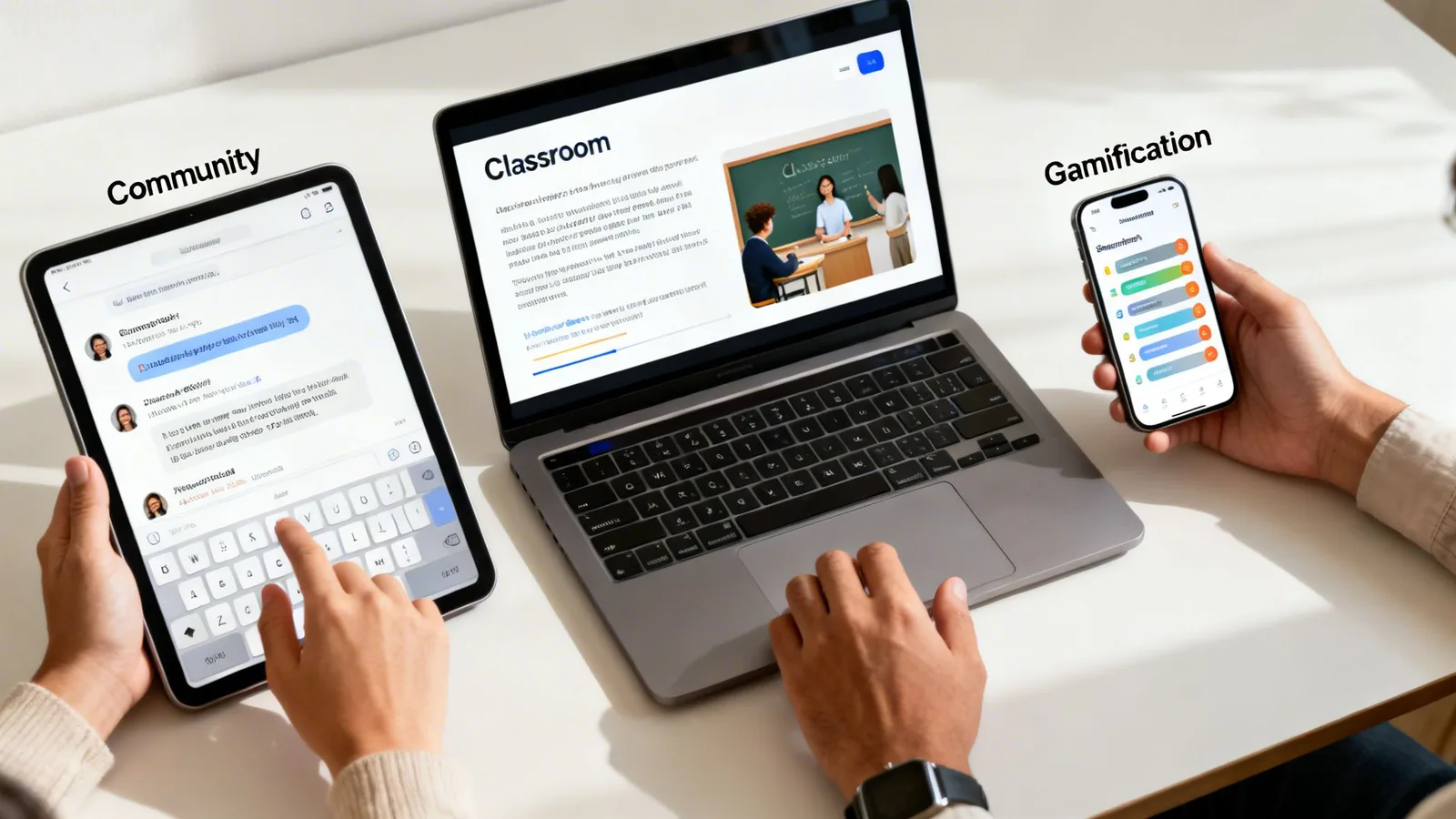
The Community Hub
The Community hub is the beating heart of any Skool group. Think of it as a private, hyper-focused version of a social media feed—but without all the ads, algorithm chaos, and off-topic noise. Here, members can start discussions, ask questions, share wins, and post content, building real peer-to-peer connections.
For creators, this is your command center. You can post announcements, run challenges, and engage directly with your audience. Because it's a closed environment, you have total control, ensuring every conversation adds value.
The Integrated Classroom
Tightly integrated with the community is the Classroom. This is where you house your online courses, complete with video lessons and downloadable resources like worksheets or PDFs. One of Skool's biggest draws is that your educational content lives right next to the conversation, so members don't need a separate login or have to navigate away to a different site.
The Classroom is intentionally simple, letting you organize lessons into clear modules. A major recent upgrade is native video hosting, allowing you to upload videos directly to Skool for a professional, ad-free experience. You can still embed from YouTube or Vimeo if you need to, but the native option is a huge step up. To see how this stacks up against other platforms, check out our detailed learning management system features comparison.
The Calendar for Live Events
Skool includes a built-in Calendar to drive real-time engagement. This is where you can schedule your live events, whether they're weekly Q&As, expert workshops, or group coaching calls.
A simple but brilliant feature is that the calendar automatically converts event times to each member’s local time zone. This small detail eliminates confusion and is a key reason why it's so effective for boosting live attendance.
An analysis of the top 1,000 Skool communities found the platform hosts over 170,000 groups. The most dominant niches are Education (152 communities), AI/Automation (94), and Finance (50), showing its strong fit for knowledge-based creators. Top groups use features like live events and gamification to build high-ticket businesses. You can explore more data on Skool's top communities on JoeApfelbaum.com.
The Power of Gamification
This is Skool’s secret weapon. The built-in gamification system is what turns passive consumption into active, daily participation. It’s what makes learning feel less like a chore and more like a game.
Here’s the breakdown:
- Points and Likes: Members earn points whenever someone likes their posts or comments. This simple reward system encourages people to contribute valuable insights.
- Levels: As points add up, members "level up" through different ranks (e.g., Level 1, Level 2). It provides a clear and visible sense of progress.
- Leaderboards: A public leaderboard ranks the most active members by their points, introducing a friendly competitive streak that motivates engagement.
- Unlocking Content: Here’s the masterstroke. Creators can lock specific courses in the Classroom until a member reaches a certain level. This brilliantly incentivizes new members to jump into the community and start participating so they can unlock more advanced content.
By weaving these four pillars—Community, Classroom, Calendar, and Gamification—into a single experience, Skool creates a powerful feedback loop. Members engage to earn points, which unlocks courses, which sparks more questions in the community. This synergy is what defines Skool and explains why it’s so good at building active, self-sustaining communities.
Who Is Skool Actually For

Skool isn’t trying to be a one-size-fits-all solution for every creator out there. Its real power comes from a laser-focused approach that naturally appeals to a specific kind of person—one who values simplicity and genuine engagement above everything else.
The common thread? A deep desire to escape the technical headache of juggling a dozen different tools. Creators who land on Skool are tired of duct-taping a forum plugin to a course builder and a payment processor. They just want to get back to what they do best: creating great content and connecting with their people.
The Ideal Skool Creator Profile
So, who is that person? Skool is a magnet for creators who see their audience not as leads in a funnel, but as members of a tribe. They understand that real, peer-to-peer interaction and a shared sense of purpose are what create long-term value.
The platform is a good match if your business is built around selling access to knowledge and community, not complex marketing funnels. It’s for creators who would much rather host a live Q&A than spend a week optimizing an email sequence. If that sounds like you, you're likely what's known as a digital creator—someone who builds a business around their unique expertise. You can learn more about what being a digital creator means in our guide.
Skool works well for creators who believe a highly engaged community is their most powerful business asset. The platform's philosophy is simple: foster connection, and the monetization will follow. This is a world away from platforms that prioritize intricate sales features over the actual member experience.
Real-World Creator Scenarios
To make this crystal clear, let's walk through three distinct scenarios where Skool’s focused toolset fits well. These examples show you exactly who the platform was built for.
- The Fitness Coach: A coach running a subscription-based workout group can use the Classroom to post weekly exercise videos, the Community hub for members to share progress and ask questions, and the Calendar to schedule live check-ins. The built-in gamification keeps everyone motivated and accountable.
- The Business Consultant: A consultant with a high-ticket mastermind needs an exclusive, private space. They can use Skool to share advanced training, host private Q&As, and foster a powerful peer network where members collaborate—all far from the noise of social media.
- The YouTuber or Influencer: A popular creator can launch a Skool community to give their top fans a "backstage pass." They can share behind-the-scenes content, host private live streams, and offer courses that aren't for the general public. Gamification even helps them identify and reward their biggest supporters.
In every case, the creator's main goal is to deliver a premium, interactive experience for a dedicated group. Skool gives them exactly the tools they need for this—a place for content, a place for conversation, and a system to make it fun—all wrapped in one clean, intuitive package.
Understanding Skool's Pricing Model
Let's get straight to the point: how much does it cost? When you’re picking a platform, the pricing model isn’t just a line item—it’s a reflection of the company’s philosophy. Skool has made waves by keeping its pricing almost shockingly simple, a deliberate move away from the confusing, multi-tiered plans that plague the creator industry.
As of early 2024, Skool’s entire model is built on one flat-rate monthly subscription. For that single price, you get one community group with unlimited members, unlimited courses, and every single feature the platform offers. There are no surprise charges, no usage-based penalties, and no tiers to navigate.
A Clear and Simple Subscription
This straightforward approach is all about predictability. You pay one fee every month, which makes budgeting and forecasting your business finances incredibly easy. It’s a huge draw for creators who are fed up with platforms that punish them with higher fees just because their community is growing.
The big idea behind Skool’s pricing is that the platform shouldn't take a cut of your success. Your revenue is your revenue. This alone sets it apart from competitors that build their business model on taking a percentage of every dollar you make.
By sticking to a clean subscription, Skool positions itself as a tool you pay for, not a partner that taxes your income. It lets you focus on what actually matters—building your community—instead of worrying about how much of your next sale will be eaten by platform fees. If you're looking for ways to structure your own offers, our guide on subscription pricing strategies breaks down the different models.
What About Transaction Fees?
This is where creators often get tripped up, so it's a critical point to understand. While Skool charges 0% in platform transaction fees, this doesn't mean your sales are completely fee-free. When a member pays you, that money is handled by a third-party payment processor like Stripe.
These processors charge their own standard fees, which are completely separate from Skool. For instance, Stripe typically takes a small percentage plus a flat fee from every single transaction.
Here’s how that actually breaks down for you:
- Skool's Fee: You pay a flat monthly subscription for the platform, which is $99/month for their one-and-only plan.
- Your Revenue: You keep 100% of the money that Skool itself processes.
- Payment Processor Fees: Services like Stripe will deduct their standard processing fees before the money ever lands in your bank account.
Getting this distinction right is crucial for projecting your actual profits. Skool’s promise is that it won’t add any extra percentage-based fees on top of what the payment gateways already charge. This transparency means you always know your costs, letting you scale your revenue without giving an ever-larger slice to your platform provider.
The Honest Pros and Cons of Using Skool
No platform is the right tool for every single creator, and the key to a smart decision is understanding the trade-offs. Skool’s greatest strength—its radical simplicity—is also the source of its biggest limitations.
Let's get real about where Skool truly shines and where it will leave you wanting more.
The Pros: Where Skool Excels
For a certain kind of creator, especially those just starting out or a "Potential Explorer" overwhelmed by tech, Skool is an absolute game-changer. Its advantages are clear, compelling, and built to cut through the noise so you can focus on what matters: your members.
- Undeniable Simplicity: Skool's interface is clean, intuitive, and so easy to use that most creators figure it out in minutes. This means you can launch your community incredibly fast, without the technical headaches or steep learning curve that plagues other platforms.
- Powerful Engagement Through Gamification: This is Skool’s secret weapon. The built-in system of points, levels, and leaderboards turns participation into an addictive game. It’s a brilliant way to motivate members to contribute, sparking a lively and self-sustaining community from day one.
- A True All-in-One Hub: Your community, courses, and calendar all live under one roof with a single login. This unified setup eliminates the friction of sending members to different websites, dramatically improving their experience and keeping them locked into your world.
- Flat-Rate Predictability: With a simple monthly price and 0% platform transaction fees, your costs are always predictable. You keep 100% of your revenue (minus standard payment processor fees), a massive financial win compared to platforms that skim a percentage off every sale.
The Cons: Where Skool Falls Short
That laser focus on simplicity comes at a cost. If you’re a more established creator—a "Business Architect" or "Craft Master"—or have a sophisticated business model, you'll quickly run into Skool's built-in limitations.
- Minimal Brand Customization: You can't truly white-label your Skool community. You can add a banner and description, but the "Skool" logo and branding are always there. For premium brands focused on building a distinct identity, this is a major drawback. Platforms like Zanfia, in contrast, give you complete white-label control on your own custom domain.
- Limited Monetization Flexibility: Skool's payment system is basic. It’s designed for one thing: recurring monthly subscriptions. It lacks the advanced options you need to scale revenue, like installment plans, product bundles, or one-click upsells, making it tough to maximize customer lifetime value.
- No Advanced Marketing Tools: Skool isn’t built for marketing. It has no native email marketing, no advanced landing page builders, and no detailed sales analytics. If you need to run sophisticated funnels, you'll be stuck trying to connect external tools with clunky workarounds. Powerful automations in other systems can save 5–10+ hours a month.
- Basic Course Features: The Classroom feature is fine for simple video courses, but it is not a full-fledged Learning Management System (LMS). It lacks essential tools for serious education, like graded quizzes, assignments, or course completion certificates.
To really see what this means in practice, let’s put Skool side-by-side with a more feature-rich platform.
Skool vs. All-in-One Alternatives: A Feature Comparison
This table highlights the core trade-off: Skool prioritizes a simple, focused experience, while comprehensive platforms like Zanfia are built to give creators the tools they need to build a scalable, brand-owned business.
| Feature | Skool | Comprehensive Platforms (e.g., Zanfia) |
|---|---|---|
| Brand Control | Limited; Skool branding is present. | Full White-Label Control with custom domains. Your brand, your platform. |
| Monetization | Simple subscriptions. | Flexible Pricing: Subscriptions, installment plans (e.g., split a $600 course into four payments), order bumps and one-click upsells. |
| Platform Fees | 0% (plus processor fees). | 0% platform commission today—creators keep 100% of revenue, minus standard processor fees. |
| Marketing | Minimal; no built-in funnels or email. | Integrated Tools: Sales analytics, MRR reporting, GA4 and Meta pixel per product, plus a visual automation builder (availability depends on the plan, see the current Zanfia pricing). |
| Course Features | Basic video hosting and resources. | Advanced LMS: Native video, smart player, progress tracking, quizzes and completion certificates. |
| AI and Voice | No built-in AI assistant. | AI team by chat or by voice: dictate any action available in the interface, plus an MCP endpoint so your own AI agents can work on your workspace (availability depends on the plan). |
Ultimately, choosing Skool is a strategic decision to embrace a trade-off. You gain radical simplicity and powerful gamification, but you sacrifice brand control, marketing power, and monetization flexibility.
For a "Potential Explorer" launching their first community, this is often a good fit. But for "Business Architects" and "Craft Masters" looking to scale, these limitations can quickly become a ceiling on their growth.
How Skool Compares to Zanfia and Other Platforms
To really wrap your head around what Skool is, you have to see where it fits in the packed market of creator tools. Skool's calling card is its radical simplicity. But this laser focus comes with some serious trade-offs, especially when you put it next to an AI-first, all-in-one platform like Zanfia.
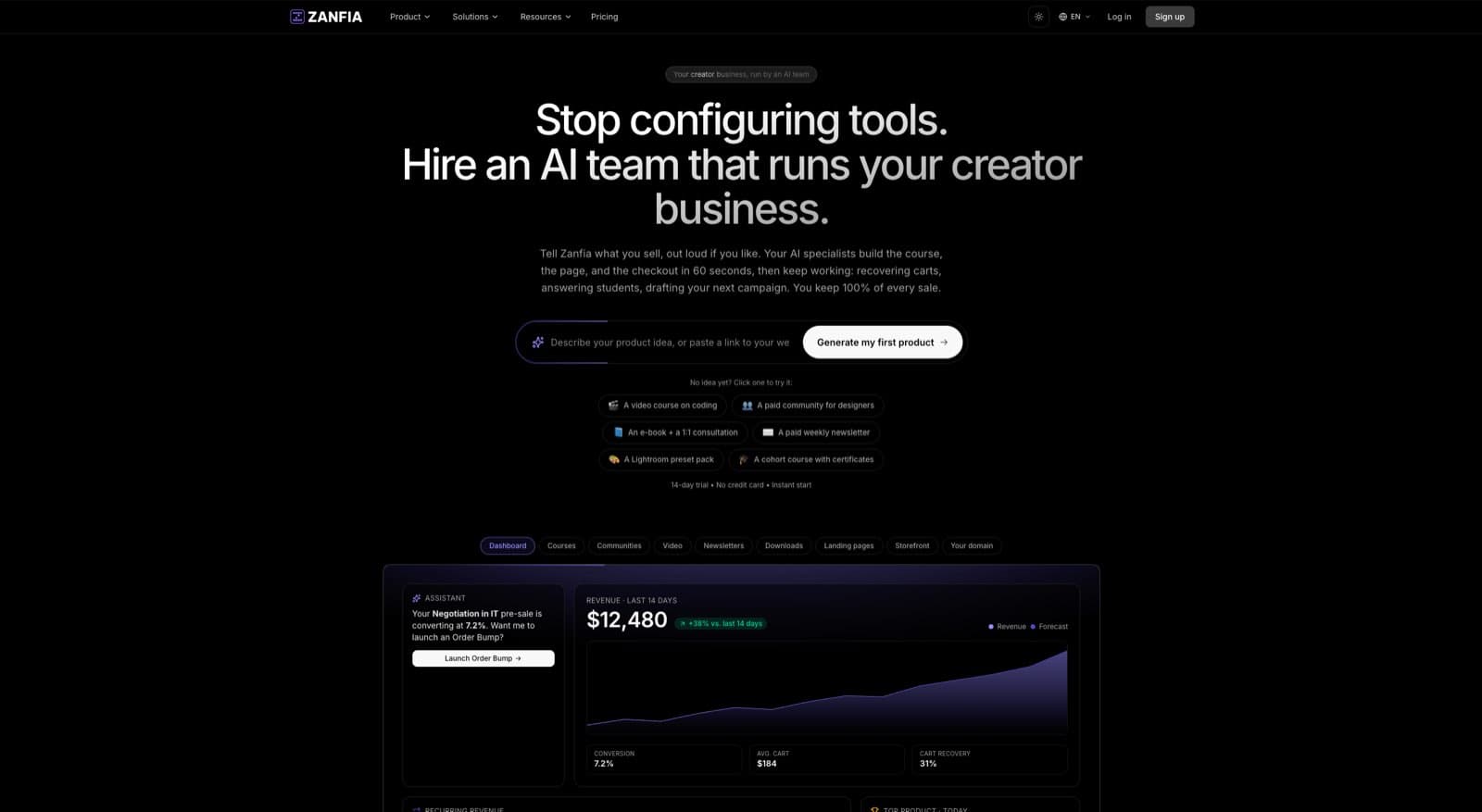
The choice isn't about which one is "better." It's about matching the tool to your business goals. Skool is built for creators who value a simple, gamified community. Zanfia is built around an AI team that runs the day-to-day of a creator business: you tell it what to do by chat or by voice, and the work lands inside courses, communities, newsletters and a checkout designed to sell. If you want your own AI agents to reach in and act on the workspace, Zanfia exposes an MCP endpoint on higher plans—see the current Zanfia pricing for what unlocks where.
Skool vs Zanfia: A Tale of Two Philosophies
The fundamental difference between Skool and Zanfia boils down to two words: control and flexibility. Skool gives you a streamlined, one-size-fits-all experience that’s fantastic for getting off the ground quickly. Zanfia gives you an AI team plus the tools to build a fully customized business that you own, from the domain name down to the last pixel.
This flowchart is a good way to visualize where Skool shines in the decision-making process.
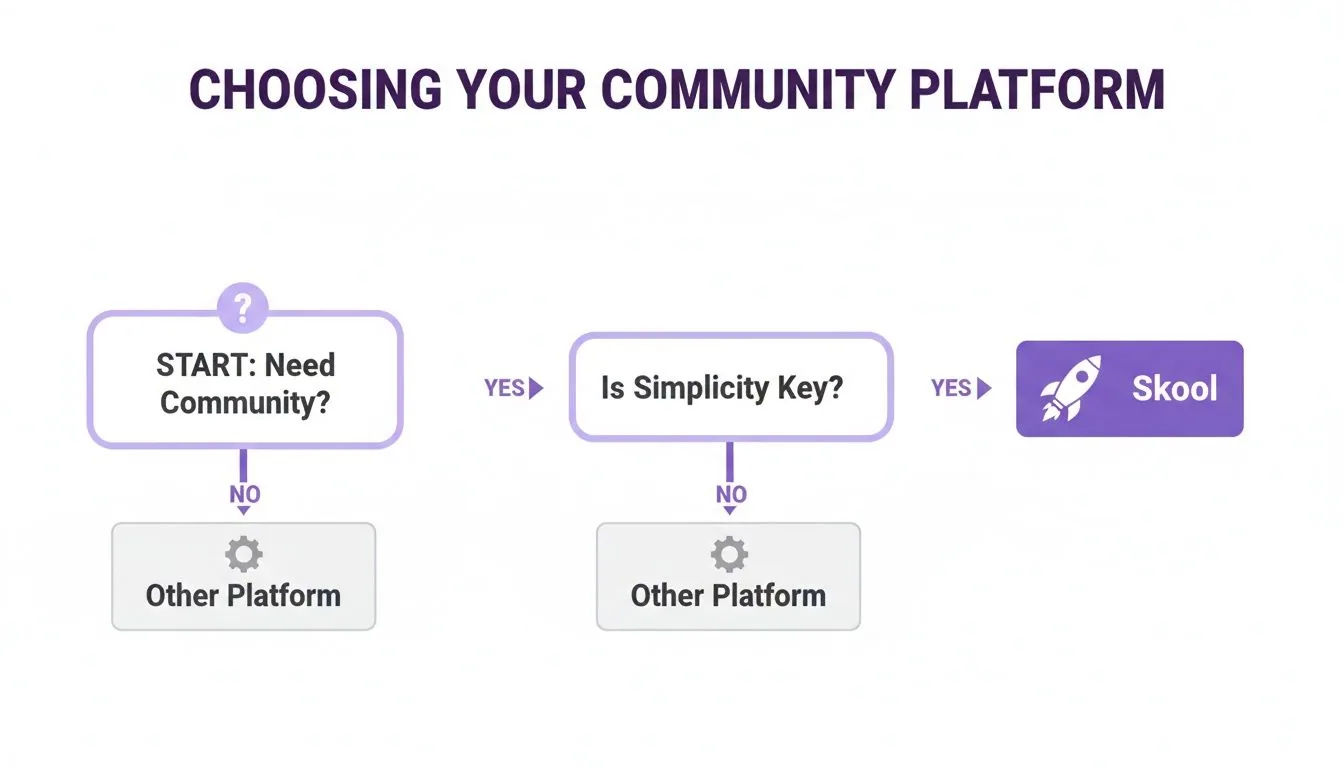
The key takeaway here is that if a simple, fun community is your absolute top priority, Skool is the obvious pick. But the moment your needs get more complex, other platforms start to make a lot more sense.
For "Business Architects" scaling a serious business, Zanfia's strengths become mission-critical. Here’s a look at how their core philosophies differ:
- Brand Control: Skool communities are always branded as Skool. With Zanfia, you get complete white-label control on your own custom domain. Your clients see your brand and only your brand.
- Monetization: Skool keeps it simple with basic subscriptions. Zanfia gives you a full checkout with order bumps, installments (say, splitting a $600 course into four payments), subscription upsells, and 12 product types under one brand—from courses and communities to bundles, downloads and consultations.
- Transaction Fees: Here’s where they align. Both platforms charge 0% platform commission on customer sales today. You keep 100% of your revenue, paying only the standard fees to payment processors like Stripe or PayPal. This is a massive win for creators tired of platforms taking a slice of their sales.
- AI and Voice: Skool has no built-in AI assistant. Zanfia sells an AI team as the product itself: plans meter monthly AI credits, the assistant can perform any action available in the interface, and you can drive it by chat or by voice. Advanced AI capabilities and the MCP endpoint sit on higher plans—see the current Zanfia pricing .
- Built to Sell: Zanfia includes a test mode so you can run a real purchase on your own checkout before launch, plus session recordings on checkout via Microsoft Clarity and Hotjar. Skool doesn't have equivalents.
Zanfia is built for creators who have hit the ceiling with simple tools. Instead of adding one more app to a stack, it puts an AI team behind the business: dictate the work, let it land in courses, communities and a checkout designed to convert, and connect your own agents through MCP when you're ready to go further.
Skool vs Kajabi and Mighty Networks
When you look at other competitors, the lines are just as clear. Kajabi is an international all-in-one powerhouse focused heavily on marketing funnels and sales pipelines. Its community features, however, often feel like an afterthought to its course and marketing tools, and it charges a percentage on sales on its lower-tier plans. You can see a deeper breakdown in our guide to the best platform for a membership site.
Mighty Networks is another big name in the community space, offering more customization and branding options than Skool. It lands somewhere in the middle—more feature-rich than Skool, but without the AI team, MCP endpoint and 0% commission model you get with Zanfia.
Ultimately, Skool has carved out its own unique territory as the champion of gamified simplicity. For creators who want an AI team running the day-to-day, total brand control, financial flexibility, and a checkout built to sell, a platform like Zanfia is a strong alternative worth evaluating.
Frequently Asked Questions About Skool
As you weigh your options, you'll inevitably have questions about where Skool shines and where it falls short. Let’s get straight to the point and answer the big ones so you can decide if it’s the right foundation for your business.
Can I Run a Free Community on Skool?
Absolutely. Skool works for both free and paid communities, and running a free group is a smart top-of-funnel strategy. It’s a great way to build an audience and warm up leads with valuable free content.
From there, you can easily guide members toward a paid group or sell them a course, all without ever asking them to leave the platform.
Does Skool Integrate With Other Marketing Tools?
Skool’s integrations are intentionally minimal. It’s built on a philosophy of simplicity, offering a core connection to Stripe for payments and webhook capabilities through tools like Zapier for custom workflows.
However, you won’t find the deep, native integrations for email marketing platforms or sophisticated CRMs that are standard on true all-in-one systems like Zanfia, which also exposes an MCP endpoint so your own AI assistants can act on your workspace. Skool is not built to be the command center for a complex marketing tech stack.
The entire point of Skool is to provide a clean, all-in-one member experience, free from the distractions of third-party tools. It prioritizes a focused environment over building intricate marketing funnels.
Is Skool Good for Selling Complex Online Courses?
Skool is a fantastic place to host a straightforward course that lives right next to your community. The "Classroom" feature is clean, simple, and perfectly functional for video lessons and supplementary resources.
But it’s important to understand it is not a full-featured Learning Management System (LMS). It lacks advanced tools like graded quizzes, course completion certificates, or automated content dripping. If your main goal is to deliver a robust educational experience, you’ll be better served by a dedicated course platform or an AI-first all-in-one like Zanfia, which includes native video hosting, a smart video player that saves progress, quizzes, completion certificates, drip content and detailed progress tracking—and lets you set up and edit most of it by dictating to the assistant.
What Is the Main Difference Between Skool and a Facebook Group?
The difference comes down to three things: focus, ownership, and monetization. A Facebook Group is a noisy, rented space. You’re constantly fighting the algorithm for attention and are subject to Facebook's ever-changing rules and distractions.
Skool, on the other hand, gives you a private, branded home that you 100% control. It also has monetization, a course classroom, and a gamification system built right in—features Facebook simply doesn't offer. Skool is a purpose-built tool for turning your community into a real business, not just a social hangout.
Ready to build a professional business with an AI team that runs the day-to-day? Zanfia puts an AI-first, voice-ready platform behind your courses, communities and newsletters, with a checkout built to sell—order bumps, installments, upsells, test mode—and 0% platform commission today. Start with a 14-day free trial, no credit card required. Start building your independent brand today.