

How to Sell Online Courses in 2026: A Creator’s Guide to Profit

Want to sell an online course? It’s not just about hitting record and uploading videos. The difference between a six-figure course business and a digital dust-collector comes down to getting a few fundamentals right before you even think about building the course itself.
Get these right, and you're not just launching a course—you're building a real, profitable business.
Table of Contents
Your Blueprint for a Course That Actually Sells
I’ve seen too many creators pour their heart and soul into a course, only to launch to the sound of crickets. Why? They built a product they thought people wanted, without a clear plan.
A profitable course business isn't an accident. It's built on a strategic foundation. A huge part of that is understanding the mechanics of how to sell digital products online in the first place—it gives you the 30,000-foot view of the entire journey from idea to checkout.
The 5 Pillars of a Successful Online Course
Think of building a successful course like constructing a house. You can't start with the paint color; you have to pour the foundation first. Here are the five non-negotiable pillars that hold up a profitable course business.
| Pillar | Key Objective |
|---|---|
| Validated Idea | Confirm a real audience will pay for your solution. |
| Clear Outcome | Design a curriculum that delivers a specific, tangible result. |
| The Right Tech | Choose a platform that simplifies, not complicates, your business. |
| Smart Pricing | Package your offer to communicate value and maximize revenue. |
| Simple Marketing | Build a straightforward plan to attract your ideal students. |
Nailing these five pillars shifts the odds dramatically in your favor, turning a risky bet into a calculated business move.
A Validated Idea
This is where most creators go wrong, and it's the single most important pillar. You absolutely must confirm that a specific audience has the problem your course solves and, crucially, that they are willing to pay money for the solution.
How? Talk to your audience. Run surveys. I'm a huge fan of pre-selling your course before you've even built it. If people will pay for the idea of your course, you've got a winner.
A Curriculum That Delivers an Outcome
Your course isn't just a collection of information; it’s a vehicle for transformation. Students don't buy information—they can get that for free on YouTube. They buy a specific, desirable outcome.
Your curriculum needs to be a step-by-step roadmap that guides them from their current pain point to that promised result. Make it logical, engaging, and packed with actionable steps.
The Right Technology
Your tech stack can either be your greatest asset or your biggest headache. Trying to duct-tape together a half-dozen different tools for video hosting, payments, and a community is a recipe for frustration and spiraling costs.
An all-in-one platform handles the technical mess for you. It lets you focus on what you do best: teaching your students and growing your business.
Smart Pricing & Packaging
How you price your course isn't just about picking a number; it’s about communicating its value. Offering a mix of payment options can open the door to a much wider audience.
Consider different models:
- A one-time payment for lifetime access.
- Payment plans to lower the barrier to entry.
- Subscription or membership models for ongoing access and community.
For a deeper dive, our guide on recurring revenue business models is a great place to start.
A Simple Marketing Plan
You don't need a massive, complicated marketing funnel to launch successfully. In the beginning, focus on what works: building an email list and consistently creating valuable content that attracts your ideal student. That’s it.
This simple visual breaks down the core creation flow.
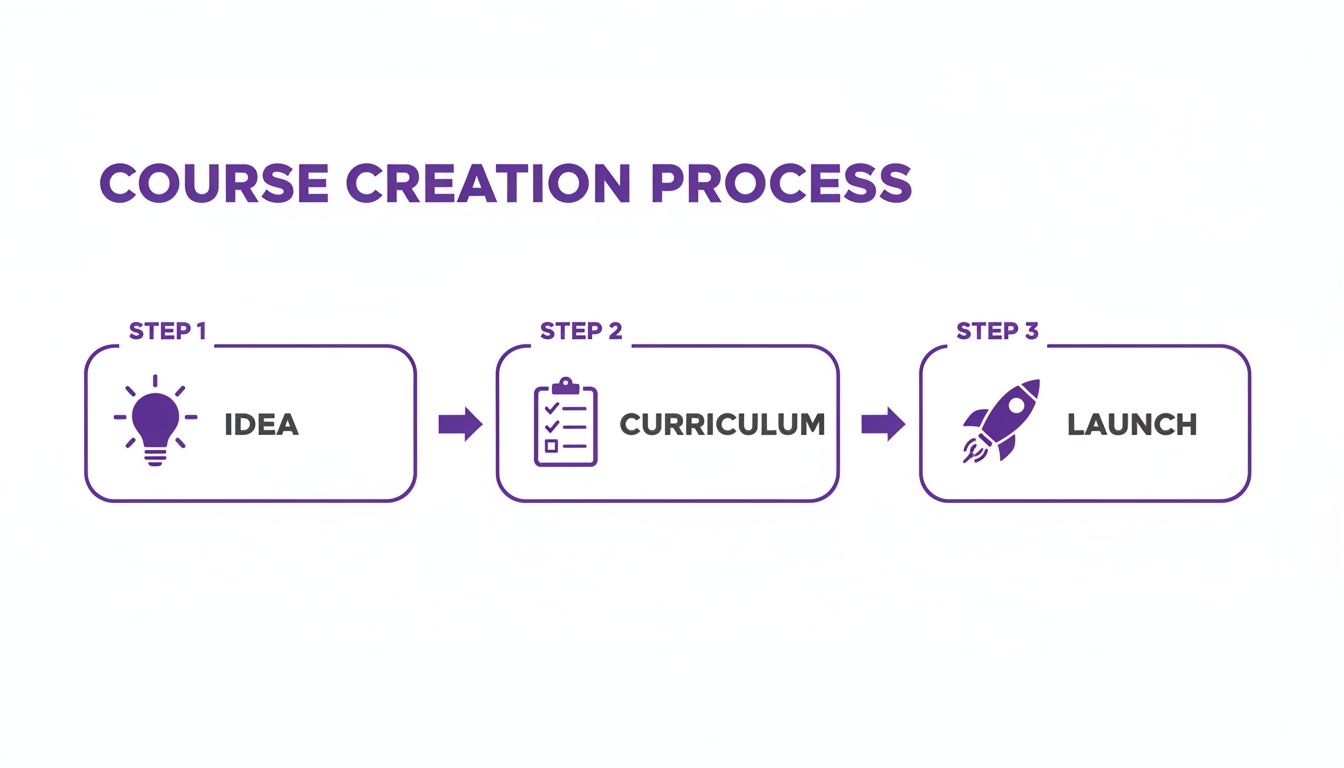
Notice that the real work—validating the idea and structuring the curriculum—happens long before you ever think about the launch. That’s the secret.
Validating Your Idea and Designing an Irresistible Curriculum
A great course idea is a fantastic start, but it's just that—a start. Before you can successfully sell your online course, you have to be dead sure that people will actually pay for the transformation you're promising. This one step is what separates a profitable business from a passion project that goes nowhere.

The opportunity is massive. The global e-learning market has absolutely exploded, doubling from $165 billion in 2014 to a projected $325 billion in 2025. With some forecasts showing the market could hit $1 trillion by 2032, the demand for quality digital education is undeniable. This creates a huge opening for creators who get it right.
But how do you claim your slice of that pie? It all starts with listening.
Confirming Demand Before You Build
Do not film a single video or write one line of content until you have proof of concept. Building an entire course on an assumption is the single biggest—and most expensive—mistake a new creator can make.
Instead, use these low-risk methods to test the waters first.
1. Audience Surveys
This is your most direct line of communication with your future students. Go to your existing audience (on social media or your email list) and ask about their biggest challenges related to your topic. The goal is to find a painful, specific problem.
- Weak Question: "Would you be interested in a course on social media?" It's too vague.
- Strong Question: "What is your #1 frustration when trying to get new clients using Instagram?" This is specific and digs for a problem.
2. The "Smoke Test" Pre-Sale
This is the ultimate validation. You create a sales page for your course before it's built, drive some traffic to it, and see if people actually pull out their credit cards based on the promise alone.
If people will pay for the idea of your course, you have a proven winner. This tactic removes all the guesswork and confirms you're building something the market has already voted for with its wallet.
3. The Pilot Program
Offer a small group of students early access to your course at a steep discount. In exchange, they provide feedback as you build out the content week by week. This not only validates your idea but helps you co-create the curriculum with your ideal students, ensuring it solves their problems perfectly.
Designing a Curriculum That Delivers Results
Once you know your idea is a winner, the focus shifts to designing a curriculum that creates real transformation. People don't buy information; they buy outcomes. Your course needs to be a clear, step-by-step roadmap that takes them from where they are now to where they want to be.
A powerful framework for this is backwards design. You don't start with Lesson 1; you start with the final result you're promising. You can dig deeper into designing lessons with the backwards planning method in our dedicated guide.
Key Elements of a High-Value Curriculum
An effective curriculum is way more than just a playlist of video lectures. It’s an engaging, multi-format learning experience. Here are the components that make that happen:
- Bite-Sized Lessons: Break down complex topics into short, digestible videos (5-15 minutes is the sweet spot). This respects your students' time and prevents them from feeling overwhelmed.
- Actionable Worksheets: For every module, give them a worksheet, checklist, or template. This forces them to turn passive learning into active practice and get immediate wins.
- Community Touchpoints: Integrate your community directly into the course flow. For example, end a module with a prompt like, "Share your completed worksheet in the #progress channel for feedback." This builds accountability and social proof.
A smooth user experience is what holds this all together. Features like a native video player that automatically saves a student's progress, like you'll find in Zanfia, make the experience feel professional and keep learners on track. It removes friction and lets them pick up exactly where they left off, making their journey toward their goal completely seamless.
Choosing Your Tech Stack to Avoid Common Pitfalls
Let's be blunt: the technology you choose to sell your online course is a make-or-break decision. It's either a silent partner that handles the grunt work so you can scale, or it's a constant source of glitches, hidden fees, and headaches that actively sabotage your growth.
Your tech stack should be your single biggest asset, not your worst bottleneck.

This kind of careful planning is essential. But the platform you build on is what actually brings that plan to life—or lets it fall apart. The right system frees you up to focus on what you do best: creating great content and connecting with your students.
The Three Main Paths for Course Creators
When you’re figuring out how to sell an online course, you’ll quickly find yourself at a crossroads with three main options for your platform. Each one has major trade-offs in cost, control, and complexity, so understanding them is the key to supporting your business for the long haul.
The WordPress Plugin Labyrinth: This DIY approach feels empowering at first. You piece together plugins for your LMS, e-commerce, and memberships. While you get total customizability, you also inherit the full-time job of an IT department. You're on the hook for every update, security patch, and plugin conflict.
The Course Marketplace Trap: These platforms promise a built-in audience, but it comes at a steep, often hidden, cost. You surrender control over your branding, your pricing, and—most importantly—your student data. Worse, they actively promote competitor courses right next to yours and slice off a huge chunk of your revenue.
The All-in-One Command Center: This is the modern approach. It integrates all the critical tools—courses, community, payments, and marketing—into one streamlined system managed by professionals. It’s built from the ground up to eliminate tech drama and let you run your business.
As you weigh your options, it's worth exploring different websites like Eventbrite that prioritize creator profitability to see how modern fee structures can protect your margins.
Why Your Fee Structure Matters More Than You Think
For many creators, especially established "Business Architects" earning PLN 10k–100k+ monthly, transaction fees become a massive drag on scalability. A platform that takes a percentage of every sale is literally penalizing you for your own success. As your revenue climbs, so does the amount of money you hand over in fees.
This is where a different model completely changes the game. Zanfia, for instance, runs on a clean SaaS subscription model with 0% platform transaction fees. You keep 100% of the revenue you generate. The only fees you ever touch are the standard, unavoidable rates from payment processors like Stripe or PayU. This transparent approach means the platform is your partner, growing with you, not feeding off you.
For creators tired of seeing commissions eat into their margins, a 0% fee model is not just a feature—it’s a fundamental shift in the business partnership. It protects your profitability and allows you to reinvest more of your hard-earned money back into your business.
Gaining Control and Saving Time
Beyond just fees, the right platform gives you back your two most precious resources: your time and your brand identity. A patched-together WordPress site can easily suck up 5–10+ hours per month in pure admin work—manually granting course access, fighting with payment gateways, and exporting data for invoicing.
An integrated system like Zanfia puts these painful tasks on autopilot.
- Instantly grant course access the moment a payment goes through.
- Automatically add buyers to the right community channels.
- Trigger welcome email sequences without you lifting a finger.
- Generate and send invoices automatically via direct integrations with Polish accounting suites like inFakt and Fakturownia.
For Polish creators, that last point is a massive win. As Wojciech Pisarski, CEO of wMinutę, says, “Without Zanfia, developing a paid newsletter and community in Poland would be much harder—it’s the best tool in the market”.
This kind of seamless automation is a lifesaver for both established "Craft Masters" who need tech that reflects their premium brand, and for "Potential Explorers" who are overwhelmed and just need the simplest path to getting their course out there.
Plus, the ability to operate under your own custom domain with full white-label control means your students get an experience that is 100% your brand, not the platform's. That’s a level of professionalism that marketplaces and generic solutions simply can't match. You can dive deeper into this with our comparison of learning management system features.
Pricing, Packaging, and Launching Your Course for Maximum Impact
Your course's price tag isn't just a number—it’s the first and clearest signal of its value. Getting this right means going beyond a simple one-time fee and designing an offer that just clicks with your ideal student. This is how you stop just selling a course and start selling a transformation.
But even the most perfect product and price mean nothing if your launch is silent. A strategic launch builds the kind of excitement that has people ready to buy the moment you open the doors.
Crafting Your Pricing and Packaging Strategy
Think of your pricing as a direct reflection of the transformation you're promising and the audience you're serving. While a single price is simple, it's rarely the most effective option. Offering flexible ways to pay can be the one thing that turns a hesitant "maybe" into an enthusiastic "yes," dramatically boosting your sales.
This is where a platform like Zanfia gives you a massive advantage. You have the freedom to build out any offer structure you can dream up, with total control over how you present it to your audience.
Here are the core models you can mix and match:
- One-Time Payment: The classic model. Your students pay once for lifetime access. It’s perfect for foundational, evergreen courses that deliver a complete result.
- Installment Plans: This breaks up a higher price into smaller, more manageable monthly payments. It’s a powerful way to make premium courses accessible without cheapening your offer.
- Subscriptions: Ideal for creating predictable, recurring revenue. This works wonders for courses with ongoing content drops, a vibrant community, or any format where value is delivered over time.
- Tiered Bundles: Package your course into different levels (like a Basic, Pro, or VIP tier). You can add high-value extras like one-on-one coaching, exclusive community groups, or bonus resources to the higher tiers.
The real goal here is to make the investment decision as easy and logical as possible for your student. For many, a payment plan isn't a "nice to have"—it's the only reason they can click "buy."
Of course, none of this matters without a frictionless checkout experience. By integrating with trusted Polish gateways like PayU, Przelewy24, Tpay, and BLIK, plus global leaders like Stripe (with Apple Pay and Google Pay), you let customers pay exactly how they want. This single step can rescue a significant number of abandoned carts.
For a full breakdown of the entire process, check out our complete guide on how to launch an online course.
Building a Powerful Launch Plan
A great launch isn't a one-day event; it's a carefully orchestrated campaign that starts weeks ahead of time. Your job is to build a groundswell of excitement and desire so that when you finally open the cart, you have a virtual line of people waiting to get in.
Let’s break down the essential phases of a high-impact launch.
The Pre-Launch Hype Sequence
This is all about building anticipation and warming up your audience. Over a 1-2 week period before you officially launch, you'll want to send a strategic email sequence to your list.
- Start by teasing a big announcement.
- Share genuinely valuable content that relates to your course topic.
- Tell the story of why you created the course—your personal connection makes it real.
- Proactively address common objections and paint a clear picture of the transformation awaiting them.
Your High-Converting Sales Page
Think of your sales page as your best salesperson, working 24/7. It must be persuasive, crystal clear, and emotionally compelling. A winning page always includes a powerful headline, a specific outcome-focused promise, a detailed breakdown of what's inside each module, and a mountain of social proof.
Leveraging Testimonials and Social Proof
Nothing sells your course more effectively than the success stories of people who have already been through it. Weave testimonials, case studies, and glowing quotes throughout your sales page, launch emails, and social media posts. This isn't bragging; it's building trust by showing potential students that you deliver real, tangible results.
For Polish creators, combining these universal launch tactics with a platform built for the local market provides an incredible edge. As EFL teacher Mateusz Grzywiński confirms, “If you plan to sell digital products and build a community of paying customers, Zanfia is the best solution.” It removes the technical friction from payments to community access, freeing you up to focus on what matters most: your launch.
Marketing Your Course and Building a Thriving Community
Getting your course launched isn't the finish line; it’s the starting gun. Now the real work begins—the work of building something that lasts. This next phase is all about two things that are deeply connected: consistently bringing in new students and turning your current members into a vibrant community that does your marketing for you.
Your launch probably brought a nice spike in sales, and that's fantastic. But long-term, sustainable income comes from building a smart, simple marketing system. A well-oiled funnel, powered by your content and a bit of email automation, becomes your growth engine, working around the clock to attract new students.
But let's be honest. In today's crowded market, the real secret weapon isn't just another marketing funnel. It's community.
The Unfair Advantage of an Integrated Community
I see so many creators make a critical mistake. They pour their heart and soul into a brilliant course, then they just dump their community into a free, disconnected Facebook group or a chaotic Discord server.
This fractures the entire student experience. You're sending your paying customers away from your brand and into a space you don't own, filled with endless distractions and the algorithm's whims.
The game-changer is keeping your community right where your course is—under your brand, inside your own ecosystem. When your course content and your community live in the same place, the magic happens. Engagement goes through the roof, students feel a deeper connection to the material (and to you), and their lifetime value skyrockets because they have more reasons to stay.
This unified approach dramatically boosts engagement and member retention. Instead of feeling like they just bought a product, students feel like they’ve joined a movement.
Using a platform that bakes these features in from the start makes it happen without you needing a team of developers. It’s a core philosophy that lets you build an independent, powerful brand where every single interaction happens on your home turf.
Fostering Engagement and Building Real Connection
A thriving community doesn't just appear out of nowhere; you have to actively nurture it. Your role evolves from being a teacher to becoming a community leader. The aim is to create a space where students feel safe enough to ask the "dumb" questions, celebrate their wins, and genuinely help each other out.
Here are a few practical things you can do to spark lively discussions and forge those deeper connections:
- Create a Welcome Ritual. Have a dedicated "Introductions" channel and make a point to personally welcome every single new member. It sets a warm, inclusive tone from the very beginning.
- Use Discussion Prompts. Don't just wait for conversations to happen. Post regular, thought-provoking questions tied directly to your course. Something as simple as, "What was your biggest 'aha!' moment from Module 3?" can get the ball rolling.
- Host Members-Only Events. Live Q&A sessions, interviews with other experts, or "hot seat" coaching calls are pure gold. They deliver immense value and give members a powerful reason to stay active.
- Spotlight Success Stories. Regularly celebrate your students' progress and wins, big or small. Showcasing their achievements not only motivates them but also creates powerful social proof that you can use to attract new people.
Building this kind of environment is a lot less work when you have the right tools. It’s why serial entrepreneur and investor Artur Kurasiński calls Zanfia “the most convenient and simplest solution for paid newsletters, courses and community on the Polish market”. When you have dedicated channels for different topics, read-only announcement spaces, and the ability to automatically group members based on what they've purchased, managing your community becomes an organic part of your business, not another chore on your to-do list. We talk a lot more about this in our guide to creating communities of learners.
Ultimately, when you weave your marketing and community together, you create a powerful flywheel. Your content attracts new leads, your course delivers the transformation they came for, and your community turns those happy students into vocal advocates who go out and bring in the next wave of members. This is the blueprint for selling online courses for the long haul.
Scaling Your Business with Smart Automation and Analytics
As your course business grows, you hit a ceiling. You can’t just work harder; you have to work smarter. This is the moment you shift from being a hands-on creator to a savvy business owner, using automation and data to scale without burning out. The goal is simple: spend less time on repetitive admin and more time creating real value for your students.

Imagine putting all those tedious, time-sucking tasks on autopilot. This isn't some far-off dream. It's exactly what smart automation is built for. Instead of manually onboarding every new student or chasing failed payments, you can set up systems to do the heavy lifting for you.
Reclaim Your Time with Built-in Automation
I see it all the time. Creators, especially those scaling past PLN 10k a month, get absolutely buried in administrative chores. These tasks are critical, but they don't directly grow your revenue. This is where automation stops being a "nice-to-have" and becomes a non-negotiable part of your business engine.
An integrated platform like Zanfia is designed specifically to automate these pain points, saving creators a very real 5–10+ hours every single month.
Here’s what that looks like in practice:
- Instant Access Grants: The second a customer buys, they're in. No more "Where's my login?" support tickets.
- Smart Onboarding: A new subscription purchase can automatically add the buyer to the right community channel and kick off a welcome email sequence. It just works.
- Subscription Management: The system handles recurring payments, sends renewal reminders, and even revokes access if a plan ends. You don't have to lift a finger.
This level of automation gives you the confidence to focus on marketing and content, knowing the back-end of your business is running like a well-oiled machine. As 30-year veteran developer Daniel Roziecki highlights, it provides the “peace of mind” that lets him focus on teaching future developers instead of wrestling with tech.
Demystifying Analytics to Drive Growth
Data can feel overwhelming, but you don't need to be a spreadsheet wizard. To effectively sell online courses, you only need to watch a handful of key numbers that tell you the real story of your business's health. These metrics are your roadmap for making smarter decisions.
Think of your analytics dashboard as a diagnostic tool for your business. It shows you exactly where the friction is in your funnel, allowing you to fix bottlenecks and optimize for higher conversions and happier students.
You can ignore almost everything else if you just focus on these three:
- Sales Page Conversion Rate: What percentage of people visiting your sales page actually buy? A low rate here points to a problem with your copy, offer, or pricing.
- Student Completion Rate: Are people actually finishing your course? Low completion is a huge red flag that your content might be too dense, too long, or not engaging enough.
- Member Churn Rate (for subscriptions): What percentage of your members cancel each month? This is a direct reflection of the value your community and ongoing content deliver.
Understanding this data is how you refine your funnel. The U.S. online education market is set for explosive growth, projected to jump from $12.35 billion in 2025 to a staggering $128.54 billion by 2034. That's a massive wave of demand. By using analytics to dial in your offers, you position yourself to capture a piece of that rapidly growing market. You can get more details on the U.S. online education market's impressive growth projections and see just how big the opportunity is.
Common Questions from First-Time Course Creators
When you're just starting out, a handful of questions always seem to pop up. Let's tackle the big ones head-on—profit, technology, and the best way to build your business.
How Much Money Can I Actually Make?
Your earning potential is a direct result of your niche, audience size, and the price point of your course. Some creators bring in a few hundred zloty a month as they get started, while established experts are building seven-figure businesses.
The key isn't magic; it's math. Success comes down to solving a high-value problem for a specific audience that's willing to pay for the solution.
Do I Have to Be a Tech Wizard to Do This?
Absolutely not. Modern all-in-one platforms were built specifically for creators, not developers. You shouldn't have to wrestle with plugins or code.
A system like Zanfia handles all the heavy lifting—native video hosting, payment gateways, community tools—so you can pour your energy into creating an amazing course. As Przemysław Niemczuk of TreningBiegacza.pl praises, the platform offers both "simplicity and high functionality," removing the technical hurdles for experts.
Should I Sell on a Marketplace or My Own Website?
Building on your own branded website gives you something priceless: control. You own the business. That means you set the prices, you own your customer list, and you build a direct line of communication with your students.
Marketplaces might dangle the promise of easy traffic, but it comes with some serious drawbacks:
- They often take a huge cut of every single sale.
- Your branding is diluted, if not completely removed.
- They will actively advertise your competitors right on your course page.
This is where the business model really matters. A platform like Zanfia operates on 0% transaction fees, which means you keep 100% of your revenue. You're not just renting space; you're building an independent brand, and that’s the only way to win in the long run.
Ready to build a professional online business with zero platform fees? Zanfia centralizes your courses, community, and digital products into one powerful system, so you can focus on growth, not tech. Start building your creator business today on zanfia.com.


