

How to Become a Content Creator: Your 2026 Guide

You probably already have the spark.
You have ideas for videos, posts, tutorials, essays, tutorials disguised as tweets, or a niche newsletter people would pay for. You may even have a notes app full of hooks and half-recorded drafts. What you don’t have yet is a clean path from “I want to create” to “I run a creator business that pays me.”
That gap is where most beginners stall. They post inconsistently, chase trends that don’t fit, spread themselves across too many platforms, and wait too long to think about monetization. Then they assume they’re bad at content, when the underlying problem is that they started without a business model.
If you want to learn how to become a content creator, start by dropping the fantasy that success comes from inspiration alone. It comes from positioning, skills, systems, and patience.
Table of Contents
Beyond the Hobbyist Mindset
A lot of people start the same way. They have one topic they can talk about for hours, they see creators building real careers online, and they think, “I could do that too.” They can. But only if they understand what they’re stepping into.
The opportunity is large and the competition is real. The creator economy is projected to reach $528 billion by 2030, with over 207 million active content creators worldwide, yet only 4% earn more than $100K per year, according to InBeat’s creator economy statistics. That doesn’t mean the field is closed. It means casual effort rarely compounds into meaningful income.
Most beginners make one of two mistakes. They either treat content like self-expression with no strategy, or they copy business tactics from established creators who already have audience trust, brand influence, and years of reps behind them.
Practical rule: Start as a creator. Operate like a business owner.
That changes how you make decisions. You don’t ask only, “What should I post?” You ask:
- Who is this for
- What problem does it solve
- What format fits the message
- What action should the audience take next
- How could this eventually connect to revenue
That doesn’t mean becoming robotic. It means building with intent.
If you want an outside perspective on positioning and public presence, this guide on how to build an influencer brand is useful because it shows how audience perception gets shaped long before monetization starts. And if your long-term model includes belonging, not just broadcasting, it’s worth studying what makes a community platform for creators work under your own brand rather than rented social reach.
The hobbyist mindset says, “I hope this takes off.” The creator-business mindset says, “I’m building an asset.”
Foundation First Defining Your Niche and Audience
A niche isn’t a prison. It’s a filter.
Beginners often resist choosing one because they think it limits creativity. In practice, the opposite happens. A clear niche makes content ideas easier, messaging sharper, and audience growth more consistent. Without it, every post starts from zero.

Choose the overlap, not just the passion
“Follow your passion” is incomplete advice. Passion matters, but a viable niche sits at the overlap of three things:
| Factor | What to ask |
|---|---|
| Interest | What can you stay curious about for a year? |
| Ability | What can you explain, demonstrate, review, or improve? |
| Demand | What are people already searching for, struggling with, or buying around? |
That overlap is where useful creator businesses start.
A strong niche usually has visible pain points, recurring questions, and room for a distinct angle. “Fitness” is broad. “Strength training for busy parents who only have short home sessions” is more workable. “Marketing” is broad. “Organic content systems for solo consultants” gives you clearer content pillars, clearer offers, and clearer audience language.
The biggest mistake here is choosing a niche based only on what looks popular. You can borrow format ideas from successful creators, but if you don’t care about the underlying topic, your consistency will collapse.
Build an audience persona before you build a brand
Generic content usually feels safe. It’s also easy to ignore.
According to MediaNug’s audience analysis guidance, generic content fails to resonate with 70% to 80% of audiences, which is why persona-centric marketing matters from the beginning. The same source also notes that brands care more about steady metric growth than raw follower count. That’s a useful reminder for beginners who think a big audience automatically beats a focused one.
Create one practical persona. Not five. One.
Write it like this:
- Who they are: job, life stage, experience level
- What they want: the result they’re trying to get
- What blocks them: confusion, time, tools, confidence, money
- What they already tried: random YouTube videos, templates, advice from bigger creators
- What language they use: the phrases they repeat in comments, reviews, Reddit threads, DMs
A creator who understands one real audience well will outperform a creator trying to appeal to everyone.
If your content could be for anybody, your monetization will usually fit nobody.
Research demand with simple signals
You don’t need a research team. You need pattern recognition.
Look in places where people reveal frustration in plain language:
- YouTube comments: What follow-up questions keep appearing?
- Reddit threads and forums: What are people stuck on?
- Amazon reviews of relevant books or tools: What do buyers praise or complain about?
- Instagram and TikTok comments: What makes people say “I needed this” or “Can you explain this part?”
- Search suggestions: What phrases appear when you start typing your topic?
Then sort your findings into three buckets:
Urgent problems
These create strong content hooks and often become future paid products.Identity questions
These help with brand messaging. People want content that reflects how they see themselves.Progress blockers
These are ideal for educational creators because they reveal where people lose momentum.
This is also the point where many creators discover they don’t need a mass audience. They need the right small audience. If you’re trying to find your tribe, the goal isn’t broad reach first. It’s relevance first.
Test your niche before you commit deeply
You don’t need a final answer on day one. You need a credible working direction.
Use a short testing cycle:
- Pick one audience
- Choose three to five content themes
- Publish consistently around those themes
- Track which topics bring comments, saves, replies, and useful conversations
- Notice what you can talk about repeatedly without forcing it
Pay attention to signals of fit. The right niche usually gives you better questions from the audience, not just more views.
A weak niche often creates shallow engagement. People might watch once, but they won’t return, subscribe, reply, or buy. A strong niche creates compounding trust because your content keeps helping the same kind of person solve adjacent problems.
Your first year gets much easier when you stop asking, “What should I create today?” and start asking, “What does my audience need help with next?”
Building Your Brand and Mastering Essential Skills
Once your niche is clear, your next job is to become recognizable and useful.
That comes from two things working together. First, your brand, which tells people what you stand for and why they should remember you. Second, your skills, which determine whether you can consistently deliver value in a format people want to consume.

Build a brand people can describe in one sentence
A beginner brand doesn’t need a perfect logo system. It needs clarity.
Someone should be able to describe your work in one sentence:
- the topic you cover
- the audience you serve
- the style or promise that makes you distinct
Examples:
- A creator who explains personal finance in plain English for freelancers
- A fitness coach who teaches realistic home training for beginners
- A designer who breaks down branding decisions for small business owners
That sentence becomes your filter for content, platform bios, collaborations, and offers.
Your brand has a few practical layers:
Voice
Are you direct, analytical, playful, calm, teacher-like, opinionated?Visual identity
Consistent thumbnails, text treatment, colors, framing, layout, or editing rhythmPoint of view
What do you believe that shapes your advice? What do you reject?Value proposition
What does the audience get from following you that they won’t get elsewhere in the same way?
If you need help tightening that message, reviewing strong brand statement examples can help you move from vague positioning to something usable.
Don’t wait to get good on camera, on the page, or in the edit
Skill matters more than most beginners want to admit.
The first year is often less about “growth hacks” and more about improving the mechanics of communication. If your ideas are strong but your delivery is muddy, the audience won’t stay long enough to see your expertise.
The core skill stack usually breaks into two categories.
Creation skills
These make the content clear and watchable.
- Writing: hooks, structure, clarity, transitions, calls to action
- Storytelling: tension, transformation, contrast, examples
- Video editing: pacing, cuts, captions, B-roll choices, audio cleanup
- Design: thumbnails, post layouts, readable visual hierarchy
- Presentation: speaking clearly, managing energy, teaching without rambling
A lot of creators over-polish too early. That often slows them down and makes content feel sterile. The more durable rule is to improve quality without losing speed.
Later in your workflow, video becomes even more valuable for trust and retention.
According to Coursera’s content creator article, embedding video in posts can increase engagement 2.5x, and the “document, don’t create” approach can help audiences grow faster because raw authenticity often outperforms content that feels overproduced. That matters for beginners. You do not need to look like a studio on day one. You need to be understandable, credible, and consistent.
Business skills
These skills keep content from becoming an expensive hobby.
| Skill | Why it matters |
|---|---|
| SEO | Helps your work get discovered through search over time |
| Analytics | Shows what’s holding attention and what’s getting ignored |
| Email marketing | Creates audience access you actually control |
| Offer design | Turns audience problems into paid solutions |
| Basic sales copy | Helps landing pages, product descriptions, and CTAs convert |
| Platform fluency | Lets you adapt format to channel instead of reposting lazily |
Your audience won’t pay you because you worked hard. They’ll pay because your content makes their next step easier.
Practice brand consistency without becoming rigid
Beginners sometimes hear “build a brand” and immediately become stiff. Every caption sounds corporate. Every video tries too hard to feel premium. The result is forgettable.
A good creator brand is recognizable, not over-managed.
Use a few fixed elements:
- repeatable content themes
- recurring phrases or frameworks
- a visual style that feels coherent
- a predictable promise to the audience
Then leave enough room for experimentation. Your first year should sharpen your identity, not trap it.
What works is repetition with evolution. What doesn’t work is changing your tone, topic, and format every week because you got bored before the audience ever understood what you do.
The Engine of Your Business Content Strategy and Growth
Good creators don’t just publish. They run a system.
Without a system, content becomes mood-based. You post when inspiration hits, disappear when life gets busy, and wonder why nothing compounds. The audience experiences that as inconsistency. Brands experience it as risk. You experience it as burnout.
The first thing to accept is that monetization usually takes longer than beginners expect. According to HubSpot’s creator economy stats, 59% of creators haven’t earned anything yet, and it takes an average of 6.5 months to earn the first dollar. The same source notes that over 50 million creators earn income globally, which is encouraging, but it also points to the key requirement: sustained execution.
Build three to five content pillars
Content pillars stop you from reinventing your strategy every week.
A pillar is a repeatable category of content tied to audience needs. If you teach productivity for freelancers, your pillars might include:
- workflows
- client communication
- focus systems
- tools and templates
- mindset under pressure
If you’re a fitness creator, your pillars might be:
- form education
- beginner routines
- nutrition basics
- realistic habit building
- common mistakes
These pillars create range without randomness.
Turn ideas into a publishing rhythm
You don’t need a fancy editorial operation. You need a repeatable cadence you can maintain.
A simple content engine often looks like this:
Choose a primary platform
Start where your format and audience fit best.Create one core piece
A long post, video, lesson, livestream, or essay.Repurpose intelligently
Pull clips, quotes, carousels, short posts, and email angles from the core idea.Collect audience questions
Comments and replies become future content prompts.Review performance weekly
Keep what deepens audience response. Cut what gets empty reach.
Many creators improve quickly by stopping disconnected posts and starting to build a body of work.
Consistency doesn’t mean posting everywhere. It means showing up reliably where your audience already expects you.
Growth comes from feedback loops, not luck
A lot of growth advice online is still “post more.” That’s incomplete.
Growth usually comes from a loop:
- publish
- watch audience response
- identify what held attention
- refine the hook, angle, or format
- publish again with a better hypothesis
That loop is more valuable than chasing every trend.
There’s also a practical difference between platform strategy and creator identity. If live interaction is part of your niche, streaming can become your core relationship channel rather than a side experiment. For creators exploring that path, this guide on start streaming on Twitch is useful because the platform demands a different content rhythm than short-form posting.
What works and what usually fails
Here’s the trade-off most beginners need to hear clearly:
| What works | What usually fails |
|---|---|
| One primary platform with supporting formats | Trying to dominate every platform at once |
| Clear recurring themes | Posting whatever feels interesting that day |
| Audience questions as content input | Guessing what people want |
| Measured experimentation | Constantly changing niche and voice |
| A documented plan | Hoping memory and motivation will carry you |
If you need a more formal planning process, study how to build a content strategy that ties content themes, publishing cadence, and business goals together.
The creators who last aren’t always the most naturally charismatic. They’re often the ones who build a process that survives low-motivation weeks.
From Content to Commerce Monetization and Your Tech Stack
The hardest part of becoming a creator isn’t starting. It’s crossing the gap between making content and making income.
That gap confuses beginners because social platforms train people to think audience first, money later. In reality, monetization should shape your strategy much earlier. Not because you should sell too soon, but because your content, audience relationship, and product path should eventually fit together.
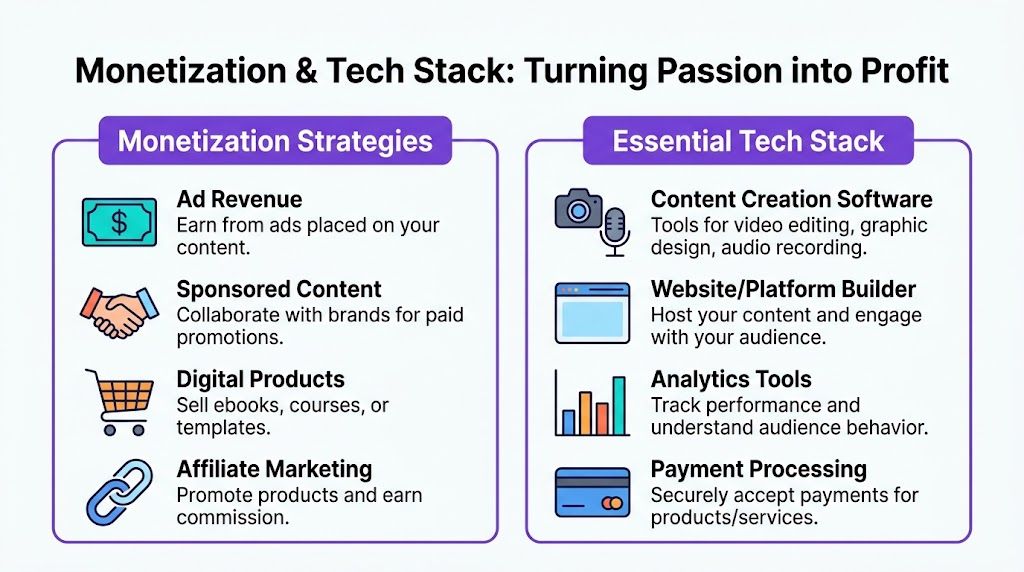
Most advice on how to become a content creator talks about niche, posting, and platform growth. It spends far less time on the unstable middle stage where you’re working hard, maybe growing slowly, but not yet earning enough to treat it like a business. As Backstage’s guide on becoming a full-time creator points out, it can take years of low income, and relying on one revenue stream can collapse fast. That’s why diversification matters.
Pick revenue models that match trust and control
Not all monetization models are equal.
Some depend heavily on platform volatility. Others depend on direct audience trust. The second category is usually more durable.
Here’s a simple comparison:
| Revenue model | Strength | Weakness |
|---|---|---|
| Ads | Passive once audience is large enough | Fragile and platform-dependent |
| Brand deals | Can pay well with the right fit | Inconsistent and outside your control |
| Affiliate income | Good for recommendation-driven niches | Depends on buyer intent and third-party programs |
| Digital products | Strong margins and direct ownership | Requires offer clarity and audience trust |
| Memberships and communities | Recurring revenue potential | Needs ongoing value and retention work |
| Courses and knowledge products | Strong fit for educational niches | Requires structured teaching and delivery |
This is why many serious creators eventually move toward assets they own. A course, membership, paid newsletter, digital download, or knowledge library doesn’t depend on an algorithm deciding whether your audience sees you today.
If your niche fits social-first monetization, there are times when platform-native income streams also make sense. For example, creators experimenting with short-form text monetization may want to study different pathways for earning money from tweets. But those models are strongest when they sit alongside products you own, not instead of them.
Build a simple offer ladder
You don’t need ten offers. You need a path.
A practical beginner ladder might look like this:
- free content that attracts the right audience
- a low-friction lead magnet or newsletter
- a small paid product such as a template, workshop, or mini-course
- a deeper offer such as a full course, membership, or premium community
That structure solves a common beginner mistake. Many creators jump from free posts directly to a high-ticket offer with no trust bridge. The audience may like the content, but they haven’t taken any smaller step with you yet.
Your tech stack can help you scale, or quietly slow you down
A lot of creators build a messy stack by accident. One tool for courses. Another for newsletters. Another for payments. Another for video hosting. Another for community. Another for invoicing. Then they spend their week troubleshooting logins, access issues, failed handoffs, and duplicate admin work.
That setup can work for a while. It rarely feels efficient.
A cleaner option is to use a system that keeps content, products, payments, and community under one roof. In that context, Zanfia is one example of an all-in-one setup for creators who want to run courses, paid newsletters, communities, digital downloads, and subscriptions under their own domain with 0% platform fees, native video hosting, built-in automations, white-label control, and support for payment methods such as Stripe, PayU, Przelewy24, BLIK, and Tpay. It also connects with inFakt and Fakturownia for automatic invoicing, which matters if you want less manual admin and a more professional operation. If you’re comparing monetization models more broadly, this overview of content monetization gives a useful framework.
The real trade-off
Creators don’t usually fail monetization because they lack talent. They fail because they delay key business decisions.
They wait too long to choose a monetization path. They rely too heavily on ads or occasional deals. They build tech stacks that leak time. They send the audience from one disconnected tool to another until the experience feels fragmented.
A stronger approach is simpler:
- create content around real audience problems
- build direct audience access
- introduce a small offer before you need one desperately
- choose systems that reduce admin friction
- keep your customer experience under your own brand
That’s how content turns into commerce without turning your week into technical chaos.
Your Actionable Launch Checklist Going Live with Zanfia
If you’re still in pre-launch mode, don’t build a grand empire first. Launch one small product that solves one real problem for one clear audience.
For most beginners, that product is a mini-course, paid newsletter, compact workshop, template pack, or private member space built around a defined transformation.

Days 1 to 7
Clarify the offer before touching design.
- Pick one audience problem: choose a problem your content already attracts questions about.
- Define the promise: name the outcome in plain language.
- Choose the format: mini-course, paid newsletter, membership, download, or bundle.
- Outline the journey: what does the buyer get first, next, and at the end?
At this stage, keep the product tight. A smaller, finished offer beats an ambitious unfinished one every time.
Days 8 to 14
Build your branded home and the basic customer path.
Use your own domain and make the experience feel coherent from the first click to the first login. The strongest setup is one where the buyer doesn’t feel pushed through a chain of disconnected tools.
A practical build includes:
- Sales page: clear promise, who it’s for, what’s inside, and what happens after purchase
- Checkout setup: connect the payment option your audience is most likely to use
- Product delivery: course access, newsletter access, downloads, or community entry
- Welcome message: tell buyers where to start and what to do next
An all-in-one platform proves invaluable. Instead of stitching together separate tools, you can keep the storefront, access, and member experience aligned.
Days 15 to 21
Set automations before the launch exposes every weak spot.
The most avoidable beginner problem is manual admin. Someone buys, then waits for access. Someone upgrades, then lands in the wrong place. Someone’s plan ends, and nobody updates their permissions. The launch doesn’t fail loudly. It just feels sloppy.
Automations help you:
- Grant access instantly after payment
- Add buyers to the right course or community space
- Send welcome emails automatically
- Handle renewals and access changes without manual chasing
- Track funnel performance so you can see where buyers drop off
Those backend details don’t feel glamorous, but they shape trust fast.
Launch quality isn’t just about the content. It’s about whether the buying and onboarding experience feels organized.
Days 22 to 30
Launch with a focused message, not a flood of random posts.
Keep the campaign simple:
- announce the problem your offer solves
- show who it’s for
- share what changed your thinking on the topic
- answer objections in public content
- invite people to buy before the window closes or the cohort starts
A useful rule for first launches is to teach and sell from the same core message. Don’t create educational content in one voice and sales content in another. Consistency builds confidence.
This type of launch also works for different creator stages. A beginner can use it to get out of paralysis. A more established creator can use the same structure to consolidate scattered products into a cleaner business engine.
One customer quote from the author brief captures why that matters. Artur Kurasiński calls Zanfia “the most convenient and simplest solution for paid newsletters, courses and community on the Polish market.” That kind of feedback points to something beginners often underestimate. Technical simplicity is not a luxury. It’s a competitive advantage when you need to launch, learn, and improve quickly.
The first version doesn’t need to be huge. It needs to be live, useful, and learnable.
If you’re ready to turn your expertise into a real creator business, Zanfia gives you one place to launch courses, paid newsletters, communities, memberships, and digital products under your own domain, with white-label control, built-in automations, native video hosting, automatic invoicing integrations, and 0% platform fees. It’s a practical fit if you want to spend less time stitching tools together and more time building something you own.

One comment
Comments are closed.


[…] you're still sorting out the basics, this guide on how to become a content creator is a helpful place to begin. For now, let's keep it simple and look at ten calm, realistic […]