

Maximize Blog Revenue: Ads on Blog Guide for 2026
Your traffic is up. A few posts are ranking. Maybe a newsletter subscriber replies now and then to say your article helped them solve a real problem. Then the obvious question lands in your lap: should you add ads on blog pages and start earning from those visits?
It sounds simple. Paste in some ad code, keep publishing, collect passive income. But this choice isn't mainly about code. It's about the kind of business you're building.
A blog already offers a distinct advantage. Companies with blogs generate 67% more leads monthly than companies without them, and 70% of consumers prefer learning about a company through an article rather than an ad, according to Hostinger's blogging statistics roundup. That matters because your blog isn't just a traffic asset. It's a trust asset.
If you're trying to grow that trust, it's worth looking at how your content attracts people in the first place. Zanfia's guide on how to bring traffic to my blog is useful because it frames traffic growth as a system, not a one-off promotion. Ads fit into that system, but they can also work against it.
Your Blog is Growing So Are Ads the Next Step
A creator usually reaches this crossroads privately.
You publish for months. Search traffic starts compounding. A few posts bring in steady readers every week. Then you notice other sites in your niche have sidebar banners, in-content display units, sponsored posts, and pop-ups stacked on top of each other. It can make ads on blog pages feel like the next adult step in monetization.
Sometimes they are. Often they aren't.
The real decision behind the ad question
The surface question is, "How do I monetize this traffic?"
The deeper question is, "Do I want to rent out my audience's attention, or turn that attention into a direct relationship?" Those are different business models. One rewards pageviews. The other rewards trust, relevance, and repeat engagement.
The trust your content earns is usually more valuable than the first monetization method that becomes available.
That's why blog ads deserve a strategic decision, not a default one. If your site behaves like a media property, ads may fit. If your site supports consulting, courses, a newsletter, memberships, or products, ads can introduce friction right where you need clarity.
Why creators get pulled toward ads
Ads appeal for understandable reasons:
- They feel fast: You can often add them without creating a new product.
- They seem low effort: Once installed, they look automated from the outside.
- They fit growing traffic: More visitors suggests more revenue potential.
- They create emotional relief: Even a small income stream can validate your work.
That emotional relief is real. But so is the trade-off. A blog that teaches, persuades, or nurtures a buyer journey works differently from a blog built purely to maximize impressions.
A practical lens before you monetize
Ask yourself which sentence sounds more like your goal:
| Business direction | What matters most |
|---|---|
| Media model | More sessions, more ad inventory, more page depth |
| Creator business | More trust, more subscribers, more customer value |
If you're a creator, educator, consultant, or niche expert, your best monetization path often isn't the one that pays for attention. It's the one that deepens the relationship your content has already started. Platforms like Zanfia lean into this by giving a creator an AI team that runs the business behind the scenes, with courses, communities, and paid newsletters as the surfaces where that work lands. You can dictate what needs to happen by chat or by voice instead of clicking through settings, and the checkout is built to sell, with order bumps, installments, and test mode so a launch is verified end to end before the first real sale.
A Visual Guide to Common Types of Blog Ads
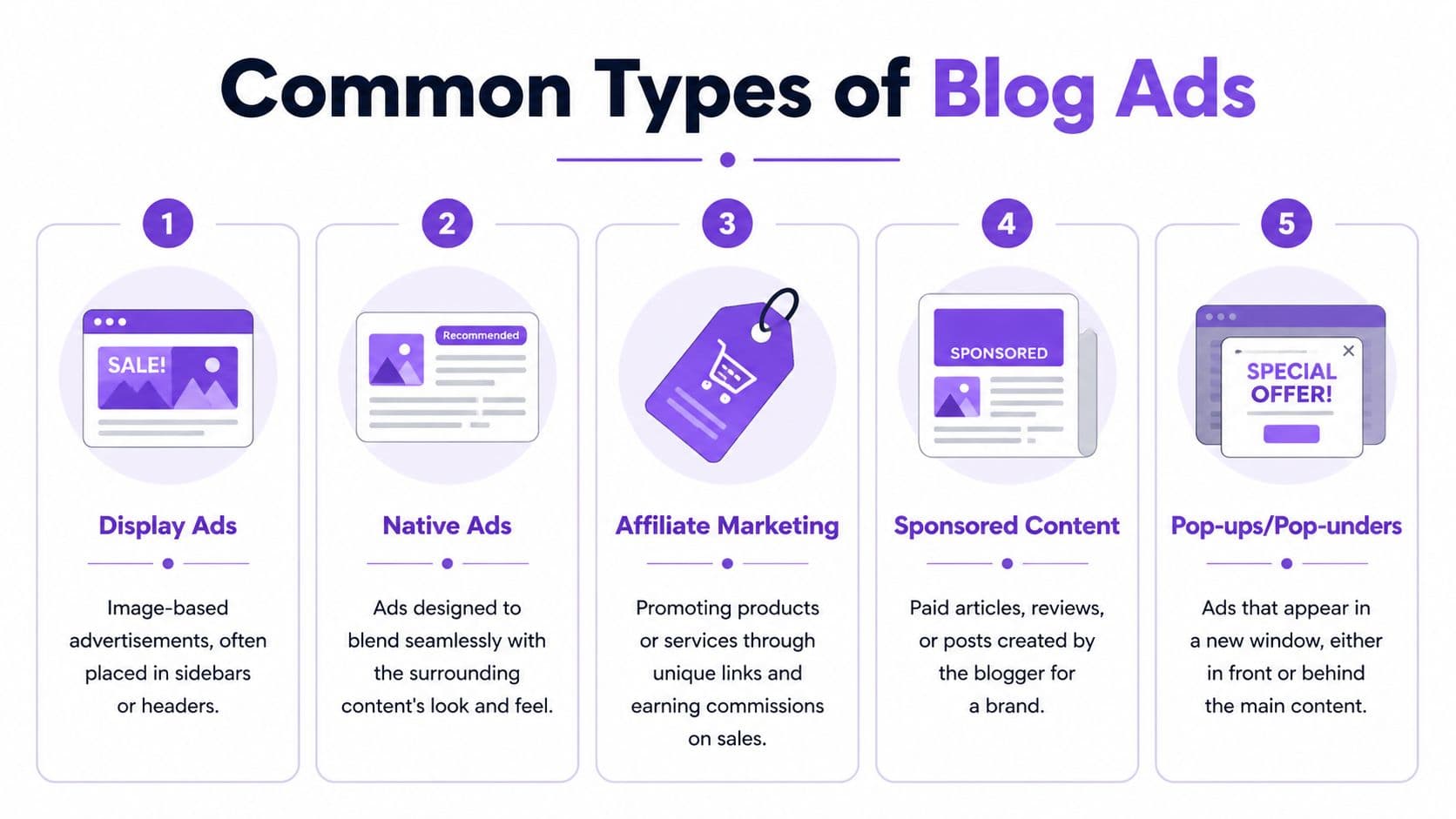
Before you decide whether ads belong on your site, it helps to know what you're choosing between. "Ads on blog" is broad. A small affiliate mention inside a tutorial is very different from a page covered in display units and pop-ups.
Display ads
These are the classic banners. You see them in headers, sidebars, between paragraphs, or at the bottom of articles. They usually come from ad networks that place image or responsive units automatically.
Display ads are easy to understand because they look like advertising. They're also the format most likely to clutter a page when publishers keep adding placements to chase more revenue.
If you want a broader view of how visual ad formats differ from intent-driven ads, Rebus has a useful primer on Display Ads vs Search Ads. That distinction matters because a visitor reading your blog is already in a content experience, not always in a buying moment.
Native ads
Native ads are designed to blend into the page. They often match the style of article recommendations, sponsored listings, or "recommended for you" cards.
They're less visually jarring than banners. That's the advantage. The risk is reader confusion. If people can't quickly tell what's editorial and what's paid placement, trust can erode.
A good rule is simple: if a native ad needs a microscope to reveal that it's sponsored, it's too close to deception.
Affiliate links
Affiliate marketing is different from running network ads. You recommend a product or service with a unique tracking link, and you earn a commission if someone buys.
For many creators, this is the cleanest ad-adjacent model because it can align with genuine education. A tutorial on email platforms can naturally include the tool you use. A gear review can include links to recommended equipment.
This model works best when the product is tightly connected to the reader's problem. It fails when every article turns into a disguised storefront.
Sponsored content
Sponsored content is a paid article, review, newsletter mention, or dedicated feature created with a brand involved. Sometimes the sponsor supplies a brief. Sometimes they only approve the topic and disclosure language.
This format can pay well relative to simple display placements, but it requires editorial discipline. If the sponsor influences your claims too heavily, the post stops serving the reader first.
Practical rule: If you'd be embarrassed to send the article to your smartest subscriber, don't publish it just because a sponsor paid for it.
Video ads and pop-ups
Some blogs embed video ads in content or run autoplay units attached to the screen. Others monetize with pop-ups or pop-unders that interrupt the reading flow.
These formats are often the most aggressive from a user experience standpoint. They can force attention rather than earn it. Sometimes they work financially. They also tend to create the most reader frustration.
A simple comparison
| Ad type | User experience impact | Effort required | Best fit |
|---|---|---|---|
| Display ads | Often noticeable to intrusive | Low to medium | High traffic content sites |
| Native ads | Lower friction if clearly labeled | Medium | Publishers with strong editorial standards |
| Affiliate links | Low if relevant and honest | Medium | Educators and reviewers |
| Sponsored content | Moderate, depends on disclosure and fit | High | Established niche creators |
| Pop-ups or video ads | High interruption | Low to medium | Sites prioritizing short-term monetization |
If you're exploring broader revenue models beyond ads, this article on what is content monetization helps put these options in a wider business context.
The True Cost of Monetizing with Ads
The biggest mistake creators make with ads is treating revenue as the only metric that matters.
A blog doesn't just "have traffic." It creates a reading experience. Ads change that experience. Some do it subtly. Some do it bluntly. Either way, the cost isn't only what appears in your dashboard. It's what disappears from the reader experience.

Revenue is visible. Friction is often hidden
Creators often fail to quantify the trade-off between ad revenue and user experience. The Memberful article on monetizing a blog without ads notes that there's a tipping point where the money no longer justifies the brand damage, higher bounce rates, and loss of reader trust. It also points out that creators are growing skeptical of ad networks because of RPM volatility and the difficulty of transitioning away without losing income stability.
That observation matters because ad income can make a weak month feel better while undermining the whole business.
What readers actually feel
Readers rarely describe the problem in technical terms. They don't say, "Your monetization stack degraded the session quality." They say things like:
- This page feels messy
- I can't find the main point
- Something keeps jumping while I read
- I don't trust this recommendation
- I'll come back later , and then they don't
None of those reactions show up neatly as a single warning. But together they reduce the value of every visitor you worked hard to attract.
Where brand damage starts
Ad-heavy pages can create three brand problems at once:
| Hidden cost | What the reader experiences | What it does to your business |
|---|---|---|
| Attention dilution | Too many competing elements | Weakens article clarity and calls to action |
| Credibility loss | Editorial and commercial lines blur | Makes recommendations less believable |
| Relationship erosion | Site feels transactional | Lowers return visits and loyalty |
This is why some creators feel uneasy about ads even before they can prove the numbers. Their audience relationship depends on depth, not just reach.
The trap of short-term logic
Short-term logic says, "If a page gets traffic, every page should carry ads."
Long-term logic asks whether the page has a more valuable job. A comparison article may be better used to grow your email list. A tutorial may be better used to sell a workshop. A thought leadership post may be better used to position your service.
If you want to evaluate that trade-off more seriously, this guide on how to calculate marketing ROI is a useful lens. It helps shift the conversation from "Did this page make something?" to "What outcome was this page supposed to produce?"
A blog post that earns a little ad revenue but loses a future customer isn't necessarily monetized well.
That doesn't mean ads are always wrong. It means they shouldn't be judged in isolation. They sit inside a larger system that includes trust, conversion intent, and how your brand feels when someone meets it for the first time.
How to Get Started with Ad Networks
If you've weighed the trade-offs and still want to test ads on blog pages, start with the mechanics. Ad networks sound mysterious until you break them down into a few basic moving parts.
Know the terms before you apply
A lot of confusion comes from jargon. Here's the plain-English version:
- CPM: Payment based on ad impressions. In other words, what advertisers pay relative to views.
- CPC: Payment based on clicks.
- RPM: A publisher view of earnings relative to page or session revenue. This is the number many creators watch because it helps them compare monetization efficiency across content.
You don't need to become an ad ops specialist. But you do need to know what your dashboard is trying to tell you.
The usual path into ad networks
Most creators start with a beginner-friendly network such as Google AdSense. Larger publishers sometimes move to premium managed networks later. The broad process looks like this:
- Build a real content base Networks want an actual site, not a placeholder. Publish original articles, clear navigation, and basic policy pages.
- Check content quality and brand safety Ad networks review whether your site is suitable for advertisers. Thin content, copied material, or unclear site purpose can create problems.
- Apply and wait for review The network checks compliance, content, and technical readiness.
- Install the ad code This usually means placing a script in your site's header or using a CMS integration.
- Monitor what appears Once ads go live, review placements on desktop and mobile. Don't assume the default setup looks good.
Choosing a network without guessing
Networks vary in ease of entry, support level, ad quality, control, and payout structure. If you want a practical overview of the decision criteria, Silver Spoon Agency's guide to choosing the right display advertising networks is worth reading.
A beginner often overvalues approval and undervalues control. That's backwards. Approval gets you in. Control determines what your site becomes after the ads are live.
What to check before and after launch
| Stage | What to review |
|---|---|
| Before applying | Content originality, policy pages, mobile usability, category fit |
| During setup | Script placement, responsive behavior, ad density, consent handling |
| After launch | Reader complaints, page layout stability, top-page experience, revenue by page type |
A sensible first test is narrow. Put ads on a limited set of informational articles, not across your entire site. Keep your most strategic pages cleaner. That includes core landing pages, product pages, service pages, and pages where trust matters more than extra inventory.
One more practical point: ad networks are not passive in the strategic sense. They're operationally lighter than launching a product, but they still need monitoring. If you don't check placements, exclusions, and performance regularly, the network will optimize for its goal, not necessarily yours.
How to Optimize Ad Revenue and Performance
If you're going to run ads, you can't treat them as decoration. Ad monetization is a technical system. Small implementation errors can lower revenue, hurt user experience, or both.

Placement matters more than most creators expect
Technical analysis collected in Marketing LTB's blogging statistics page notes that incorrectly implemented lazy loading can slow page load times by 20-30%, ads below the fold can reduce viewability and eCPM by as much as 50%, and auditing technical details can improve ad revenue by 15-35%.
That gives you a useful reality check. The difference between "ads don't pay much" and "ads pay acceptably" is sometimes execution, not niche alone.
Three areas worth auditing
- Lazy loading setup Lazy loading can help, but bad implementation delays rendering awkwardly or creates layout shifts. If your page feels unstable while scrolling, readers notice.
- Above-the-fold real estate Above-the-fold placements usually earn more because people see them. But this area is also where first impressions form. Don't overcrowd it.
- Mobile reading flow A placement that looks reasonable on desktop can overwhelm a phone screen. Check spacing, sticky units, and paragraph breaks on mobile every time you test.
Audit habit: Open your top articles on your own phone, scroll slowly, and ask one question. "Would I read this if I didn't own the site?"
Use behavioral tools, not guesswork
Revenue numbers tell you what happened. Behavior tools help explain why.
A traffic analysis workflow should include:
- Analytics review: See which pages attract sustained visits and where exits happen.
- Heatmaps or session tools: Spot where readers pause, rage-click, or abandon.
- Placement testing: Compare one layout against another instead of changing everything at once.
In such cases, a guide like how to analyze website traffic becomes useful. Revenue optimization works better when paired with reader behavior data. Otherwise you end up tuning ad settings in a vacuum.
Respect the privacy layer
Ads don't only affect layout and speed. They also trigger privacy and consent obligations. If you serve ads to users in regulated regions, you need a consent approach that matches your setup.
That means checking:
- Consent banners: They should be clear, not manipulative.
- Script behavior: Know which tags fire before and after consent.
- Vendor controls: Review which ad and measurement partners are active.
Privacy isn't a side issue. If your monetization relies on third-party scripts, your compliance setup is part of your ad strategy.
Protect the page before you protect the yield
A mature ad strategy starts with a principle: the page itself is the product the reader experiences.
That changes how you optimize. You don't ask, "How many units can I fit?" You ask, "What's the highest-performing setup that still feels respectable?" On some blogs, that answer is a few well-placed units. On others, it means keeping ads off key sections entirely.
Beyond Ads The Path to a Sustainable Creator Business
Ads monetize traffic. A direct-to-audience business monetizes trust.
That distinction changes everything. If you build your business around ad impressions, you need more pageviews, more inventory, and constant attention to network performance. If you build around direct value, you need the right audience, clear offers, and a stronger relationship.

Why direct monetization gets stronger over time
The basic advantage is control.
When a reader subscribes to your newsletter, buys a course, joins a paid community, or purchases a digital product, you're no longer earning because an ad loaded on a page. You're earning because your expertise solved a problem well enough that someone paid for more access, more depth, or more implementation help.
For B2B creators, this often matters even more. The WebGilde article on when to stop using AdSense argues that traditional ad metrics like RPM are often irrelevant for B2B creators because pageview volume is lower, while selling products, courses, or memberships can generate 10-100x more revenue than advertising by serving a high-value niche audience directly.
That doesn't mean every creator should stop using ads immediately. It means low volume doesn't automatically equal low business potential.
The direct revenue options that fit creators best
A creator business usually grows through a mix of offers, not one giant bet.
Courses and workshops
If your blog already teaches, a course is a natural extension. The blog handles discovery and trust. The course handles structure, transformation, and paid depth.
This works especially well when readers repeatedly ask for implementation help, templates, walkthroughs, or a step-by-step path.
Memberships and paid communities
Some knowledge is most valuable when people can ask follow-up questions and learn with peers. That's where paid communities or memberships become compelling.
You aren't just selling content. You're selling access, context, accountability, and belonging.
Premium newsletters
A blog attracts broad attention. A premium newsletter narrows the relationship. It creates a habit and gives you a more direct communication channel than search alone.
For creators with a strong point of view, this can become a cleaner business model than trying to squeeze more value from ad placements.
Digital products
Templates, playbooks, recordings, mini-guides, swipe files, and downloadable resources can turn specific article topics into offers. These products don't need huge complexity. They need relevance.
For a useful outside perspective on this shift, LinkJolt's guide on how to monetize your content and build your creator business captures the broader move away from pure audience renting and toward owned monetization paths.
When ads are a mismatch
You should be cautious with ads if your blog is mainly doing one of these jobs:
| Blog role | Better monetization path |
|---|---|
| Lead generation for services | Consultation, retainers, project work |
| Audience building for expertise | Paid newsletter, membership, cohort offer |
| Education-based trust building | Course, workshop, digital resource |
| Niche B2B authority | Direct sales, training, premium access |
In these cases, ads can dilute the exact signal you're trying to strengthen. They can make a premium expert site feel like a general publisher.
A practical shift in how you think
A lot of creators ask, "How much can this traffic earn from ads?"
A stronger question is, "What is this audience trying to achieve, and what would they gladly pay me to help with?" That question leads to product thinking. It usually produces a more stable business than chasing ad efficiency alone.
If recurring revenue is part of your plan, Zanfia's article on recurring revenue business models is a good reference point. It helps frame why subscriptions, memberships, and continuity offers can create a sturdier foundation than monthly ad swings.
Build the kind of blog that makes a reader want a deeper relationship, not just another pageview.
This is the hidden opportunity in refusing to overload your site with ads. You preserve the environment where authority compounds. A cleaner blog can sell more trust-intensive offers because it feels aligned with the promise behind them.
That matters for educators, consultants, and expert creators. Their business isn't built on being glanced at. It's built on being believed.
Conclusion Choosing Your Monetization Path
Ads on blog pages aren't necessarily bad. They're one monetization model among several. The mistake is treating them like the default end point of growth.
One path is the attention rental model. You grow traffic, add ad inventory, and try to increase earnings without pushing readers away. This can work, especially for high-volume publishing businesses. But it asks you to think like a media operator.
The other path is the relationship ownership model. You use your blog to earn trust, grow an audience you can reach directly, and sell products, services, memberships, or education. This path usually fits creators, experts, and niche businesses better because it compounds around credibility.
Neither choice is universal. A site can even use both, carefully. But your primary model should match your ambition.
If you want to build a publication, optimize inventory, placement, and performance. If you want to build a high-value brand, protect the reader experience and turn trust into direct revenue. That's the more durable asset.
A useful final test is simple. Ask what you'd rather own a few years from now:
- A site that needs constant traffic volume to sustain ad income
- A business with direct customers, recurring revenue, and a loyal audience
Most serious creators already know their answer. They just need permission to stop chasing the easiest-looking monetization option and choose the one that builds more long-term value.
FAQ
Should I add ads to my blog if I sell courses, coaching, or a newsletter?
Probably not as a first step. The article frames this as a choice between two business models: ads reward pageviews, while creator businesses reward trust and repeat customer value. If your blog supports consulting, courses, a newsletter, or memberships, ads can introduce friction exactly where you need clarity to convert readers into buyers.
What's the difference between CPM, CPC, and RPM in ad networks?
CPM is what advertisers pay based on ad impressions (views), while CPC is payment based on clicks. RPM is a publisher-side metric showing earnings relative to page or session revenue, and it's the number most creators watch to compare monetization efficiency across content. You don't need to become an ad ops specialist, but you should understand what your dashboard is reporting.
Are affiliate links a better option than display ads for a creator blog?
For many creators, yes, because affiliate marketing can align with genuine education rather than renting attention. A tutorial can naturally recommend the tool you actually use, and a gear review can link to equipment you trust. It works best when the product is tightly connected to the reader's problem, and fails when every article becomes a disguised storefront.
How do I start with an ad network without hurting my site?
Build a real content base with original articles and clear policies, apply to a beginner-friendly network like Google AdSense, then install the ad code and monitor placements on both desktop and mobile. Start narrow: test ads only on a limited set of informational articles, and keep your most strategic pages (landing pages, product pages, service pages) clean where trust matters more than extra inventory.
How do I know when ad revenue is costing more than it earns?
Watch for hidden signals the dashboard won't show: readers finding pages messy, losing the main point, distrusting recommendations, or not coming back. The article points to a tipping point where money no longer justifies brand damage, higher bounce rates, and lost reader trust. Judge each page by the outcome it was supposed to produce, not just the ad revenue it generated in isolation.
If you're ready to build a business around courses, paid newsletters, digital products, and community instead of depending on ads, Zanfia gives you a way to do it under your own brand and domain. An AI team runs the day-to-day work of the business for you, and you can direct it by chat or by voice instead of clicking through settings. Selling is built into the platform, with a checkout that supports order bumps, installments, and test mode so you can buy your own product before launch, and 12 product types (courses, communities, paid newsletters, memberships, digital downloads, and more) live under one brand. A 14-day free trial, no credit card required, and the current model is 0% platform commission on customer sales, so only the payment processor takes its standard cut. Availability of specific capabilities depends on the plan, see the current Zanfia pricing.