

AI Business Summit: A Playbook for 2026

AI is pulling attention from every direction right now. Your audience is asking about tools, workflows, ethics, automation, and what to do next. Most of them don't want another vague content stream. They want someone to filter the noise, bring the right people into the room, and turn scattered curiosity into a practical plan.
That's why an ai business summit works so well. It gives you a format that builds authority faster than isolated blog posts, webinars, or social threads. You stop being another commentator and become the person who curates the conversation, selects the experts, and frames the implementation path.
For creators, consultants, educators, and niche brands, that shift matters. A summit can generate attention, partnerships, product ideas, and long-tail content assets. It can also become the front end of a recurring revenue model if you structure it correctly from the start. If you're thinking beyond a one-day event, this guide pairs naturally with these recurring revenue business models.
Table of Contents
The Unmissable Opportunity of an AI Business Summit
The window is open because the demand has changed. People aren't looking for broad AI inspiration anymore. They're looking for applied guidance they can trust.
Large enterprise events show how far this category has matured. The Economist's AI and Business Innovation Summit is positioned as an enterprise-focused gathering with 600+ attendees and 70+ speakers, which tells you something important. AI summits are no longer niche meetups for technical insiders. They've become executive forums where strategy, adoption, and transformation are discussed at scale.
That shift creates room below the global flagship events. If you serve a defined market, you don't need to compete on size. You need to compete on relevance.
Why niche beats broad
A generic event called “AI in Business” sounds safe. It also sounds forgettable.
A focused summit like these is easier to market and easier to monetize:
- AI for accounting firms
- AI for e-commerce operators
- AI for HR leaders
- AI for course creators
- AI for local service businesses
Specificity does three things at once. It sharpens your speaker selection, improves your conversion copy, and raises the perceived value of the event because attendees can see themselves in the agenda.
Practical rule: If your summit theme could apply to everyone, it won't feel urgent to anyone.
What actually makes a summit valuable
The format works when you stop treating it as a content dump. A strong ai business summit does four jobs:
- Aggregates trust by putting respected operators in one place.
- Creates a decision environment where attendees compare tools, workflows, and risks.
- Builds community momentum around a shared business problem.
- Generates reusable assets you can repackage into offers after the live event ends.
What doesn't work is copying a standard online conference template, inviting random “AI experts,” and hoping ticket sales appear because the topic is hot. AI is hot. That doesn't make your summit clear, useful, or differentiated.
Crafting Your Summit Blueprint and Agenda
The fastest way to ruin an ai business summit is to start with speakers before you define the event architecture. Strong summits are built from the attendee backward.

Pick a market problem, not a trendy topic
“The future of AI” is not a summit theme. It's a vague umbrella.
Build your theme around a business outcome, a role, or an industry constraint. Good summit titles usually combine all three. For example, “AI for E-commerce Growth” is stronger than “AI in Retail” because it points toward a result and gives speakers a narrower frame.
A useful planning question is simple: what expensive, time-consuming, or risky problem does my audience want help solving right now?
That answer should shape the summit's positioning more than your personal interests.
Build one attendee profile in detail
Before you write a single agenda session, define your ideal attendee in operational terms.
Include points like these:
- Role and responsibility. Are they a founder, department lead, consultant, or operator?
- Decision authority. Can they buy software, approve experiments, or only research options?
- Current frustration. Are they overwhelmed by tool choices, blocked by team adoption, or unsure what use case to prioritize?
- Desired outcome. Do they want efficiency, better customer experience, new offers, or governance clarity?
This step keeps your content grounded. It also improves your messaging across registration pages, outreach emails, and speaker recruitment.
If you need help shaping educational flow, study how a clear learning journey is built in this guide on how to write a curriculum.
A practical agenda structure
The best summit agendas move from orientation to evidence to action. They don't throw people into advanced tactics before they understand the broader context.
A simple structure that works:
| Session type | Purpose | What to avoid |
|---|---|---|
| Opening keynote | Frame the market shift and stakes | Generic futurism |
| Operator case panel | Show how teams are actually applying AI | Theoretical commentary |
| Tool evaluation session | Compare workflows, not just brands | Vendor pitches disguised as education |
| Hands-on workshop | Help attendees leave with a draft plan | Overly broad demos |
| Live Q&A | Surface objections and edge cases | Unmoderated rambling |
| Networking block | Turn attendance into relationships | Dead air with no prompt or structure |
The broader market supports this more structured format. Major events like the Economist's AI and Business Innovation Summit show how these gatherings have evolved into dense executive forums, which signals ongoing demand for professional communities and digital knowledge products tied to practical guidance.
Don't fill every slot with presentations. Attendees remember the sessions that help them decide what to do next.
One agenda mistake to catch early
Too many hosts stack the lineup with “thought leadership” and leave implementation until the end. That's backwards.
Put concrete material early. By the midpoint, attendees should already have a framework for selecting use cases, evaluating risks, or prioritizing experiments. Inspiration is useful, but clarity sells the next offer.
Recruiting World-Class Speakers and Experts
Speaker recruitment usually looks harder than it is. The core issue isn't access. It's positioning.
Most outreach fails because organizers ask for a favor. Strong outreach offers a well-defined stage, a relevant audience, and a format that helps the speaker look good. That's especially important in an ai business summit, where credible operators are flooded with vague invitations.
Build a cross-sector lineup
One of the most useful models comes from UAB's AI in Action Business Summit, which brings together voices from venture development, corporate innovation, government, and emerging AI companies. That matters because applied AI adoption rarely sits in one silo. Buyers want technical reality, policy awareness, and business context in the same room.
A balanced lineup often includes:
- The operator who has implemented something in the field
- The strategist who can explain prioritization and governance
- The builder who understands technical limits
- The ecosystem voice from government, venture, or industry support organizations
That mix creates better sessions than a stage full of consultants who all repeat the same talking points.
Where to find strong speakers
Don't start with the biggest names in your niche. Start with the clearest practitioners.
Look in places like:
- conference breakout speakers rather than headline keynoters
- startup advisors working close to implementation
- consultants publishing teardown-style content
- leaders inside regional innovation programs
- creators who teach workflows, not just trends
If you want a useful example of the kind of practical thinking that resonates with a high-intent audience, this breakdown of Typist's agentic engineering insights is worth reviewing. It's the kind of topic angle that attracts people who want depth, not AI theater.
A speaker outreach message that gets replies
Keep it short. Respect their time. Make the event feel specific.
Use this structure:
We're hosting a focused ai business summit for [audience].
The event is centered on [specific problem or industry use case].
I'd like to invite you for a [session format] because your work on [specific topic] fits the agenda.
The audience is highly targeted, and the session would be designed around practical takeaways, not generic trend discussion.
If it's a fit, I'll send the session brief, audience profile, and timeline.
That message works because it shows curation. It doesn't promise “exposure.” Serious speakers hear that word too often.
Manage speakers like a producer
Once someone says yes, most organizers get sloppy. That creates weak sessions.
Send a concise speaker packet with:
- Audience summary
- Session goal
- Format and timing
- Moderation style
- Technical requirements
- Deadline for assets
- Rehearsal date
A polished summit feels professional long before the camera turns on. Speakers notice the prep, and attendees notice the difference.
The rehearsal matters more than hosts think. It's where you catch bloated slides, fuzzy session angles, weak audio, and panelists who need tighter prompts.
Building Your Summit Marketing and Sales Funnel
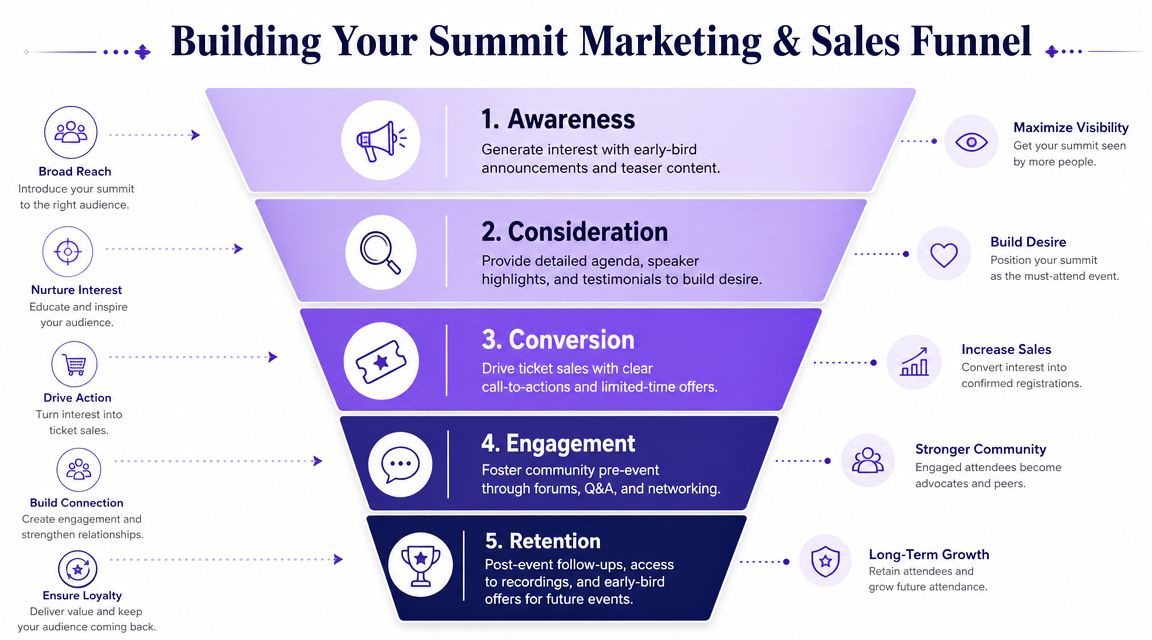
Most summit launches underperform for a simple reason. The organizer treats promotion like a list of tactics instead of a funnel with clear stage transitions.
You need a path from awareness to conversion to post-purchase engagement. If any stage is weak, the whole launch feels expensive and chaotic. This guide to sales pipeline strategies is a useful parallel because ticket sales follow the same logic. You move people from interest to action through structured follow-up, not isolated announcements.
Start with the offer stack
Before you market anything, define what people can buy.
A practical summit offer stack often includes:
- Keynote Pass for broad reach and list growth
- All-Access Pass with recordings and session extras
- VIP Offer with a private Q&A, workshop, or curated networking layer
The mistake is treating the ticket as the product. The ticket is only one part of the product. The full offer includes access, depth, convenience, and continuity.
Map the funnel in stages
A clean summit funnel usually works like this:
Pre-launch interest
Start with a waitlist page and early concept messaging. This tells you which angle is pulling attention before you finalize the full campaign.Authority build
Release speaker announcements one by one. Don't dump the whole lineup in a single post unless your audience is already primed.Conversion push
Open registration with a strong landing page, a clear promise, and a fast path to checkout.Pre-event engagement
Registrants should receive reminders, speaker spotlights, and prompts that increase attendance quality, not just attendance quantity.Post-event segmentation
Separate non-buyers, live attendees, replay buyers, and high-engagement participants. They each need a different follow-up path.
If you want a model for structuring those transition points, this sales funnel template is a solid reference.
What works in summit promotion
The highest-performing summit campaigns usually share three traits:
- Speaker distribution is built in. Each speaker gets prewritten assets and posting prompts.
- The registration page answers objections quickly. Who is this for, what will I get, and why this now?
- The email sequence does actual selling. It doesn't just repeat the announcement.
Use your emails to handle hesitation. Address things like relevance, time commitment, format, and practical outcomes. People often buy because one email finally translates the agenda into a decision they can justify.
What usually fails
Three patterns show up again and again:
- launching with a broad promise and no clear attendee fit
- relying on social posts while neglecting email
- offering a paid pass without enough perceived differentiation from free content
Field note: If your paid pass looks like “the same event, but more expensive,” people wait, hesitate, or skip it.
Ticketing strategy with margin in mind
Keep the pricing structure simple enough that people can decide quickly. Complexity kills momentum.
Offer fewer tiers, make the differences obvious, and use add-ons only when they increase clarity. Recordings, worksheets, small-group sessions, and implementation templates usually outperform random bonus clutter.
The strongest summit funnels don't push harder. They reduce friction at every step.
Your All-in-One Summit Tech Stack with Zanfia
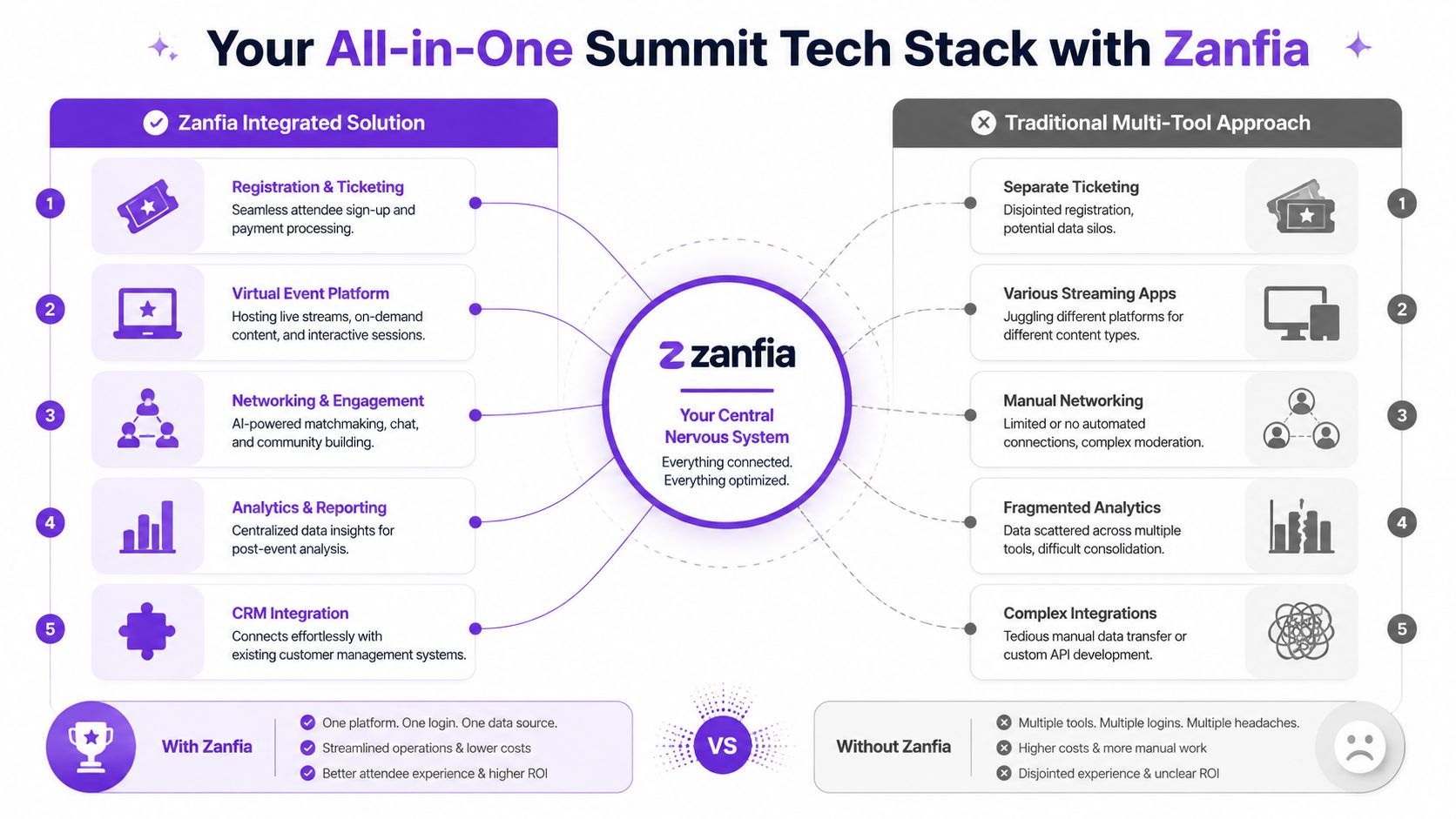
The wrong tech stack can turn a promising ai business summit into a support nightmare. I've seen organizers stitch together one tool for checkout, another for video, another for community, another for invoices, and still another for email access. That setup looks flexible on paper and becomes fragile in practice.
The better question isn't “What tools can I combine?” It's “How many moving parts can I remove before launch day?”
Piecemeal stack versus integrated stack
Here's the trade-off:
| Approach | Advantage | Cost of using it |
|---|---|---|
| Piecemeal tools | You can pick separate apps for each function | More setup, more handoffs, more failure points |
| Integrated platform | Fewer systems to manage under one brand | You need to choose a platform that fits your business model |
For summit operators who want to monetize beyond the event itself, an integrated system usually wins. You need registration, payments, access control, content delivery, community, and post-event productization to work together.
What matters most in the stack
The platform should handle these jobs without duct tape:
- Registration and payment collection
- Access delivery after purchase
- Replay hosting
- Private attendee community
- Product upsells after the event
- Administrative automation
- Branded experience under your own domain
That's where Zanfia fits unusually well. It combines community, courses, paid newsletters, knowledge libraries, subscriptions, e-books, and downloads under a single login and custom domain. For summit operators, that means you can sell access, deliver recordings, host a private member space, and turn the event into an ongoing product without pushing people across disconnected tools.
Another major advantage is margin control. Zanfia charges 0% platform transaction fees, with only payment operator fees applying. If your summit turns into a replay product, membership, or bundled education offer, that fee model matters over time.
Operational advantages that compound
The obvious benefit is convenience. The less obvious benefit is decision speed.
Zanfia includes:
- native video hosting, which reduces the need for a separate premium video stack
- automations for granting course access, adding buyers to the right community spaces, sending welcome emails, handling renewals, and revoking access when a plan ends
- automatic invoicing through inFakt and Fakturownia
- payment support including Stripe, PayU, Przelewy24, BLIK, and Tpay, with Apple Pay and Google Pay supported via a Stripe-linked cart
- white-label and custom domain support on every plan
Those automations can save 5 to 10+ hours a month, which is time most hosts would rather spend on speakers, partnerships, and content quality.
A small engagement layer can also make the event feel more alive. If you want a simple add-on for attendee fun during a virtual gathering, this guide on how to create a virtual photo booth is a practical companion.
For creators and educators who plan to turn summit recordings into a structured learning product later, Zanfia's platform for online courses is the relevant next step.
Later in your build, it helps to see the platform in action:
An event business becomes easier to scale when access, content, billing, and community live in one operating system.
Delivering an Unforgettable Summit Experience
A summit feels premium when attendees stay oriented, engaged, and clear on what to do with what they're learning. It feels forgettable when sessions blend together and the audience becomes passive.
That's why live execution should be designed around participation, not just broadcasting. The strongest enterprise events push toward practical outcomes. The AI Business Summit in Glasgow is positioned to help leaders cut through the hype by focusing on implementation discipline and measurable business outcomes, with a workflow that pre-screens use cases, maps them to data readiness, and validates tools against KPIs.
That framing is useful for your own event design. Every session should move attendees closer to a business decision.
A live delivery checklist
On event day, the host needs control over rhythm. Keep this operational checklist tight:
- Moderator alignment. Every moderator should know the session goal, fallback questions, and time boundaries.
- Speaker readiness. Confirm slides, audio, internet stability, and backup contact method before the event starts.
- Attendee orientation. Open with a short briefing on where to ask questions, where to find updates, and how networking will work.
- Support triage. Assign someone to handle access problems, chat issues, and speaker transitions.
This isn't glamorous work, but it protects the audience experience.
Design interaction by session type
Not every session deserves the same format.
Use a pattern like this:
| Session | Best interaction style |
|---|---|
| Keynote | Pre-submitted questions plus live vote on top challenge |
| Panel | Moderator-led case comparison, not loose discussion |
| Workshop | Worksheets, templates, and implementation prompts |
| Tool session | Evaluation criteria and decision checklists |
| Networking | Prompted introductions around role, use case, and current obstacle |
If you leave networking unstructured, many attendees won't participate. Give them prompts they can answer quickly and usefully.
Keep the summit grounded in action
A practical ai business summit should help attendees answer questions like:
- Which use case should I test first?
- Is my team ready for this workflow?
- What data do I need before I buy software?
- What should I not automate yet?
- How will I know whether this experiment is working?
The audience doesn't need more AI excitement. They need a sharper next move.
Common execution mistakes
The biggest mistakes are predictable:
- too many sessions with the same tone and pacing
- Q&A windows that are too short to be useful
- no clear path for attendees to connect with one another
- content that never translates into implementation criteria
A summit becomes memorable when people leave with language for internal decisions. If an attendee can brief a colleague or manager the next day with confidence, the event did its job.
Turning Attendees into Lifetime Customers
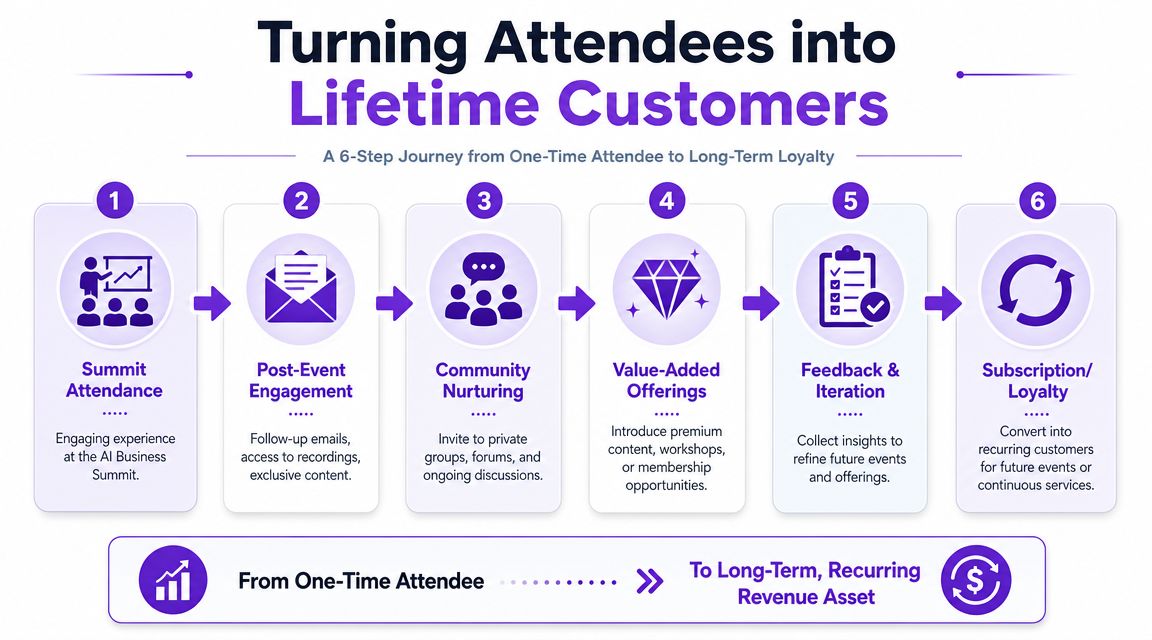
Most organizers think the summit is the product. It isn't. The summit is the conversion event that reveals who wants more depth, more access, and more continuity.
That's where core business gets built. If you stop at ticket sales, you'll keep rebuilding momentum from zero each time. If you design the post-event path properly, your ai business summit becomes the front end of a durable education and community business.
Turn the event into a replay product
Your first post-event asset is obvious but often underused. Package the recordings, slides, worksheets, transcripts, and bonus materials into a clean replay offer.
Don't sell it as “missed the event?” Sell it as a focused implementation library.
The framing matters. A replay product should feel organized, searchable, and outcome-oriented. It's closer to a course than a raw video archive.
Build the next offer from behavior
Your attendees will tell you what to launch next if you pay attention.
Look at questions such as:
- Which sessions kept people engaged longest?
- Which topics triggered the strongest Q&A?
- Which buyers wanted more access to the speakers?
- Which segment asked for accountability or peer discussion?
Those signals usually point toward one of three follow-up offers:
- A structured course
- A paid membership community
- A workshop series or advisory layer
The strongest path is often a membership built around continued implementation support. That's especially true when your audience doesn't just need information. They need accountability, examples, and a place to compare decisions with peers.
Why community beats one-off follow-up
A summit creates temporary intensity. Community extends it.
When people continue discussing tool choices, use cases, hiring questions, governance concerns, and experiments after the event, the summit stops being a date on the calendar and starts becoming a business ecosystem.
That's why retention strategy matters as much as acquisition. If you're thinking about how to keep members active after they join, these member retention strategies are worth applying to the post-summit phase.
Closing insight: The summit earns attention. Ongoing access earns stability.
A simple post-summit monetization sequence
Use a sequence like this:
- Immediate follow-up with recordings, session summaries, and a next-step survey
- Segmented offer based on attendee behavior and interests
- Founding member invitation for a paid implementation community
- Ongoing content rhythm with expert sessions, templates, and discussion prompts
- Future event priority access for existing members
What works is continuity. What doesn't work is a single “thanks for attending” email followed by silence.
The long-term play
When this model is done well, each summit strengthens the next one. Past attendees become repeat buyers. Community members become ambassadors. Recordings become product inventory. Speaker relationships become distribution assets.
That's the shift often overlooked. A summit isn't just an event format. It's a customer acquisition and trust-building mechanism for a broader digital business.
If you want to run an ai business summit without juggling scattered tools, Zanfia gives you a practical foundation for selling access, hosting courses and replay libraries, building a branded community, automating member workflows, and keeping 100% of your revenue at the platform level with 0% transaction fees. It's built in Poland, supports local payments and invoicing, and helps you turn a one-time summit into a cleaner, more profitable recurring business.


