

Ebook Pricing Strategy 2026: $7 vs $27 vs $47 – What Actually Sells Best
Pricing an ebook in 2026 is a different problem than it was even two years ago. Readers have more options, fewer dollars per impulse buy, and sharper instincts for spotting a $7 PDF that should have been a $0 lead magnet. The creators making real money from ebooks right now aren’t winning because they found a magic number. They’re winning because they matched price to positioning, audience, and what the buyer actually walks away with.
This guide breaks down the three price points that dominate the digital ebook market — $7, $27, and $47 — plus the bundle math, pay-what-you-want experiments, and global pricing decisions that determine whether your ebook becomes a business or a hobby. By the end, you’ll have a clear framework for which price your next ebook should launch at, and why.
Why $7 ebooks rarely build a business in 2026
The $7 ebook is the most romanticized price point in the creator economy. It feels accessible. It feels like a no-brainer impulse buy. It feels like volume will save you. In practice, $7 ebooks almost never build a sustainable business — and the math is brutal once you look at it honestly.
Assume you sell 1,000 copies of a $7 ebook in a month. That’s $7,000 gross. Strip out payment processor fees (around 3% on Stripe), and you’re at roughly $6,750. If you ran any paid traffic at all, even a conservative $2 cost-per-acquisition wipes out $2,000. Now you’re at $4,750 for 1,000 buyers. That’s a respectable side income — until you realize you need to repeat that volume every single month, and 1,000 copies a month is not easy at any price point.
The real cost of low-ticket buyers
The hidden tax of $7 ebooks isn’t the price — it’s the buyer profile. Low-ticket buyers churn faster, refund more aggressively, and rarely convert into higher-tier offers. A reader who pays $7 has made a frictionless decision; they haven’t committed. When you launch a $200 course six months later, they ghost. According to Harvard Business Review’s research on price anchoring, low initial anchors compress what buyers are willing to pay for follow-up products from the same creator.
$7 ebooks make sense in exactly two scenarios. First, as a tripwire — a paid lead magnet designed to convert email subscribers into buyers before you pitch a real offer. Second, as a high-volume play when you have organic distribution that scales (a 100k newsletter, a viral TikTok account, an SEO-ranking blog). For most creators, neither is true on day one.
What $7 actually communicates
Price is a signal. $7 communicates “this is a snack, not a meal.” If your ebook delivers a complete framework, a multi-week implementation roadmap, or insider knowledge that took you years to compile, pricing it at $7 actively undermines the perception of value. Buyers anchor on the price, then evaluate the content against that anchor. A $7 product that delivers $50 of value still feels like a $7 product to most readers.
The $27 sweet spot: conversion rates and audience size
If there’s a default smart starting point for a serious ebook in 2026, it’s $27. This price clears the impulse-buy threshold for engaged audiences, signals seriousness, and gives you margin to actually run ads or affiliate programs without selling at a loss.
The conversion math at $27 is forgiving. With a focused landing page, warm traffic, and a niche audience that already knows your name, conversion rates of 3% to 8% are realistic. On a list of 5,000 engaged subscribers, a single launch email sequence selling a $27 ebook can produce $4,000 to $10,000 in a week — without paid ads, affiliates, or extensive funnels.
Why $27 outperforms $17 and $37
$27 lives in a psychological dead zone where buyers stop scrutinizing price and start scrutinizing fit. At $17, buyers still compare to free alternatives. At $37, they start asking “does this come with a video course or coaching?” $27 sits below the “is this a real product?” threshold for most readers — they assume yes, and focus on whether the topic is right for them.
According to Forbes Business Council coverage of pricing psychology, prices ending in 7 consistently outperform round numbers in direct-response digital sales because they cue a discount-adjacent feeling without explicitly anchoring to a higher price.
What $27 requires from the product
A $27 ebook needs to feel like a real product. That usually means:
- 60 to 150 pages of focused, structured content (not 30 pages of fluff)
- A clear transformation or outcome the reader gets by finishing it
- Worksheets, templates, checklists, or downloadable assets that justify the price beyond “words on a page”
- Professional design — Canva is fine, but the cover and interior layout should look intentional
If you can deliver those four things, $27 is a strong starting price for a creator with an audience under 50,000.
$47 and above: when premium positioning unlocks more revenue
$47 is where the math gets interesting. At this price, you don’t need volume — you need positioning. Sell 100 copies of a $47 ebook and you’ve made $4,700 from a small, focused audience. That’s a realistic outcome for a creator with 1,000 engaged newsletter subscribers and a tight, specific offer.
What earns the right to charge $47+
Premium pricing isn’t just a number — it’s a promise. A $47 ebook needs to deliver something a $27 ebook can’t: insider knowledge, proprietary frameworks, time-tested templates, or expertise that buyers can’t easily find elsewhere. Three categories consistently support premium pricing:
- Niche expertise: An ebook for “commercial real estate investors in secondary markets” can charge $47 to $97 because the audience is small, monetizable, and starved for good content.
- Done-for-you assets: When the ebook includes 50+ swipe files, scripts, or templates that buyers will actually use, the perceived value scales with the asset count, not the page count.
- Credentialed authority: If you have a track record (a successful exit, a top-ranked podcast, a public portfolio of results), readers pay premium prices for the chance to learn from you specifically.
The $97 ebook frontier
Some creators successfully sell ebooks for $97 to $197. These are almost always B2B or professional services niches — agency owners selling to founders, consultants selling to executives, freelancers selling to operators. The buyer’s purchase decision is grounded in expected ROI, not entertainment. A $97 ebook that saves a buyer 10 hours of consulting fees is a no-brainer.
If you’re considering premium pricing, the question to ask yourself is: can my buyer reasonably expect to recoup this price within 30 days of reading? If yes, charge accordingly. If no, you’re priced wrong — either too high for the value, or you haven’t communicated the value clearly enough.
Bundle math: 3 ebooks at $19 each vs 1 bundle at $47
Bundling is the most underused leverage point in ebook pricing. The math behind bundles isn’t just “sell more units at a discount” — it’s about repositioning your catalog so each individual ebook drives demand for the others.
Consider a creator with three ebooks priced at $19 each ($57 total if bought separately). Offering all three as a $47 bundle does three things at once:
- Increases average order value from $19 to $47 — a 147% jump
- Reduces decision fatigue (buyers stop comparing the three ebooks and just grab everything)
- Resets the price anchor — buyers see “$57 value for $47” and feel the saving, not the spend
When the bundle beats the standalone
Bundles work best when the ebooks share a common reader. If you’ve written three ebooks for freelance graphic designers — one on pricing, one on contracts, one on client onboarding — a $47 bundle is an obvious win. The same reader needs all three, and bundling captures the full lifetime value upfront instead of trickling it across three separate launches.
Bundles fail when the ebooks target different personas. A creator with one ebook on email marketing, one on SEO, and one on copywriting will struggle to sell a bundle because most buyers only want one of the three. Better to keep these as standalone $27 to $47 offers and use email sequences to cross-sell over time.
Order bumps and upsells inside the bundle
The smartest creators don’t stop at “buy this bundle.” They add an order bump at checkout — a $17 add-on like “30-minute consulting call recording” or “Notion template library” — that 20% to 35% of buyers take. On a $47 bundle, a $17 bump taken by 25% of buyers adds an extra $4.25 in average order value across the entire bundle’s sales. That compounds fast.
This is one of the operational reasons creators move off pure marketplace platforms. Stitching together standalone ebooks, bundles, and order bumps on Gumroad or a basic file-delivery tool often means juggling separate products, separate landing pages, and separate checkouts. A platform with native bundles, discount codes, and order bumps built into one checkout flow turns this from a manual headache into a default behavior.
Pay-what-you-want: when it works, when it kills perceived value
Pay-what-you-want (PWYW) pricing has a cult following in the creator world. The pitch is irresistible: let readers pick their price, generate goodwill, and watch some buyers pay generously. The reality is more complicated.
PWYW works in three specific situations:
- You have massive distribution and want to maximize reach. A creator with a 200k-follower audience can use PWYW to extract more total revenue from the small percentage who’d happily pay $30 to $100, while still capturing the broader audience at $5.
- You’re testing demand for a new format. Launching a paid newsletter or a new ebook category? PWYW with a $5 minimum tells you what readers are actually willing to pay, with real money on the line.
- You’re building a tip-jar relationship. Some creators (essayists, indie researchers, niche analysts) genuinely operate as patronage-style businesses where readers fund the work, not the product. PWYW is honest pricing in that context.
Where PWYW destroys value
For most creators, PWYW is a quiet trap. It tells the market your work is unpriced, which buyers interpret as “unpriceable” — meaning, not worth a real number. Average PWYW payments tend to cluster near the suggested minimum. A creator who would have made $27 per copy at a flat price often makes $9 to $12 per copy on PWYW, despite serving the same audience.
PWYW also makes future pricing harder. Once readers anchor on “pay what you can,” switching to a $47 flat price triggers churn and complaints. The transition from PWYW to fixed pricing is one of the hardest pricing moves in the creator economy — usually requiring a complete product relaunch under a new brand.
The hybrid approach
A smarter version: set a fair flat price ($27 or $47), then add a small “pay extra to support” option at checkout. This captures the goodwill effect of PWYW without sacrificing the anchor. A surprising number of buyers will tip an extra $5 to $15 if you make it easy — and your baseline revenue stays predictable.
Currency and geo-pricing: serving global readers without losing margin
The ebook market is global. A $27 ebook is an impulse buy for a US software engineer, a meaningful purchase for a reader in Poland or Brazil, and a serious financial decision for someone in Indonesia or Egypt. Pricing the same way everywhere leaves money on the table — or worse, prices out half your potential audience.
Geo-pricing strategies that actually work
Three approaches dominate:
- Display in local currency, charge a converted equivalent. A $27 ebook shows as £21 in the UK, €25 in Germany, R$135 in Brazil. This reduces sticker shock and conversion friction. Modern checkout systems handle this automatically.
- Tiered regional pricing with purchasing power parity (PPP) discounts. Offer the same product at $27 in the US, $19 in Mexico, $12 in India. This is more aggressive but can dramatically increase conversion in lower-income markets. The downside is policing the discount (some buyers in higher-income countries will use VPNs).
- Discount codes by audience segment. Instead of geo-detection, share region-specific codes through targeted email campaigns or partnerships with local creators. This avoids VPN gaming and gives you cleaner data on which audiences respond.
Research from Pew Research on creator economy demographics highlights how global creators serve increasingly diverse buyer bases — making geo-pricing less of a nice-to-have and more of a competitive necessity.
The currency conversion trap
If you sell globally but only price in USD, you lose buyers at checkout. Foreign card holders see a converted amount they didn’t expect, plus a 2% to 3% foreign transaction fee from their bank. A $27 ebook can land at $30 to $32 on a foreign card statement — enough to trigger refund requests and chargebacks. Native multi-currency support eliminates this friction.
How Zanfia supports tiered ebook pricing and bundles natively
Most ebook sellers piece together their pricing stack with three or four tools: a checkout app, a delivery system, a discount code generator, and a separate analytics layer. That fragmentation is the reason most creators don’t actually test their pricing — the friction of changing prices, launching a bundle, or adding an order bump is just too high.
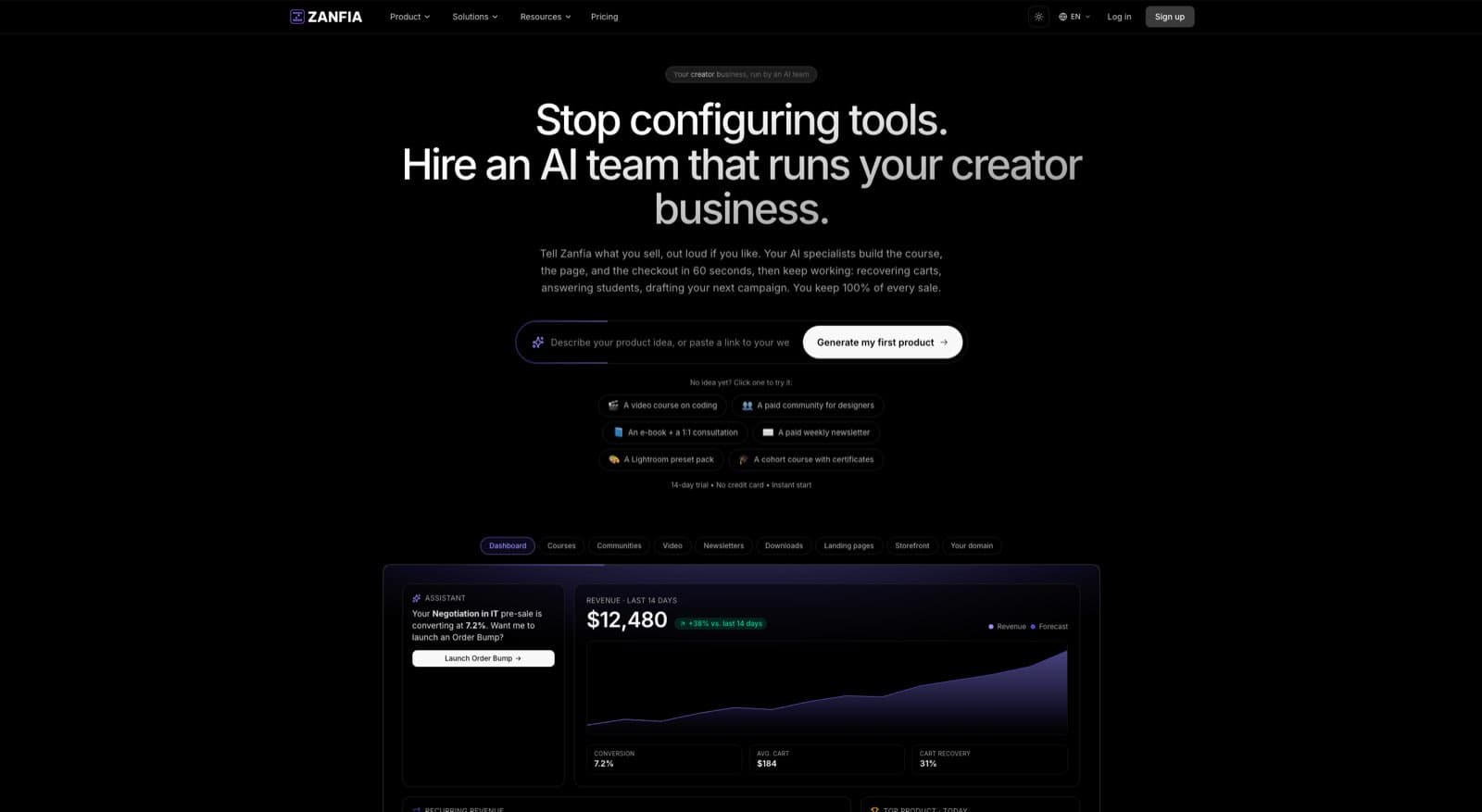
Zanfia is built as an AI team that runs the creator business, and a platform second: the assistant knows the whole application and can perform any action available in the interface, by chat or by voice, so pricing changes, bundle launches, and order bumps stop being multi-tool projects. Ebooks, courses, communities, newsletters, and paid downloads all live under one brand, and the MCP endpoint lets your own AI agents work with the workspace directly. Here’s what that looks like in practice for ebook sellers. Every plan starts with a 14-day free trial, no credit card required.
Tiered pricing and bundles in one checkout
Zanfia’s Cart 2.0 supports one-time payments, subscriptions, installments, and free trials inside the same checkout flow. You can price a $600 course as four payments of $150, sell a $27 ebook today, launch a $47 bundle next month without rebuilding your funnel, and even test a $19/month “ebook library subscription” later — all from the same product catalog, and all editable by asking the assistant instead of clicking through settings.
Bundles aren’t an afterthought. You can group existing ebooks into a single product, set a bundle price below the sum of individual prices, and let buyers see exactly what they’re getting and saving. This is the kind of flexibility that turns a single ebook into a real product line.
Order bumps and discount codes without third-party tools
Order bumps — those checkout add-ons that lift average order value 20% to 40% — are part of Zanfia’s checkout on higher plans (see the current Zanfia pricing for what unlocks where). Add a $17 template pack as a bump on your $47 ebook, and a portion of buyers will say yes without leaving the page. No Zapier, no separate upsell tool, no janky redirects. Test mode lets you buy your own product end to end before launch, confirming the bump, the tracking, and the delivery all work — without recording a real order.
Discount codes are equally direct. Run a launch discount, a flash sale, an affiliate-specific code, or a regional pricing experiment without touching code. A built-in referral program (where existing customers earn rewards for sending new buyers) is coming soon, and together they will replace what most creators currently use three separate tools to manage.
0% platform fees, fair payment processing
Selling a $47 ebook on Gumroad’s direct mode means losing $5.20 per sale to their 10% + $0.50 cut — before Stripe fees even kick in. Across 500 sales, that’s $2,600 left on the table. Zanfia charges 0% platform transaction fees on customer sales — only the actual payment processor fee applies (around 3% on Stripe). On the same 500 sales of a $47 ebook, that’s roughly $1,900 more in your pocket annually, just from removing the platform tax.
White-label checkout and global readiness
Your ebook deserves a checkout experience that doesn’t scream “hosted on someone else’s platform.” Zanfia gives every creator a subdomain (yoursite.zanfia.co), with custom domain mapping available on higher plans, so the buying experience stays on your brand. Stripe and PayPal as payment processors mean global card support out of the box, and Apple Pay and Google Pay are supported in checkout for mobile buyers.
For US-based ebook sellers serving a global audience, this combination — an AI team you can direct by chat or voice, native bundles, installments, order bumps, test mode, 0% platform fees, white-label branding, multi-processor support — replaces what most creators currently stitch together across four or five tools. See current Zanfia pricing to find the plan that fits your ebook business.
FAQ
What is the best price for an ebook in 2026?
For most creators with an established audience under 50,000, $27 is a strong starting price. It clears the impulse-buy threshold, signals a real product, and gives you margin to invest in marketing. $7 works only as a tripwire or with massive organic distribution; $47 and above require premium positioning, niche expertise, or included done-for-you assets.
Should I use pay-what-you-want pricing for my first ebook?
Usually not. PWYW tells the market your work is unpriced, average payments cluster near the minimum, and switching to flat pricing later is painful. Use a flat price ($27 is a safe default), then optionally add a “tip extra to support” option at checkout if you want some of the goodwill effect.
How many ebooks should I bundle together?
Two to four ebooks is the sweet spot. The ebooks must share a common reader — bundling unrelated topics fails because each buyer only wants one or two of the included items. Set the bundle price 15% to 30% below the sum of individual prices to make the saving feel meaningful without giving away too much margin.
Do I need to price in local currencies for global readers?
If more than 20% of your audience is outside your home country, yes. Foreign buyers seeing prices only in USD face conversion fees, sticker shock, and higher checkout abandonment. Modern checkout platforms can display local currency automatically, which is the lowest-friction way to serve a global audience.
How do I justify charging $47 instead of $27 for an ebook?
Premium pricing requires premium signals: niche expertise, proprietary frameworks, done-for-you templates, credentialed authority, or a clear ROI promise. If your buyer can reasonably expect to recoup the $47 within 30 days of reading (through saved time, avoided mistakes, or new revenue), the price justifies itself. If not, either reposition the offer or stay at $27.
What payment processors should I use for ebook sales?
Stripe and PayPal cover the vast majority of global buyers. Stripe is the default for card payments, supports Apple Pay and Google Pay, and handles currency conversion cleanly. PayPal adds a layer for buyers who prefer not to share card details directly. Together, these two processors serve well over 90% of international ebook buyers.