

How to Find Your First 10 Paying Mentees Without Cold Outreach in 2026
You started your mentoring practice because you love the work. You wanted to help ambitious people move faster, avoid the mistakes you made, and build something meaningful. What you didn’t sign up for was becoming a full-time cold DM operator, spending three hours a day begging strangers to book a call with you.
Here’s the good news: in 2026, the mentors making $10,000 to $50,000 per month from a small roster of clients almost never send cold outreach. They’ve built systems that make qualified mentees raise their hand and apply. The mentors still grinding through cold DMs? They’re stuck at $2,000 to $4,000 per month, burning out, and quietly resenting the work.
This guide walks you through the exact system to find your first 10 paying mentees without a single cold DM. It’s the audience-of-one method, the free content sequencing that surfaces buying intent, the qualifying landing page, and the application flow that filters tire-kickers before they touch your calendar. By the end, you’ll have a replicable funnel that pulls mentees in while you sleep.
Why cold DMs are dead for premium mentoring in 2026
Cold outreach worked in 2019. It sputtered through 2022. By 2026, it’s a graveyard for premium mentoring offers, and there are four reasons why.
First, the inboxes are saturated. The average LinkedIn power user gets 40 to 80 unsolicited pitches per week. Instagram DMs are worse. Your carefully crafted message competes with automated spam that looks nearly identical to human effort. Response rates for cold DMs offering high-ticket mentoring have collapsed from around 3% in 2020 to under 0.4% today, according to sales operations benchmarks tracked by Harvard Business Review’s 2024 research on modern sales performance.
Second, cold outreach is a status signal, and it’s the wrong one. When a mentor DMs a stranger, they’re broadcasting scarcity of demand. The prospect thinks, consciously or not, “if you were as good as you say, why are you the one messaging me?” Premium buyers want to be selected, not pitched. The mentor who runs an application process is playing a completely different game than the one sliding into DMs.
Third, platform algorithms punish outbound. Instagram throttles accounts that send lots of unsolicited DMs. LinkedIn caps connection requests and shadow-flags accounts that hit “connect and pitch” patterns. What used to be a free channel is now a slow account death sentence.
Fourth, and most importantly, cold DMs skip the pre-qualification step that makes mentoring engagements actually work. You end up on calls with people who aren’t ready, can’t afford it, or don’t respect your time. Every unpaid discovery call is 45 minutes you didn’t spend on the client work that grows your reputation. The economics don’t survive scale.
The mentors who broke past the first-10-clients wall in 2026 aren’t better at outreach. They just stopped doing it.
The audience-of-one method: serve in public, attract privately
The audience-of-one method flips the funnel. Instead of casting a wide net and hoping to catch someone, you write, film, and post as if you’re speaking directly to one specific person, your ideal mentee, and let them find you.
Here’s what “one specific person” means in practice. It’s not “solopreneurs.” It’s not even “solopreneurs who want to build a personal brand.” It’s more like: “Marcus, a 34-year-old former product manager at a mid-sized SaaS company who quit his job six months ago to build a solo consulting practice, is stuck at $8,000 per month, and knows he needs a positioning fix but can’t find anyone honest enough to tell him what’s wrong.”
That’s the person you write for. Every LinkedIn post, every newsletter issue, every YouTube video is a direct message to Marcus. When you write this way, three things happen simultaneously.
Marcus feels seen. He shares your post with a screenshot and “this is me.” His network, full of other Marcuses, starts following you. Your audience compounds because you stopped writing for everyone.
Your positioning sharpens. You can’t hide behind vague advice when you’re writing to one person. “Charge more” becomes “raise your day rate from $1,500 to $3,000 and add a mandatory two-week diagnostic before any engagement.” The specificity signals expertise.
Buying intent surfaces. Marcus, having felt seen for the fourth or fifth time, starts wondering: “could this person actually help me directly?” He clicks your profile, finds your application link, and applies. You didn’t sell him. He sold himself.
How to find your audience-of-one
Take your last five paying clients (or, if you don’t have five, your last five ideal-fit conversations). Write down their titles, their previous jobs, their current revenue, the specific problem they hired you to solve, and the exact quote they used when describing that problem to you.
Look for overlap. Nine times out of ten, three of those five people are almost identical: same background, same stuck point, same language. That’s your audience-of-one. Everything you publish for the next 90 days is written to that composite person.
Free content sequencing that surfaces buying intent
The mistake most mentors make with content is treating every post like an isolated performance. They post whatever’s on their mind, hope it gets engagement, and wonder why leads don’t come in.
Effective mentor content is sequenced. There are three layers, and each one does a specific job.
Layer 1: Awareness (60% of your output)
These are posts that describe the problem your mentee is stuck on, in their own language. You’re not selling. You’re not pitching. You’re diagnosing.
Examples: “The reason your $2K/month consulting practice isn’t growing to $10K/month has nothing to do with lead volume.” Or: “Most solo consultants underprice by 60% because they benchmark against employees instead of against the problem they solve.”
The goal here is recognition. Marcus reads and thinks, “yes, this is exactly my situation.” He follows you.
Layer 2: Perspective (30% of your output)
These are posts that show your specific point of view on how to fix the problem. You’re teaching, but only enough to prove you have a system, not enough to give the whole system away.
Examples: A three-step breakdown of how you’d audit a stuck consultant’s pricing. A short case study of a client who went from $3K to $12K per month by removing three services from their offer. A hot take on why “niching down” advice is usually wrong.
The goal here is trust and differentiation. Marcus reads and thinks, “this person actually knows what they’re doing, and their approach is different from the generic advice I’ve been getting.”
Layer 3: Proof and invitation (10% of your output)
These are posts that share client outcomes, screenshots (with permission), or subtle invitations to work together. Never in a “DM me” way. Always in a “here’s what happened when we worked together” way, with a link to your application at the bottom.
Examples: “Last month a client sent me this Slack message after we restructured her pricing (screenshot). Here’s what we changed and why.” Followed by: “I take on three new 1:1 mentees per quarter. Applications open here: [link].”
The goal here is conversion. Marcus, who has been reading you for six weeks, sees this and clicks the link.
Justin Welsh’s 2026 solopreneur playbook popularized this ratio (roughly 60/30/10), and it holds up across mentors, coaches, and creators in the $10K to $50K per month tier. The mentors who invert it (60% pitching, 30% teaching, 10% diagnosing) get low engagement and near-zero applications.
The qualifying landing page (and what it must include)
Once someone clicks your link, the next 45 seconds decide whether they’ll apply or bounce. Your landing page has one job: convince the right person to apply, and convince the wrong person to leave without wasting your time.
Here’s what a qualifying landing page for a mentoring offer must include, in the order it should appear.
1. A specific positioning headline
Not “I help entrepreneurs grow their business.” That’s a wet napkin. Try: “1:1 mentoring for former corporate operators building a $30K/month solo consulting practice.” The specific reader thinks, “that’s me.” Everyone else leaves. That’s the point.
2. A one-paragraph problem statement
Describe the exact situation your ideal mentee is in. What have they tried? Why hasn’t it worked? What are they afraid of? This paragraph should feel like reading their own journal entry.
3. What the mentorship actually is
Format, cadence, duration, and delivery. Weekly 1:1 calls? Async Slack access? A three-month minimum? A private community alongside the calls? Be concrete. Vague offers convert badly because prospects can’t imagine themselves in the program.
4. Who it’s for and who it’s not for
This is the counterintuitive move most mentors skip. Write a bullet list of “this is for you if…” (5 items) and “this is not for you if…” (3 items). The disqualifiers are as important as the qualifiers. They signal that you have standards, which raises perceived value.
5. Investment (yes, name a range)
Not the exact price. A range. Something like “engagements start at $6,000 for a 12-week package.” This filters out tire-kickers instantly. If you hide the price entirely, you’ll get a flood of unqualified applications from people who assume it’s affordable.
6. Social proof, close to the CTA
Two or three short client quotes, with names and outcomes. Not testimonials that say “great mentor!” but specific outcomes: “went from $4K to $18K/month in 90 days.”
7. The application CTA
Not a calendar. Not “book a call.” An application. A form. A button that says “Apply for mentorship.” The distinction matters enormously, and we’ll cover why in the next section.
Application > availability calendar (always)
The single biggest mistake mentors make is putting a Calendly link on their site and calling it a day. Never do this.
When you offer a calendar, you’re telling prospects: “my time is available, come grab a slot.” You attract everyone, including the broke, the confused, the merely curious, and the tire-kickers who will no-show. You’ll spend 60% of your calendar time on unqualified conversations.
When you offer an application, you’re telling prospects: “my time is scarce, and you need to prove you’re a fit before I invest 45 minutes in you.” The frame flips completely.
What to include in your application form
Keep it under 10 questions. More than that and drop-off is brutal. Fewer than five and you can’t qualify properly. The sweet spot is 7-8.
- Full name and email
- Website or LinkedIn URL
- One-line description of what they do
- Current monthly revenue (dropdown with ranges, this is your qualifier)
- The specific outcome they want in the next 90 days
- What they’ve tried so far and why it hasn’t worked
- Budget range they’re comfortable investing (dropdown)
- How they heard about you
The revenue and budget questions do 90% of the qualifying work. Someone at $500/month who selects a $500 budget is not a fit for your $6,000 program. You save 45 minutes. They save embarrassment. Everyone wins.
Only book calls with qualified applicants
Once someone applies, you review the application within 48 hours. Two outcomes:
- Qualified: You send them a personal reply and a booking link for a 30-minute discovery call.
- Not qualified: You send them a warm, honest reply explaining why they’re not a fit right now, and point them to your free content (newsletter, community, etc.) so they can grow into fit.
This second step matters more than most mentors realize. The person who’s not ready today might be ready in six months. Treating them well now means they’ll apply again when they’re ready, and they’ll bring their friends.
First call: discovery before pitch
The discovery call is where most mentors blow the sale. They spend 40 of the 45 minutes talking about their program, their credentials, their methodology, and then wonder why the prospect “needs to think about it.”
Here’s the structure that works, tested across hundreds of mentor engagements documented in Forbes coverage of high-ticket sales conversations.
Minutes 0-5: Rapport and frame
Small talk, then set the frame: “The goal of this call is for us both to figure out if I can actually help you. I’ll ask you a lot of questions first. If we get to minute 30 and I’m confident I can help, I’ll explain how we’d work together. If not, I’ll tell you honestly and try to point you in the right direction.”
That single sentence changes the entire dynamic. The prospect relaxes. You’ve established authority without arrogance.
Minutes 5-30: Deep discovery
Ask about their current state, their desired state, and the gap between them. Get specific. When they say “I want to grow my business,” ask “grow how? To what number? By when? What have you tried?” Keep going until you have a crystal-clear picture of what success looks like for them.
Most importantly: understand the emotional cost of the gap. Not just “I want $30K/month.” It’s “I want $30K/month because my partner is stressed about our savings and I feel guilty every time I take a work call on the weekend.” That’s the real problem. That’s what they’re buying help with.
Minutes 30-40: The recommendation
Only now do you talk about your program. And when you do, frame it as a recommendation, not a pitch: “Based on what you told me, here’s what I think you need. It’s not a rush. Take a week. But if you want to move forward, here’s how it works.”
Name the price. Explain the format. Answer questions. Don’t chase, don’t discount, don’t over-explain.
Minutes 40-45: Next steps
Either they say yes, they say no, or they say “I need to think.” All three are fine. For the “think” answer, agree on a specific follow-up date and end the call.
Never chase. Follow up once, warmly, on the agreed date. If they don’t move forward, they weren’t ready, and your energy is better spent on the next application in the queue.
How Zanfia hosts your free content + paid application + paid mentoring
The system above works. But most mentors run it across five or six disconnected tools: a newsletter platform for the free content, a landing page builder for the application page, Google Forms for the application itself, Calendly for the calls, Stripe for payments, and a private Slack or Discord for the paid mentoring community. Each tool costs $20-$50 per month, requires its own setup, and breaks the branded experience every time a prospect moves between them.
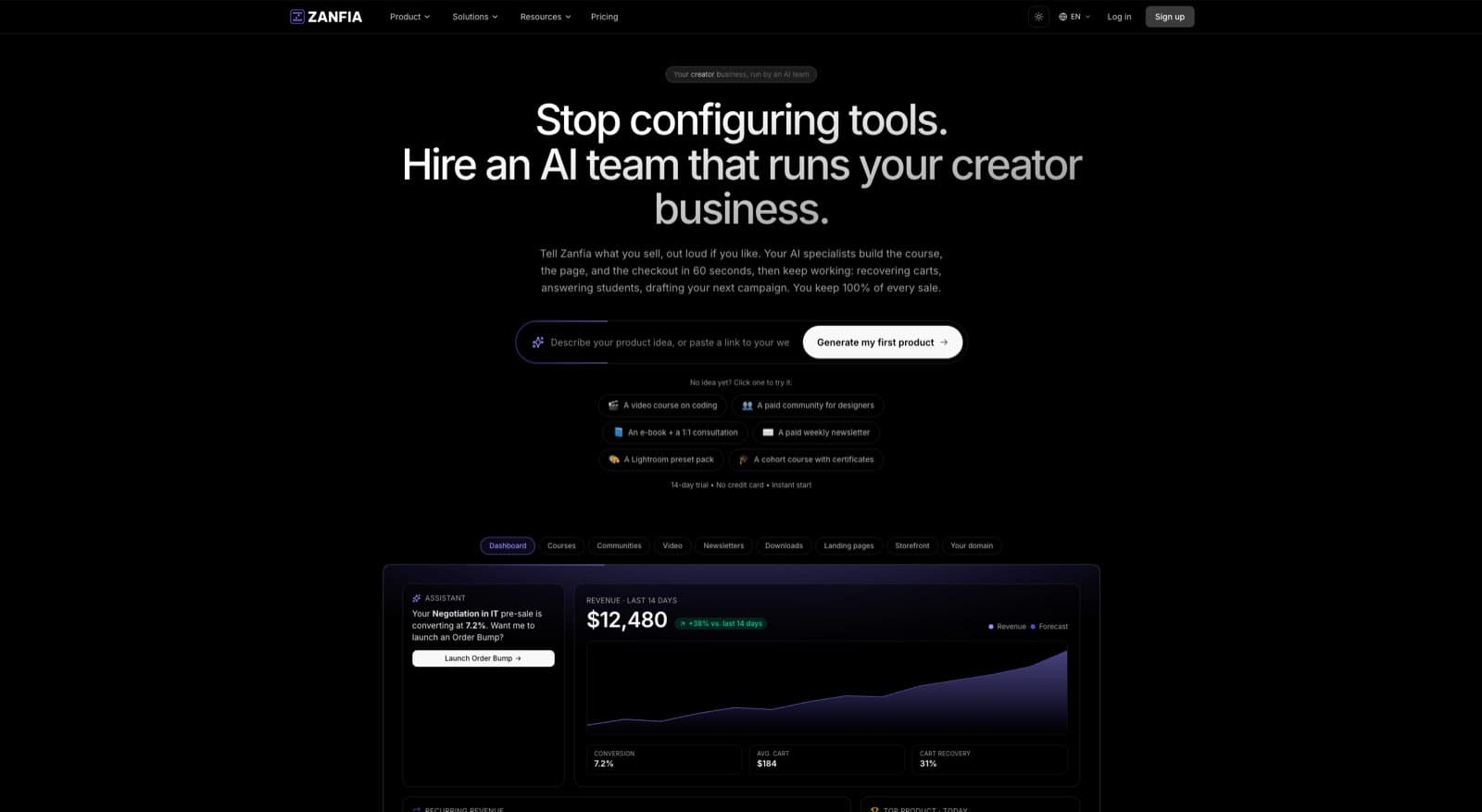
Zanfia takes a different shape. It is an AI team that runs your creator business, wrapped around a platform that hosts the whole mentor funnel (free content, application, paid mentoring, community, and payments) under a single custom domain. You dictate what needs to happen by chat or by voice, and the assistant carries out anything available in the interface. Payments run at 0% platform commission on customer sales (only the payment processor takes its standard cut, roughly 2.9% + $0.30 in the US). Here’s how each piece maps to the funnel described above.
Free newsletter for audience-of-one content. Zanfia’s newsletter product runs free lists too. You publish your Layer 1 and Layer 2 content to a growing subscriber list, all under your own branded domain. Subscribers land on your site, not a third-party inbox brand. When you’re ready to segment or gate premium content, you can flip on paid tiers without migrating tools. Because AI is the product, not a bolted-on feature, the same assistant that runs your workspace can draft the next issue from what you’ve already published, and you can approve it by voice.
The native iOS and Android mobile app means your subscribers can read your content on the go, which matters enormously for engagement, since mentor content is often long-form, and mobile-optimized delivery keeps read-through rates high.
Qualifying landing page. Zanfia’s white-label domain support (available on higher plans, see the current Zanfia pricing) means your application landing page lives at yourbrand.com/mentoring, not a subdomain that screams “platform.” Full control over branding, copy, layout, and social proof placement. Combined with a checkout built to sell (Cart 2.0 supports one-time, subscription, and installment pricing, plus order bumps, subscription upsells, and Stripe and PayPal with Apple Pay and Google Pay), you can collect application fees or deposits directly on the same domain, no external form processor needed. Before you go live, run a test purchase in test mode: the same checkout opens on a shareable link, conversion events fire to test surfaces, and no production data is recorded.
Consulting bookings for discovery calls. Bookings and consultations are on the Zanfia roadmap and marked coming soon on the product page, so scheduling and payment for one-on-one sessions will land inside the same platform, with the same branded checkout, rather than a separate Calendly and Stripe stack. As of publication, the built-in booking is not live yet, so pair the platform with your current scheduler until the module rolls out.
Some mentors charge $200-$500 for the discovery call itself, then credit it toward the mentorship if the prospect signs up. This filters out tire-kickers even further and turns your calendar into a paid revenue channel. Zanfia’s checkout already supports the paid-call workflow natively as a one-time product; native scheduling stitches it into a single flow once bookings ship.
Paid mentoring community for cohort mentees. Once someone signs up for your $6,000 program, they need somewhere to interact with you and, if applicable, with the other mentees. Zanfia’s community product includes topic-based discussion channels, admin-only channels, direct messages, a community calendar, roles and gamification, and native integration with any course content you deliver alongside the mentorship. There is also an AI agent inside the community that can write from your own content to keep the space active between your live touches, and everything it publishes is labeled as AI so mentees always know what came from you and what came from the assistant. No third-party community tool like Circle or Discord. Everything lives inside your branded platform.
Course content for scalable delivery. Once you have 10 paying mentees, the natural next step is to package your recurring lessons into an evergreen course that mentees can consume on their own time, freeing up your 1:1 calls for high-value strategic work. Zanfia’s native video hosting includes a smart player with automatic progress memory, so mentees can pick up exactly where they left off. Time-locked module unlocking (drip delivery) lets you pace the content to match the 90-day mentorship structure. Quizzes and completion certificates come built in, so you can check understanding at the end of each module and hand mentees a certificate when they finish. And because the assistant can generate a quiz from a lesson or summarize a module on your command, the busywork behind “turn my mentoring into a course” stops being the reason it never gets done.
Referral programs for compounding growth. Once your first cohort of mentees hits their goals, they’ll want to refer their friends. A creator-side referral program is coming soon in Zanfia, so once it ships you’ll be able to reward existing mentees for referrals directly inside the same platform. This is how mentors go from 10 to 30 clients without ever adding a new marketing channel.
The end result: the entire funnel (free content, application, payment, community, delivery, and referral) runs under one branded domain, with no platform tax on your revenue, an AI team you can dictate to, and predictable monthly SaaS pricing. Instead of managing seven vendors, you manage one.
Explore Zanfia’s plans and pricing here.
FAQ
How long does it take to get the first 10 paying mentees without cold outreach?
Most mentors following this system see their first paying client within 30-60 days and hit 10 paying clients within 4-8 months, depending on how consistently they publish. The compounding is real. Months 1 and 2 feel slow, but by month 6 you’re usually turning away applications.
Do I need a huge audience to make this work?
No. Mentors have hit 10 paying clients with audiences under 3,000 followers on LinkedIn or under 800 newsletter subscribers. What matters is audience-of-one specificity, not raw size. A 500-person audience of exactly the right people outperforms a 50,000-person audience of the wrong people.
What if I don’t have client testimonials yet?
Start with pro-bono or discounted first engagements to build case studies. Two or three real outcomes are enough to justify premium pricing. As a bridge, share your own results (revenue, methodology, transformation) with the same specificity you’d expect from a client testimonial.
Should I charge for the discovery call?
Once you have proof of results, yes. A $200-$500 paid discovery call filters out tire-kickers, signals your value, and creates a small revenue stream from prospects who don’t sign up for the full mentorship. Credit the call fee toward the mentorship if they enroll.
How often should I publish free content?
The floor is three posts per week on your primary platform (LinkedIn, Twitter/X, or YouTube). Newsletter once per week. Below this, the compounding stalls. Above five posts per week, quality usually drops.
What’s the biggest mistake mentors make with this funnel?
Skipping the application step and putting a Calendly link on their landing page. It multiplies unqualified conversations, kills your calendar, and drops your close rate. The application is the single highest-leverage filter in the entire system.