

Productized Consulting: How to Package Services Into Sellable Offers (2026)
Open-ended consulting contracts used to be the industry default. In 2026, they’re a liability. Buyers want to know exactly what they’re getting, when they’ll get it, and how much it will cost before they sign anything. If your proposals still read like “we’ll audit your systems and recommend improvements over a 90-day engagement,” you’re losing deals to consultants who packaged the exact same work into a $4,500 offer with a checkout link.
Productized consulting fixes that. You take the outcomes you already deliver, wrap them in a fixed scope, publish a fixed price, and stop trading hours for dollars. Done right, it makes your business easier to sell, easier to deliver, and dramatically more profitable per hour of your time.
This guide walks through the full stack: why the shift is happening, how to structure the offer ladder, how to protect margins, how to sell it without a discovery-call maze, and how to deliver it consistently so referrals compound.
Why buyers in 2026 reject open-ended consulting contracts
Three things changed in the last five years, and they permanently reshaped how buyers evaluate consulting work.
The first is procurement fatigue. Mid-market and enterprise buyers spent the post-pandemic years cutting redundant SaaS, renegotiating agencies, and cleaning up shelfware. That discipline bled into how they buy consulting. A vague statement of work reads as budget risk. A packaged offer with a fixed deliverable reads as a controllable line item.
The second is the commoditization of “strategy.” Frameworks that used to justify a $50,000 discovery phase are now free on YouTube, in newsletters, and in ChatGPT outputs. Buyers don’t want to pay for a slide deck that summarizes what they already know. They want the specific implementation that turns those frameworks into revenue, and they want it in weeks, not quarters.
The third is trust asymmetry. When a buyer visits your website and sees “consulting engagements starting at $25,000, contact us for a quote,” they assume you’re going to price them based on how much they seem willing to pay. That’s not paranoia. It’s how the industry actually operated for two decades. Published, productized pricing signals confidence and eliminates the “am I getting fleeced?” tax that kills close rates.
The consultants growing in 2026 aren’t the ones with the most impressive credentials. They’re the ones whose offers are so clearly scoped that a buyer can decide in a single meeting whether to proceed.
Productization: selling outcomes, not hours
Productization is a specific shift in how you package what you sell. Instead of pricing based on the time you’ll spend, you price based on the outcome the client walks away with. Instead of custom scoping every engagement, you standardize the scope so the same offer can be sold repeatedly without reinventing the proposal.
The mental model change matters more than the mechanics. When you sell hours, every conversation with a prospect is about your rate, your calendar, and your capacity. When you sell outcomes, every conversation is about the client’s problem and whether your specific package solves it. The second conversation is dramatically easier to win.
A useful test: can you describe your offer in one sentence that a stranger would understand? “I run a 30-day funnel audit that identifies the top three revenue leaks in your paid acquisition and delivers a prioritized fix roadmap with implementation specs” is a productized offer. “I do marketing consulting” is not.
The Harvard Business Review has documented how the consulting industry’s shift toward outcome-based pricing accelerated after clients started scrutinizing billable-hour models. That scrutiny didn’t slow down. It intensified.
The three shifts productization forces
First, you have to commit to a niche narrow enough that the same package solves the same problem for most of your buyers. A generalist can’t productize because every engagement is bespoke. Specialists can.
Second, you have to move the intelligence out of the sales conversation and into the offer itself. The buyer should be able to read a landing page, see exactly what’s included, understand the process, and know the price, all before they book a call.
Third, you have to design the delivery to protect margins. If your “fixed price” offer requires 40 hours of custom work every time, you’ve just built a services business with a marketing problem. If it requires eight hours of your time plus a repeatable process, you’ve built a real product.
The three-tier offer ladder: audit, core, premium
Most productized consulting businesses that scale past $500,000 in annual revenue run a three-tier ladder. Each tier serves a specific stage of buyer intent, and each one feeds the next.
Tier 1: the audit (entry point)
The audit is a low-friction, low-price offer that lets a prospect experience your thinking without committing to a large engagement. Price range: typically $500 to $2,500. Delivery time: one to three weeks. What the buyer gets: a documented assessment of their current state, a prioritized list of problems, and a specific recommendation for next steps.
The audit exists for three reasons. It filters serious buyers from tire-kickers (people who won’t spend $1,500 to solve a problem won’t spend $15,000). It shortcuts the sales cycle for your higher-tier offers because the audit produces the exact scope the buyer needs to purchase the next tier. And it generates predictable cash flow between larger engagements.
Tier 2: the core offer (main revenue driver)
This is where most of your revenue should come from. Price range: $5,000 to $25,000. Delivery time: 30 to 90 days. What the buyer gets: implementation of the specific outcome your business is known for.
The core offer needs to be tight. If you’re a positioning consultant, this is the offer where you rewrite the client’s messaging, produce the assets, and hand them a launch-ready system. If you’re an operations consultant, this is where you install the specific process, train the team on it, and document it. The buyer doesn’t have to think about what happens next. You’ve defined it.
Tier 3: the premium offer (compounding value)
The premium tier serves clients who want ongoing access, deeper integration, or a larger transformation. Price range: $25,000 to $100,000+. Delivery time: three to twelve months. What the buyer gets: your core outcome plus ongoing implementation support, monthly strategic reviews, or embedded advisory work.
Not every consulting business needs a premium tier. If your core offer already handles your largest clients, don’t force a tier that dilutes your positioning. But if you keep having clients ask “what happens after this?” that’s the signal that premium demand exists.
Why the ladder outperforms flat pricing
The ladder works because it matches the buyer’s actual decision process. First-time buyers want a low-risk way to test you. Committed buyers want to solve the specific problem. Long-term buyers want ongoing partnership. A single flat offer forces every prospect into the same bucket and loses the other two.
The Forbes Coaches Council has written extensively about how tiered productization outperforms one-off custom scoping, particularly for consultants trying to break past the ceiling that hourly billing creates.
Defining scope so the offer stays profitable
The most common productization failure isn’t the pricing. It’s the scope creep. You sold a $10,000 engagement, quoted 40 hours of your time, and 90 days later you’ve spent 110 hours because the client kept asking for “one more thing.” Fixed-price offers only work if the scope is airtight.
Write the boundaries into the offer, not into a follow-up call
Your landing page and proposal should explicitly state what’s included and what isn’t. Not in fine print, in the actual pitch. “This offer includes X, Y, and Z. It does not include A, B, or C. If you need A, B, or C, that’s available as a separate engagement.”
Buyers respect this. What they resent is buying a service and discovering scope limits mid-project. Being upfront about what you don’t do increases trust and closes deals faster than pretending your offer covers everything.
Set revision limits and decision timelines
Productized offers should specify the number of revision rounds and the client’s decision-response window. “Two rounds of revisions on the strategy document, delivered within seven business days of each draft. Client feedback due within five business days or the timeline shifts.”
This isn’t rigid. It’s protective. Consultants who don’t specify these limits end up in projects that drag for months because the client stalls and then wants back-loaded work at the original price. Specify them, and clients respect the process because they know the rules going in.
Build a change-order path into the offer
Some scope changes are legitimate. The client discovers something during the engagement that requires expanding the work. Build a change-order process so this doesn’t become a friction point. “Additional scope is quoted at $X per day and requires written approval before work begins.” This turns scope creep from a margin killer into an upsell mechanism.
Selling a productized offer with a clear checkout
The biggest sales advantage of productization is that you can sell without a proposal. When the offer is standardized, the price is published, and the deliverables are documented, most of your buyers should be able to purchase directly from a landing page.
Kill the multi-step discovery maze
The traditional consulting sales process, discovery call, custom proposal, follow-up call, negotiation, contract, was built for bespoke engagements. It’s overhead your productized offers don’t need. A prospect who’s read your landing page and watched your explainer video already has 80% of what they need to decide.
Replace the discovery-to-proposal sequence with a single fit call for larger tiers, or direct checkout for smaller ones. A $1,500 audit shouldn’t require a call before purchase. A $15,000 core offer might benefit from a 30-minute conversation, but only to answer questions the prospect already has after reading the landing page, not to re-scope the work.
Publish the price
This is where most consultants flinch. The instinct is to hide pricing to “qualify leads” or “customize the quote to the buyer.” In practice, hiding prices does the opposite of qualifying. It filters out serious buyers who want to compare options and forces you into pricing conversations with unserious prospects.
Published pricing filters better than any qualifier question. Buyers who can afford your offer will move forward. Buyers who can’t will self-select out. You save hours of sales calls with people who were never going to buy.
Offer flexible payment structures
Not every buyer will pay $15,000 upfront, even if they have the budget. Installment plans and subscription-based access can dramatically expand who says yes. Splitting a $12,000 engagement into three payments often closes when a lump-sum offer wouldn’t. Some consultants also offer a retainer-style subscription where the buyer gets ongoing access to specific deliverables for a fixed monthly rate.
The technical piece matters here. Your checkout needs to handle installments, subscriptions, and one-time payments cleanly, without forcing you to stitch together separate tools for each payment type.
Delivering consistently with a signature process
Productization only works when the delivery is as standardized as the offer. If every engagement runs differently, you’ve productized the front end but not the back end, and your margins will suffer.
Document your signature process
Every productized consultant needs a named, documented process that guides delivery. Give it a name. Describe the phases. Specify the deliverables at each phase. This isn’t just for marketing, though it does help. It’s for delivery discipline. When your process is documented, you can hand pieces of it to a team member, and you can spot when an engagement is drifting off-scope.
The Consulting Success guide to productization emphasizes this point: your signature process is what allows the same offer to be delivered by different team members and at scale. Without it, you’re just a solo consultant with a landing page.
Templatize the deliverables
Your final client deliverable, the strategy document, the audit report, the implementation plan, should have a template that gets 70% of the way there before you customize the last 30% for the specific client. This is where the hours-saved multiplier comes from.
Consultants who template their deliverables can hand a $10,000 engagement in 25 hours of billable work. Consultants who start from a blank page every time spend 60 hours. Same offer, same price, radically different profitability.
Build in touchpoints, not endless meetings
Productized offers should specify a fixed number of client touchpoints, a kickoff call, a mid-engagement review, a final delivery meeting. Everything else happens asynchronously through documented updates. This protects your time and trains the client on how the engagement runs.
Consultants who let engagements devolve into weekly status calls burn their margin on meetings. Consultants who defend the touchpoint structure keep the offer profitable and set expectations that scale.
How Zanfia combines booking, checkout, and delivery for consultants
Productized consulting looks simple on paper. In practice, most consultants end up running their offers across four or five separate tools: a scheduler for calls, a checkout tool for payments, a course platform for onboarding content, an email tool for delivery updates, and a client portal for documents. Every disconnection is a place where the buyer experience breaks.
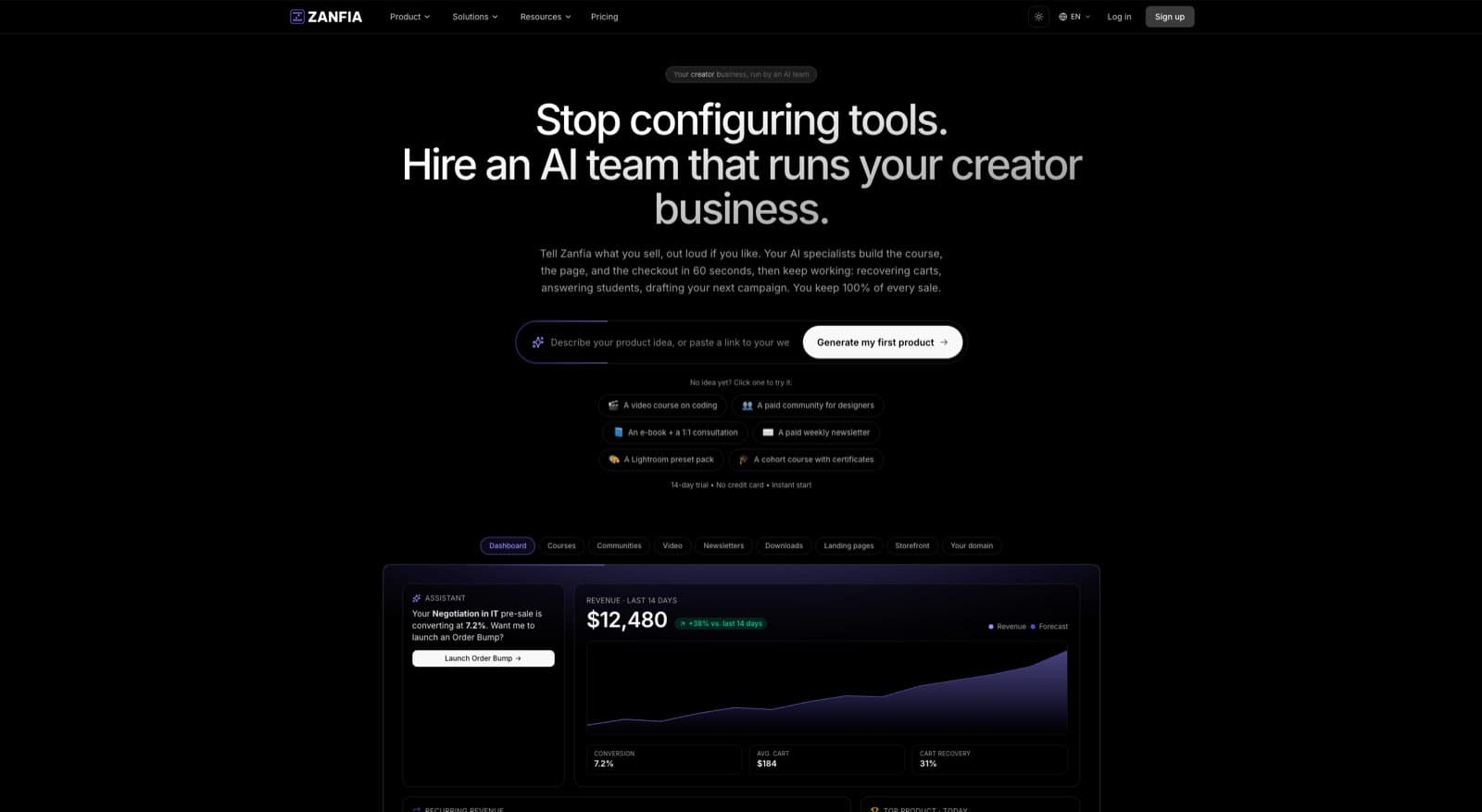
Zanfia is built as an AI team that runs the delivery side of a productized consulting business, not just as a place to host your offers. The pitch on the pricing page is literal: hire the team, keep the revenue. For a consultant, that means the assistant knows every surface of your workspace and can act on it by chat or by voice. You can dictate a new audit page, a follow-up email template, or an update to your knowledge base rather than clicking through settings, and the assistant executes inside the interface the same way you would. Anything you can click, you can also ask for.
Consulting bookings with built-in payment
Zanfia is rolling out built-in Bookings and Consultations that combine scheduling with payment, so when a buyer selects your audit tier they can pay and book their kickoff call in the same flow. As of publication this is marked coming soon on the product menu, so by the time you read this it may already be available on your account, worth checking your dashboard. Until then, Zanfia connects to the scheduling tool you already use so the checkout flow still ends with a confirmed session, without manual reconciliation between the payment and the calendar.
Cart 2.0 for tiered offer ladders
Zanfia’s Cart 2.0 handles the exact pricing structures productized consultants need. You can offer one-time payment for the audit tier, installments for the core tier, and subscription pricing for premium retainers, all from the same checkout system. Order bumps let you add adjacent services at checkout (a $500 pre-engagement questionnaire, for example), and subscription upsells let you convert one-time buyers into ongoing clients at the moment they’re most engaged. Order bumps and upsells are available on higher plans, see the current Zanfia pricing.
Discount codes work for launch promotions or referral partners. Multi-quantity offers handle team licensing when a client wants to buy your audit for multiple business units. Apple Pay and Google Pay support keeps friction low on mobile checkouts. Stripe and PayPal handle the payment processing globally. Before you launch, you can run a test purchase on the real checkout in test mode, tagged TEST in the events log so no production data is recorded, which means you catch broken pixels or missing confirmation content before the first paying client hits the page.
Content delivery under one roof
Once a buyer purchases, your delivery content lives on the same platform. Onboarding materials, workbooks, video walkthroughs, and templated deliverables can be organized as courses with time-locked module unlocking, so buyers get the right content at the right phase of the engagement. Knowledge bases can host your reference documentation, so clients can search for answers without emailing you. Paid newsletters can deliver ongoing insights to your premium-tier clients between engagements. Twelve product types live under one brand, so audits, core packages, retainers, and downloadable templates all sit inside the same workspace instead of scattered across separate tools.
White-label, 0% platform fees, and an MCP endpoint
Everything runs under your own domain with full white-label control, so buyers see your brand at every step, not a marketplace logo. Zanfia charges 0% platform transaction fees on customer sales as of publication (only payment processor fees apply, like Stripe’s standard rate), which matters when you’re processing $50,000 core-tier engagements. On other platforms that take 5-10% platform cuts, you’d hand over $2,500 to $5,000 per engagement. On Zanfia, that revenue stays with you. For consultants who already work with AI tooling, Zanfia also exposes an MCP endpoint so you can point your own AI assistants at your workspace and let them read and act on it directly, available on higher plans, see the current Zanfia pricing.
The mobile app for on-the-go delivery
Zanfia’s native iOS and Android app lets your clients access onboarding courses, paid newsletters and knowledge bases from their phones. For consulting engagements where the buyer is a busy executive who consumes content between meetings, this dramatically improves completion rates on any content-based deliverables you build into your process.
The point isn’t that Zanfia replaces every tool you use. It’s that for the core consulting stack, booking, payment, content delivery, client portal, and now an AI team you can dictate work to, running it all in one place removes the connective work that eats consultant time. You can start on the 14-day free trial with no credit card required, and see the current plans to find the tier that matches your revenue.
FAQ
How is productized consulting different from regular consulting?
Regular consulting typically prices by the hour or by a custom scope negotiated with each client. Productized consulting prices by the outcome, with a fixed scope, published price, and standardized delivery process. The buyer knows what they’re getting before they engage, and the consultant delivers the same package repeatedly instead of custom-scoping every project.
Can any consulting service be productized?
Most can, but not all should. Productization works best when you can identify a repeatable outcome that multiple clients need in a similar form. Highly bespoke strategy work for Fortune 500 companies is harder to productize because the scope varies too much per engagement. Consultants serving small and mid-market clients almost always benefit from productization because the same problems recur across clients.
How much should I charge for a productized offer?
Price based on the value delivered, not the time required. If your audit identifies $200,000 in annual revenue leaks for a mid-market client, charging $2,500 for it is more than fair. The mistake most consultants make is pricing based on hours-times-rate, which caps the offer’s perceived value. Start with the outcome the buyer walks away with, then price accordingly.
Do I need to give up custom consulting entirely?
No. Many consultants run productized offers as the primary revenue stream and take occasional custom engagements for existing clients or specific opportunities. The productized offers create predictable revenue and free your time; custom work can fill in strategically. What you want to avoid is running everything as custom work, that’s the model productization is designed to replace.
What’s the biggest risk in productizing consulting?
Scope creep. If your offer is fixed-price but you let the delivery scope expand without change orders, you’ll burn margin fast. The second-biggest risk is niching too broadly. If your offer tries to solve five different problems for five different buyer types, it stops being productized and becomes just another custom service with better marketing.
How long does it take to launch a productized offer?
The offer itself can be defined in a week if you already have delivery experience. The infrastructure (landing page, checkout, delivery process) takes another two to four weeks depending on your tech stack. Consultants using an integrated platform can compress this significantly by not having to stitch tools together.
Should I have testimonials before I launch a productized offer?
Yes, but they don’t have to be for the exact productized version. Testimonials from the underlying consulting work you’ve already done are enough to validate credibility. Once you’ve delivered the productized version a few times, replace older testimonials with ones that describe the specific packaged outcome.
How do I know if my productized offer is priced correctly?
Watch your close rate. If you’re closing more than 60% of qualified prospects, you’re probably underpriced. If you’re closing under 20%, the offer may be priced above the value buyers perceive, or the value isn’t being communicated clearly enough. The 25-50% range is a healthy target for productized offers.
Productized consulting isn’t a marketing trick. It’s a structural change to how your business operates: how you sell, how you deliver, and how you protect your margins. Consultants who make the shift in 2026 aren’t just capturing better clients. They’re building businesses that don’t collapse the moment they stop taking every call themselves.
If you’re ready to package your consulting into offers that sell without a proposal maze and deliver without scope creep, the tooling matters. Explore how Zanfia combines booking, tiered checkout, and content delivery in one place, so your productized offer is sold and fulfilled without stitching five tools together.