

Your Coaching Online Business: A 2026 Blueprint
A coaching online business looks simple from the outside. Pick a niche, open a calendar, post on social media, sell sessions.
That model breaks fast.
The coaches who last don't just sell advice. They build a system that handles positioning, delivery, community, payments, follow-up, and retention without creating daily operational drag. That is the fundamental shift heading into 2026. Coaching is no longer only about expertise. It's about turning expertise into a resilient digital business that clients can move through smoothly.
The State of the Coaching Online Business in 2026
The opportunity is large enough to attract almost anyone with a skill, method, or framework worth teaching. The global online coaching market was valued at approximately $3.2 billion in 2022 and is projected to reach $11.7 billion by 2032, growing at a 14% CAGR, according to Luisa Zhou's coaching industry market analysis.
That matters because it confirms a structural shift, not a temporary trend. Buyers are comfortable learning, interacting, and getting results online. If you're building a coaching online business today, you're entering a category with real demand and a long runway.

Opportunity doesn't protect weak business models
The same market that creates access also creates noise. More coaches can launch quickly, but quick launch doesn't equal durable business. A lot of operators still build around scattered tools, unclear offers, and manual admin.
That usually shows up in familiar ways:
- Unclear positioning: The coach can describe their topic, but not the buyer, problem, or outcome.
- Session-first delivery: Revenue depends on filling a calendar instead of building assets that compound.
- Disconnected experience: Sales happen in one tool, delivery in another, community somewhere else, and follow-up gets patched together later.
- Operational fatigue: The founder spends more time fixing workflows than coaching clients.
A strong coaching business feels coherent to the client. Discovery, purchase, onboarding, learning, discussion, and renewal all fit together.
One useful mindset shift is to stop thinking like a freelancer with expertise and start thinking like a product builder. Coaches are a close cousin of modern digital creators, especially those packaging knowledge into memberships, communities, and education products. If that framing is new, this guide to what a content creator is helps clarify how expertise becomes a business asset.
The real job is system design
In practice, most coaching businesses don't fail because coaching itself lacks value. They fail because the business around the coaching is unstable. The coach tries to scale a promise without scaling delivery, accountability, client experience, or cash flow discipline.
A resilient coaching online business starts with a different question: not "How do I get clients?" but "What business structure lets me deliver results repeatedly without chaos?"
That question changes everything. It affects your niche, your offer design, your platform choice, your funnel, and the way clients experience your brand from day one.
From Passion to Product Defining Your Niche and Signature Offer
Most weak coaching businesses start with a broad label. Life coach. Business coach. Mindset coach. Career coach.
Those labels describe a category, not a buying decision. Clients don't purchase broad categories. They purchase help with a specific pain, for a specific context, from someone who sounds like they understand the problem at ground level.
Niche clarity has to be practical
A useful niche sits at the intersection of three things:
- A problem you can solve repeatedly
- A buyer who recognizes that problem quickly
- An outcome that affects money, time, stress, or performance
That means "I help founders install a weekly operating rhythm so their team stops relying on them for every decision" is stronger than "I help entrepreneurs grow." The first statement points to a real operating problem. The second could mean almost anything.
If you're still shaping the offer, do the hard validation work before building pages and funnels. This guide on how to validate a business idea is a useful starting point because it forces you to test demand before you build infrastructure around assumptions.
Build an offer ladder, not a single service
A coaching online business becomes more stable when you package expertise at different levels of access. That gives buyers options and stops your revenue from depending on one format.
A practical offer ladder often looks like this:
- Entry product: A workshop, mini-course, audit, or paid newsletter that lets clients experience your thinking.
- Core offer: A structured coaching program with a clear transformation, timeline, and milestones.
- Group layer: Cohort sessions or a membership where clients get support, accountability, and peer learning.
- Premium access: A limited 1:1 offer for clients who need speed, customization, or strategic depth.
This isn't about adding complexity. It's about matching delivery format to client need.
Practical rule: If every client must buy your time directly, you don't have a scalable model yet.
Price around transformation, not hours
A lot of coaches underprice because they anchor on session length. That misses how buyers evaluate serious coaching. They don't care how many minutes you spent preparing a worksheet. They care whether your process helps them produce change they can feel and measure.
That's why the economics of coaching matter. Executive coaching reports an average ROI of 788%, industry studies show a median ROI of 7 times the investment for companies, and 99% of clients report satisfaction according to High5Test's coaching industry statistics.
Those figures don't mean every coach should charge premium prices immediately. They do mean coaching is not a low-value category by default. If your method creates meaningful business or personal progress, your pricing should reflect the result, structure, and support involved. Charging in installments matters here too: splitting a $1,800 program into three or six payments removes the sticker-shock objection without lowering the price, and that mechanic belongs inside the checkout, not bolted on.
What a signature offer actually needs
A signature offer doesn't need fancy branding. It needs clear mechanics.
Make sure the offer answers these questions:
- Who is it for: Name the client precisely.
- What problem does it solve: Focus on one urgent issue, not a vague ambition.
- What happens inside: Outline the process, milestones, and support model.
- What format fits the promise: 1:1, group, hybrid, course-plus-coaching, or community-led.
- Why this structure works: Explain why the client gets a better outcome through your method than through self-study alone.
The coaches who gain traction fastest usually remove ambiguity. Their clients know what they're buying, how it works, and why it's worth committing to.
Choosing Your Tech The All-in-One Platform Advantage
Technology decisions shape margins, delivery quality, and the day-to-day sanity of the business owner. Many coaching businesses create problems they do not notice until they are already growing through these very choices.
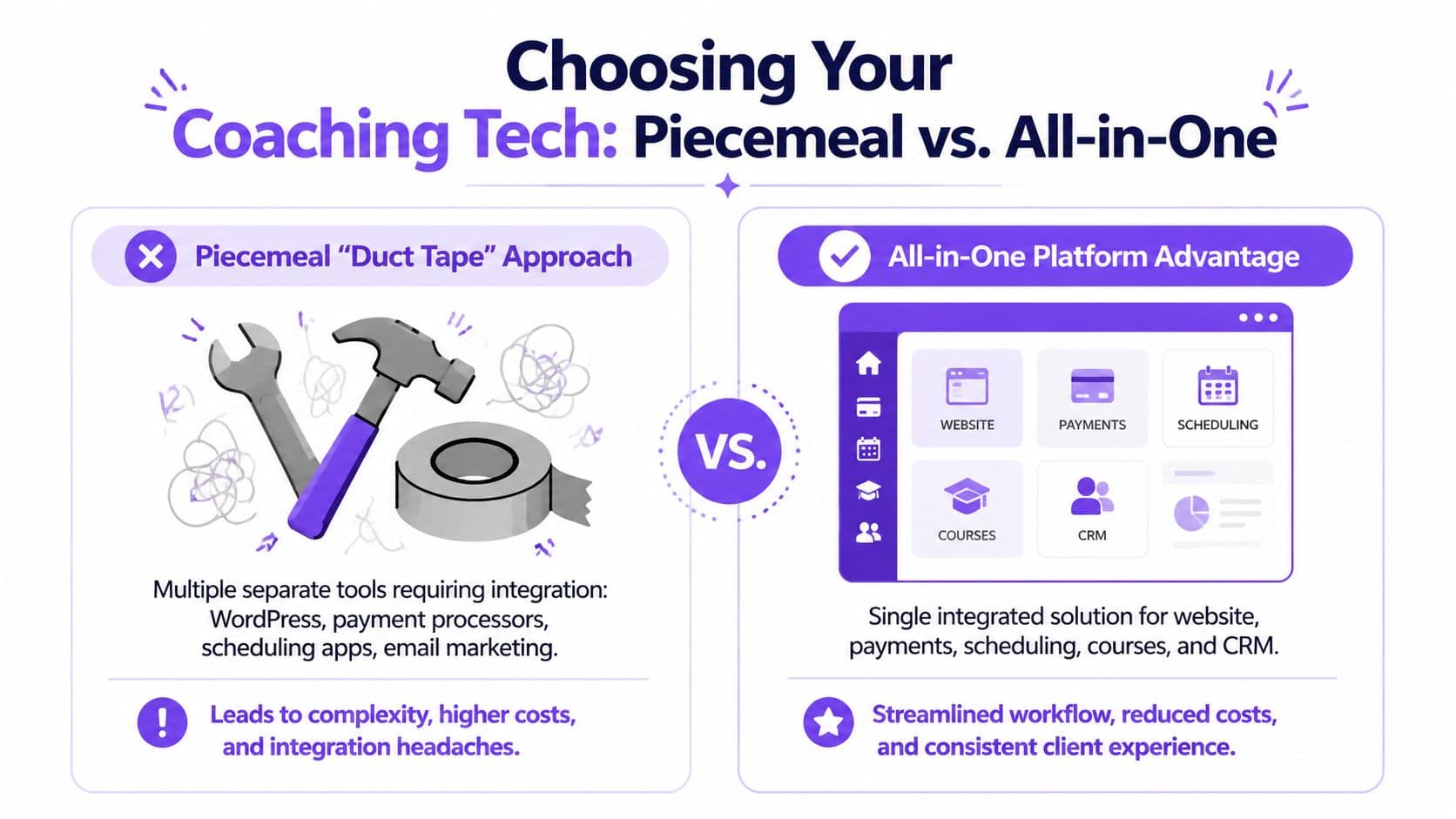
The usual path is a patched stack. One tool for the site. Another for payments. Another for email. Another for video. Another for community. Another for invoices. Another for automations. Each tool can be good on its own. Together, they often create friction.
What breaks in a duct-tape stack
The problem isn't only subscription cost. The deeper problem is fragmentation.
When your checkout, onboarding, lesson delivery, client discussion, and billing all live in different places, four things happen. The client experience feels less professional. You spend more time troubleshooting. Reporting becomes harder to trust. Small failures accumulate unnoticed, especially around access, renewals, and follow-up.
For coaches planning to sell courses or structured programs alongside live support, this overview of a platform for online courses is relevant because the delivery layer affects more than teaching. It affects retention and operations too.
Tech Stack Comparison
| Feature | Piecemeal 'Duct-Tape' Stack | Integrated Platform (e.g., Zanfia) |
|---|---|---|
| Brand experience | Clients move across different tools and interfaces | One branded environment under your own domain |
| Payments and access | Manual connections between checkout and delivery | Access can be tied directly to purchase |
| Video delivery | Often requires separate hosting tools | Native hosting can live inside the same system |
| Community | Usually pushed into external apps | Community and learning can sit together |
| Payment plans and order bumps | Requires a separate cart tool or custom code | Installments, subscriptions and order bumps built into checkout |
| Test mode before launch | Rarely available, so first buyer becomes the QA | Test purchase runs the real checkout with events tagged TEST |
| Automation | Depends on extra connectors and maintenance | Core workflows can run from one backend |
| Analytics | Data is split across platforms | Funnel and product data are easier to read in one place |
| Operational overhead | More setup, more breakpoints, more admin | Fewer moving parts to manage |
Why the platform choice matters early
Early-stage coaches often delay this decision because they think systems only matter later. In practice, platform decisions are hardest to unwind after you already have clients, products, and recurring payments in motion.
Zanfia is worth a look in this category because it is built as an AI team that runs the business, with courses, community, paid newsletters, knowledge libraries, subscriptions and digital products as the surfaces where that work lands. The creator can dictate an action instead of clicking through settings: the assistant performs anything available in the interface, by chat or by voice. Anything doable in the interface is also doable through API, CLI and an MCP endpoint, so a creator who wants their own agents to act on the workspace has that option on higher plans, see the current Zanfia pricing. The checkout is built to sell, with order bumps, installments and subscription upsells, plus a test mode so a coach can buy their own program end to end before the first real client does. Pricing starts at $39/month, or $31/month billed annually, on Starter, with a 14-day free trial and no credit card required. Zanfia charges 0% platform commission on customer sales; only the payment processor takes its standard cut.
If clients have to remember where to pay, where to watch, where to ask questions, and where to find updates, your system is working against your coaching.
The all-in-one model isn't about minimalism for its own sake. It's about reducing operational drag while protecting the client journey and your margins.
Building Your Client Acquisition Engine
A coaching online business doesn't need constant promotion. It needs a repeatable acquisition engine.
That engine should bring the right people in, capture interest before they're ready to buy, and move them toward a clear next step. Without that system, marketing becomes emotional. You post, wait, second-guess, then start over.
Industry analyses show that 82% of online coaching businesses fail within two years, with primary causes including cash flow issues, lack of niche clarity, and ineffective marketing, according to Joanna Lott's analysis of why coaching businesses fail.

The funnel has four jobs
A practical funnel for coaches usually handles four stages.
First, attract. This is your public content. Articles, short videos, emails, or posts that help a specific buyer understand a problem better.
Second, capture. Give that visitor a reason to raise their hand. That might be a newsletter, a free framework, a workshop registration, or an application page.
Third, nurture. Most buyers won't purchase on first contact. They need proof that your thinking is consistent, your method is specific, and your offer is relevant to their situation.
Fourth, convert. At this point the path should be direct. Sales page, webinar, application, or consultation. No detours.
What works better than random posting
Most coaches don't need more content. They need tighter alignment between content and offer.
Use content in layers:
- Problem-aware content: Name the pain your audience already feels.
- Myth-breaking content: Show why common advice fails in their situation.
- Process content: Teach part of your method without giving away the full implementation.
- Decision content: Help the buyer understand when they need support instead of more free information.
That structure creates momentum. It also makes analytics more useful because you can see which messages attract attention and which ones pull people toward action. If you're refining that process, this guide on leads and conversions is a practical reference point.
A webinar still works when the offer is clear
For many coaches, a webinar is still one of the cleanest ways to move from attention to trust. It lets prospects experience your teaching style, understand your framework, and decide whether your approach fits their problem.
Here's a concrete example of the format in action:
The mistake is treating the webinar like a lecture or treating content like performance. The goal is diagnosis. You want the right client to think, "This person understands what I'm dealing with and has a process for it."
Your funnel should answer one question at every stage: what should this prospect do next?
When that answer is obvious, acquisition gets calmer. You stop chasing visibility and start building predictable demand.
Beyond the Sale Crafting a High-Retention Client Experience
The first sale proves your marketing worked. Retention proves your business model works.
A lot of coaching businesses put most of their effort into getting the client and too little into what happens after payment. That's backwards. The post-sale experience determines whether clients engage, complete the work, renew, refer, and talk about your program without being asked.

Onboarding sets the tone
Strong onboarding does three things quickly. It reassures the client they made a good decision. It reduces uncertainty about what to do first. It creates momentum before doubt has time to grow.
That usually means a concise welcome flow, a clear roadmap, access to materials, and one immediate action the client can complete without friction. Long welcome messages and messy login paths create drag right when confidence should be rising.
Accountability has to be built into delivery
Over 70% of failing online coaching relationships lack clear execution frameworks and accountability mechanisms, which leads clients to fall back into old habits after sessions, according to Strategy Ladders' discussion of business coaching frameworks.
That point is easy to underestimate. Coaching often fails not because the advice is bad, but because implementation is loose. Clients leave a call feeling clear, then disappear into their week.
A better delivery model includes:
- Defined actions: Every session ends with a concrete next step.
- Visible tracking: Clients can see commitments, milestones, or progress markers.
- Shared context: Resources, recordings, prompts, and discussion stay in one accessible place.
- Peer reinforcement: A community environment helps normalize action and follow-through.
Good coaching changes behavior between sessions, not just insight during sessions.
Community makes the service stickier
External groups can work, but they often weaken brand cohesion and participation. When clients have to jump to a Facebook group or Discord server, the program starts to feel fragmented. Some engage thoroughly. Others lose track and drift.
An integrated community works better because discussion lives beside the program itself. Clients can move from lesson to conversation to update without leaving the environment. That creates a stronger rhythm of participation and a clearer sense that they're inside a designed experience, not a collection of links.
For a coaching online business, that's a meaningful advantage. Retention is rarely the result of one brilliant session. It's usually the outcome of repeated small interactions that keep clients connected to the work and accountable to progress.
Scaling Your Business with Automation and Analytics
Scale in coaching doesn't come from working longer. It comes from removing yourself from tasks that shouldn't require your attention in the first place.
Many guides neglect backend operational systems, yet data shows that 70% of six-figure coaches succeed by implementing financial forecasting and legal structures early, reducing failure rates by 40%, according to A Plan Coaching's article on scaling online coaching operations.
Automation should remove repeatable admin
The first automation wins are usually boring. They also matter the most.
Think about what repeats every week. New client welcome emails. Course access after payment. Community permissions. Subscription renewals. Reminder sequences. Access revocation when a plan ends. None of that is high-value founder work.
When those steps run automatically, the business gets cleaner in three ways:
- Clients get immediate consistency
- The founder gets time back
- Fewer manual errors reach the customer
For coaches who are ready to standardize operations, this guide on how to automate your business is a sensible next read.
Analytics should drive decisions, not vanity
A mature coaching online business tracks behavior across the client journey. Not for dashboards that look impressive, but for decisions.
You want to know where prospects stop reading, where buyers abandon checkout, which lessons get consumed, where members disengage, and which offers renew cleanly. That tells you what to fix.
Useful questions include:
- Where does interest stall: Is the message unclear, or is the next step weak?
- Where do clients drop off: Is the issue content quality, pacing, or onboarding?
- Which assets drive progress: Are clients using the materials that support action?
- What creates repeat demand: Which offers or support layers keep clients engaged longer?
Operations are part of the product
A lot of coaches resist this because operations feel less exciting than transformation. But clients feel operations. They feel broken access, unclear billing, and confusing login flows just as much as they feel a strong coaching call.
The strongest businesses treat backend systems as part of client care. Clean finances, legal structure, organized delivery, and dependable workflows protect the brand. They also make it easier to grow into a team model later, because the business isn't held together by founder memory.
Build that structure early and your coaching business becomes easier to run, easier to improve, and much easier to scale without turning into another demanding job.
FAQ
How is a coaching online business different from just selling coaching sessions?
A session-first model ties revenue directly to filling a calendar, which creates operational drag and stalls growth. A coaching online business is a system that handles positioning, delivery, community, payments, follow-up, and retention as one coherent experience. The shift is from freelancer with expertise to product builder who packages that expertise into assets that compound.
What does a practical offer ladder look like for a coach?
It usually has four levels: an entry product like a workshop, mini-course, audit, or paid newsletter; a structured core coaching program with clear milestones; a group layer such as cohort sessions or a membership; and a premium 1:1 offer for clients who need speed or customization. The point is matching format to client need, not adding complexity. If every client must buy your time directly, the model isn't scalable yet.
Why is a piecemeal tool stack a problem if each tool works fine on its own?
Fragmentation is the real cost, not subscriptions. When checkout, onboarding, lesson delivery, discussion, and billing live in different places, the client experience feels less professional, troubleshooting eats time, reporting becomes hard to trust, and small failures around access, renewals, and follow-up pile up unnoticed. Platform decisions are also hardest to unwind after you already have clients and recurring payments in motion.
How should coaches think about pricing if they don't want to anchor on session length?
Price around the transformation, structure, and support involved, not the minutes spent. Industry data cited in the article shows executive coaching averages a 788% ROI and a median 7x return, which signals coaching is not a low-value category by default. Offering installments inside the checkout, for example splitting an $1,800 program into three or six payments, removes sticker-shock without lowering the price.
What does a client acquisition funnel for coaches actually need to do?
It needs to handle four jobs: attract the right buyer with problem-focused content, capture interest with a reason to raise their hand, nurture with proof that your method is specific and relevant, and convert through a direct path like a sales page, webinar, application, or consultation. Content should be layered across problem-aware, myth-breaking, process, and decision stages so each piece pulls the prospect toward the next step. When every stage answers 'what should this prospect do next,' acquisition stops feeling emotional and demand becomes predictable.
If you're building a coaching online business and want one place to run courses, community, subscriptions, digital products, automations, and branded delivery under your own domain, take a look at Zanfia. It's built for creators and experts who want a cleaner operating system from day one, with an AI team that handles the work by chat or voice and a checkout designed to close the sale.